Maharashtra State Board Class 12 Economics Solutions Chapter 3A Demand Analysis
1. Complete the following statements:
2. Give economic terms
1. A situation where more quantity is demand at lower price…………….
2. Graphical representation of demand schedule……………….
3. A commodity which can be put to several uses……………….
4. More quantity is demanded due to changes in the factors determining demand other than price…………..
5. A desire which is backed by willingness to purchase and ability to pay……………
Answers:
(1) Expansion or Extension of Demand
(2) Demand Curve
(3) Composite Demand
(4) Increase in Demand
(5) Demand
3. Distinguish between:
Desire | Demand |
1. Desire is a mere wish for something. For example desire for a chartered plane. | 1. Demand refers to desire backed by ability and willingness to pay for a particular commodity. |
2. Desire has no limits. | 2. Demand is limited by ability to pay and willingness to pay. |
3. Desire is not related or dependent on price. | 3. Demand is inversely related to price. |
4. Desire is wider in scope as it includes demand. | 4. Demand is narrow in scope as it is a part of desire. |
5. Example : Desire of a beggar to own a car. | 5. Example: Demand for a BMW Car by business man who has ability and willingness to pay. |
Expansion of demand | Contraction of demand |
1. Expansion of demand refers to a rise in demand only due to a fall in price. | 1. Contraction of demand refers to a fall in the demand due to a rise in price. |
2. Expansion of demand takes place solely due to falling in price. All other factors affecting demand remain constant. | 2. Contraction of demand takes place solely due to a rise in price. All other factors affecting demand remain constant. |
3. Expansion of demand is shown by a downward movement on the same demand curve. | 3. Contraction of demand is shown by an upward movement on the same demand curve. |
Increase in Demand | Decrease in Demand |
(a) Increase in demand refers to a rise in demand due to changes in other factors, price remaining constant. | (a) Decrease in demand refers to fall in demand due to changes in other factors, price remaining constant. |
(b) Increase in demand occurs when more is purchased at the same price. | (b) Decrease in demand occurs when less is purchased at the same price. |
4. State with reasons whether you agree or disagree with the following statements:
Reasons justifying downwards sloping demand curve are as follows:
Reason:
The following are a few determinants:
Income of the consumer – Change in the income of the consumer also affects the market demand for goods. The effect of the change in income on the market demand depends on the type of the good.
Type of Good – The market demand for normal goods shares a positive relationship with the consumer’s income. The market demand for inferior goods (such as coarse cereals) has a negative relationship with the consumer’s income.
The market demand for Giffen goods also has a negative relationship with the income.
Consumer’s tastes and preferences – Consumers’ tastes and preferences highly influence the demand for goods. Other things being constant, if all consumers prefer a commodity over another, then the market demand for that commodity increases and vice versa.
Population size – The market demand for a commodity is also affected by the population size. Other things being equal, an increase in the population size increases the market demand for a commodity and vice-versa. This is because with the change in population size, the number of consumers in the market changes.
5. Observe the following table and answer the following questions:
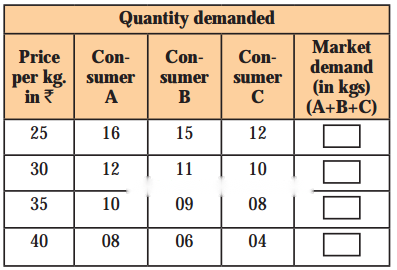
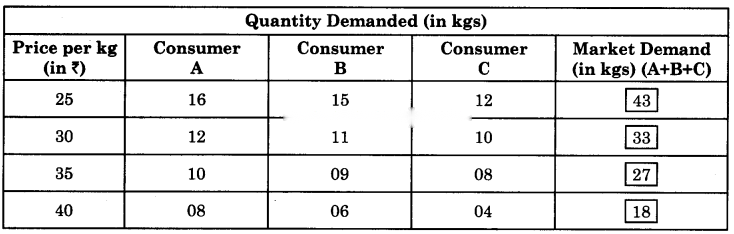
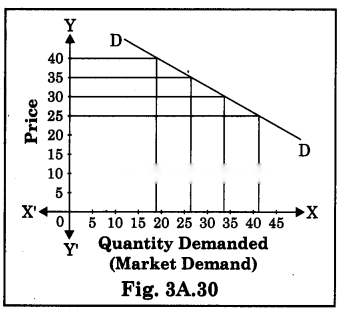
b) Draw market demand carve based on above market demand schedule.
Answer:
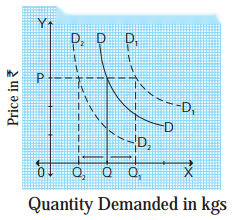

2) In diagram A movement of demand curve is in ………………… direction
Answer:
Downward.
1) Diagram B represents …………………… in demand
Answer:
Constraction.
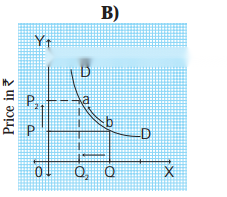
2) In diagram B movement of demand curve is in …………………… direction
Answer:
Upward.
6. Answer in detail :
(B) Statement of the Law : According to Prof. Alfred Marshall, “Other things being equal, higher the price of a commodity, smaller is the quantity demanded and lower the price of a commodity, larger is the quantity demanded.
In other words, other things remaining constant, demand varies inversely with price. Marshall’s law of demand describes the functional relationship between demand and price. It can be presented as:
Dx= f(Px)
where D = Demand for Commodity
x = Commodity
f = function
Px= Price of a commodity
(C) Assumption :
(D) Explanation of the law of Demand :
The law of demand is explained with the help of the following demand schedule and diagram:
Demand Schedule
Price of Commodity ‘X’ (in Rs.) | Quantity Demanded of Commodity ‘X’ (in kgs) |
50 | 1 |
40 | 2 |
30 | 3 |
20 | 4 |
10 | 5 |
From the above demand schedule we observe that at higher price of ₹ 50 per kg, quantity demanded is 1 kg. When price fall from ₹ 50 to ₹ 40, quantity demanded rises from 1 kg to 2 kg. Similarly, at price ₹ 30 quantity demanded is 3kg and when price falls from ₹ 20 to ₹ 10 quantity demanded rises from 4 kg to 5 kg. This shows an inverse relationship between price and demand.
In the above diagram X-axis represent quantity demanded and Y-axis represent the price of the commodity. The demand curve DD slopes downwards from left to right ] showing an inverse relationship between price and demand. It has a negative slope.

(E) Exceptions to the Law of Demand :
No, I do not agree with this statement.
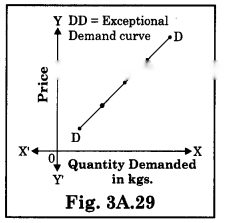
There are some important cases in which the demand for the commodity is greater when price rises and smaller when price falls. Such cases are called exceptions to the law of Demand. In such case, demand curve slopes upwards from left to right and it has a positive slope.
Features of Demand :
Determinants of Demand :
Intext Questions
Activity : (Textbook Page no. 17)
Identify the concepts :
(i) A poor person wants to have a car.
Answer:
Desire : because he does not have ability and capacity to pay the price for a car.
(ii) A rich person bought a car.
Answer:
Demand : because a rich person has a desire as well as capacity to pay a car.
Activity : (Textbook Page no. 19)
Prepare a monthly demand schedule of your family for various commodities. For example, vegetables, fruits, medicines, etc.
Answer:
[Students should do this activity by themselves]
Activity : (Textbook Page no. 19)
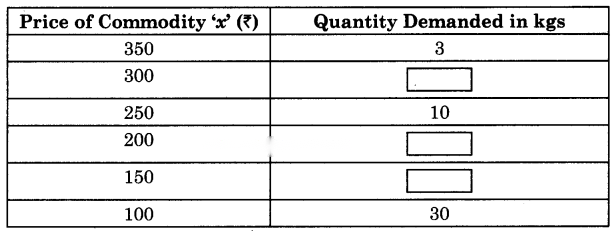
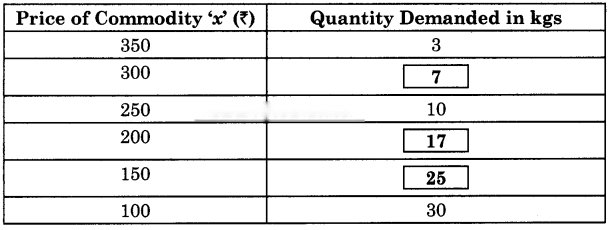
Complete the following hypothetical demand schedule.
Answer:
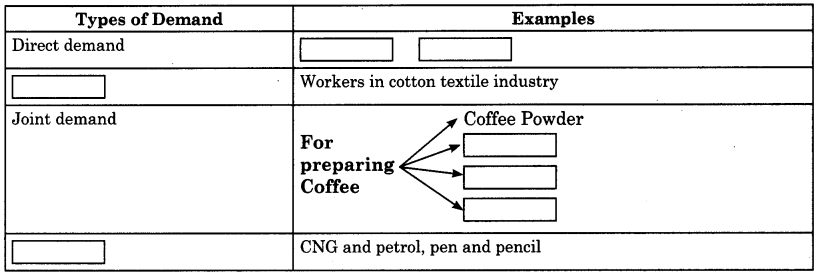
Activity : (Textbook Page no. 20)
Complete the table.
Answer:


Activity : (Textbook Page no. 22)
Draw a demand curve from the following demand schedule :
Answer:


Activity : (Textbook Page no. 23)
Find out : Examples of the given exceptions to the law of demand.
(1) Prestigious Goods
Answer:
Car, Gold, Diamond, etc.
(2) Habitual Goods
Answer:
Cigarette, Tea, Drugs, Chocolates, etc.
(3) Branded Goods
Answer:
Godrej Lockers, Levis Jeans, Sony T.V, etc.