Maharashtra State Board Class 12 Economics Solutions Chapter 3B Elasticity of Demand
1. Complete the following statements:
Solution & Step-by-Step Answer:
a) zero
Solution & Step-by-Step Answer:
c) infinity
Solution & Step-by-Step Answer:
a) perfectly elastic demand
Solution & Step-by-Step Answer:
a) flatter
Solution & Step-by-Step Answer:
c) necessities
2. Give et onomic terms:
Solution & Step-by-Step Answer:
Income elasticity
Solution & Step-by-Step Answer:
Cross elasticity
Solution & Step-by-Step Answer:
Elasticity of demand
Solution & Step-by-Step Answer:
Perfectly elastic demand
Solution & Step-by-Step Answer:
Price elasticity
3. Complete the correlation:
1) Perfectly elastic demand: Ed = ∞ :: ……………. : Ed = 0
2) Rectangular hyperbola : ………………. : Steeper demand curve : Relatively inelastic demand.
3) Straight line demand curve : Linear demand curve:: …………….. non linear demand curve.
4) Pen and ink : …………….. :: Tea or Coffee: Substitutes.
5) Ratio method : Ed = :: …………… : Ed =
Answer:
4. Assertion and Reasoning type questions:
Solution & Step-by-Step Answer:
3) Both (A) and (R) are True and (R) is the correct explanation of (A)
Solution & Step-by-Step Answer:
4) Both (A) and (R) are True and (R) is not the correct explanation of (A)
Solution & Step-by-Step Answer:
3) Both (A) and (R) are True and (R) is the correct explanation of (A)
5. Distinguish between:
Solution & Step-by-Step Answer:
Relatively Elastic Demand
Relatively inelastic demand.
Solution & Step-by-Step Answer:
Perfectly elastic demand :
Perfectly inelastic demand.
6. Answer the following questions:
Solution & Step-by-Step Answer:
The concept of Price Elasticity was developed i by great neo-classical economist Dr. Alfred \ Marshall in the year 1890. According to Dr. Alfred Marshall, “The elasticity or responsiveness of demand in a market is great or small, according to the amount demanded which increases much or little for a given fall in price, and diminishes much or little for a given rise in price. ” Elasticity of demand in fact refers to the £ degree of responsiveness of the quantity demanded of a commodity to change in the variable on which demand depends.
Solution & Step-by-Step Answer:
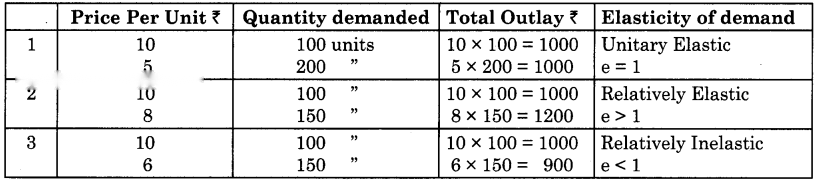
Total Outlay Method : This method was introduced by Dr. Alfred Marshall. The limitation of this method is that in this method unlike ratio method, the exact numerical value of the elasticity of demand cannot be determined. According, to this method, the elasticity of demand is measured on the basis of expenditure incurred by consumer when the price of a commodity changes.
Total outlay or total expenditure can be calculated by multiplying the price with the quantity demanded (Price x Quantity demand = Total Expenditure). Depending upon the kind of change in total outlay, whether it increases, or decreases, or remain constant with the change in price we will be able to decide the type of elasticity. This can be explained with the following example:-
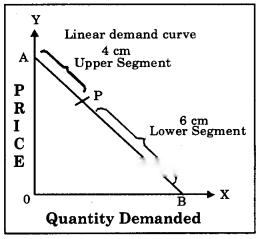
Solution & Step-by-Step Answer:
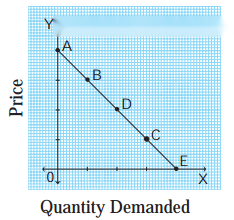
7. Observe the following figure and answer the questions:
Solution & Step-by-Step Answer:
Concept: Perfectly Inelastic demand (Ed = 0) Explanation : When change in price has no effect on the quantity demanded of that commodity, then it is called as perfectly inelastic demand. Demand curve ‘DD’ is a vertical straight line parallel to ‘Y’ – axis.
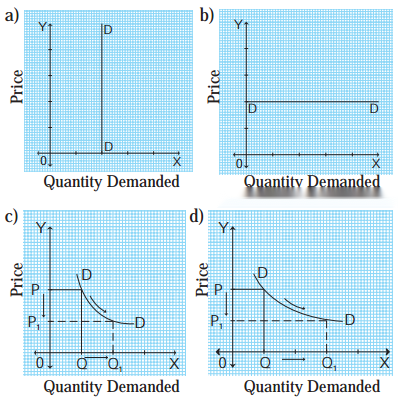
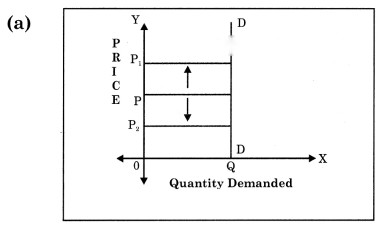
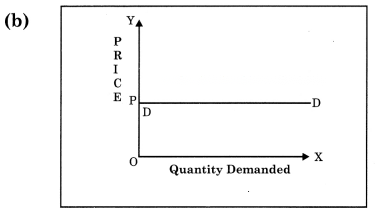
Concept: Perfectly Elastic demand (Ed = ∞) (infinity)
Explanation: When a change in price leads to infinite change in quantity demanded of a commodity then it is called as perfectly) (d) elastic demand.
Demand curve is horizontal straight line ( parallel to ‘X’ – axis.
Concept: Ed = 1 Unitary elastic demand Explanation : When proportionate or percentage change in quantity demanded is exactly equal to proportionate or percentage change in price, then it is called as Unitary Elastic demand. Demand curve is called as rectangular hyperbola.
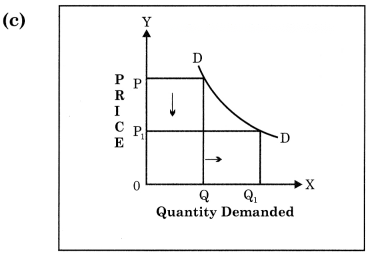
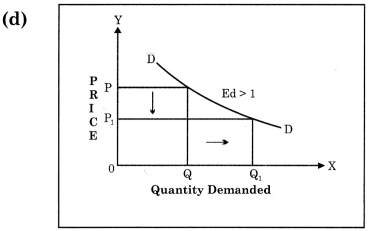
Concept: Relatively Elastic Demand (Ed > 1)
Explanation : When proportionate or percentage change in quantity demanded is more than proportionate change it its price, then it is called as Relatively Elastic Demand. Demand curve is called as flatter curve.
Solution & Step-by-Step Answer:
1) Demand at point ‘C’ is relatively elastic demand. 2) Demand at point ‘B’ is unitaiy elastic demand. 3) Demand at point ‘D’ is perfectly inelastic demand. 4) Demand at point ‘A’ is perfectly elastic demand. Answer: