Maharashtra State Board 12th Physics Solutions Chapter 5 Oscillations
1. Choose the correct option.
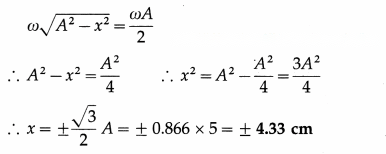
i) A particle performs linear S.H.M. starting from the mean position. Its amplitude is A and time period is T. At the instance when its speed is half the maximum speed, its displacement x is
(A) A
(B)
(C) A/2
(D)
Answer:
(A) A
ii) A body of mass 1 kg is performing linear S.H.M. Its displacement x (cm) at t (second) is given by x = 6 sin (100t + π/4). Maximum kinetic energy of the body is
(A) 36 J
(B) 9 J
(C) 27 J
(D) 18 J
Answer:
(D) 18 J
iii) The length of second’s pendulum on the surface of earth is nearly 1 m. Its length on the surface of moon should be [Given: acceleration due to gravity (g) on moon is 1/6 th of that on the earth’s surface]
(A) m
(B) 6 m
(C) m
(D) m.
Answer:
(A) m
iv) Two identical springs of constant k are connected, first in series and then in parallel. A metal block of mass m is suspended from their combination. The ratio of their frequencies of vertical oscillations will be in a ratio
(A) 1:4
(B) 1:2
(C) 2:1
(D) 4:1
Answer:
(B) 1:2
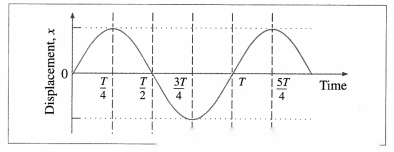
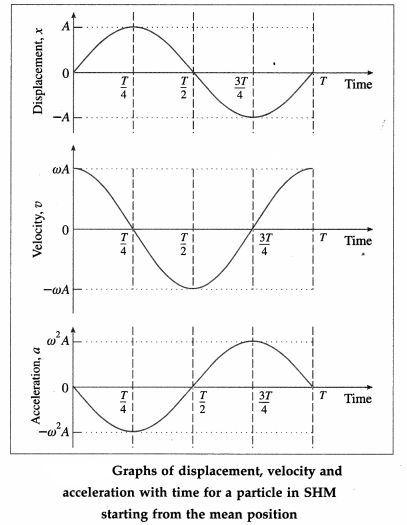
v) The graph shows variation of displacement of a particle performing S.H.M. with time t. Which of the following statements is correct from the graph?
(A) The acceleration is maximum at time T.
(B) The force is maximum at time 3T/4.
(C) The velocity is zero at time T/2.
(D) The kinetic energy is equal to total energy at time T/4.
Answer:
(B) The force is maximum at time 3T/4.
2. Answer in brief.
i) Define linear simple harmonic motion.
Answer:
Definition: Linear simple harmonic motion (SHM) is defined as the linear periodic motion of a body, in which the force (or acceleration) is always directed towards the mean position and its magnitude is proportional to the displacement from the mean position.
OR
A particle is said to execute linear SHM if the particle undergoes oscillations about a point of stable equilibrium, subject to a linear restoring force always directed towards that point and whose magnitude is proportional to the magnitude of the displacement of the particle from that point.
Examples : The vibrations of the tines (prongs) of a tuning fork, the oscillations of the needle of a sewing machine.
ii) Using differential equation of linear S.H.M, obtain the expression for
(a) velocity in S.H.M.,
(b) acceleration in S.H.M.
Answer:
The general expression for the displacement of a particle in SHM at time t is x = A sin (ωt + α) … (1)
where A is the amplitude, ω is a constant in a particular case and α is the initial phase.
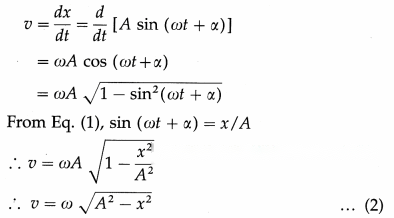
The velocity of the particle is
Equation (2) gives the velocity as a function of x.
The acceleration of the particle is
a = = [Aω cos (ωt + α) J at at
∴ a = – ω2A sin (ωt + α)
But from Eq. (1), A sin (ωt + α) = x
∴ a = -ω2x … (3)
Equation (3) gives the acceleration as a function of x. The minus sign shows that the direction of the acceleration is opposite to that of the displacement.
iii) Obtain the expression for the period of a simple pendulum performing S.H.M.
Answer:
An ideal simple pendulum is defined as a heavy point mass suspended from a rigid support by a weightless, inextensible and twistless string, and set oscillating under gravity through a small angle in a vertical plane.
In practice, a small but heavy sphere, called the bob, is used. The distance from the point of suspension to the centre of gravity of the bob is called the length of the pendulum.
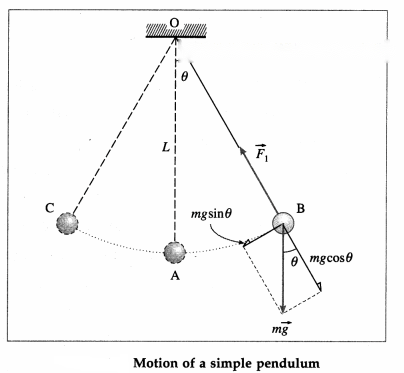
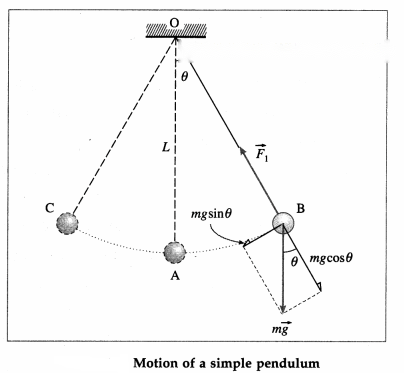
Consider a simple pendulum of length L1– suspended from a rigid support O. When displaced from its initial position of rest through a small angle θ in a vertical plane and released, it performs oscillations between two extremes, B and C, as shown in below figure. At B, the forces on the bob are its weight and the tension in the string. Resolve into two components : mg cos θ in the direction opposite to that of the tension and mg sin θ perpendicular to the string.
mg cos θ balanced by the tension in the string. mg sin θ restores the bob to the equilibrium position.
Restoring force, F = – mg sin θ
If θ is small and expressed in radian,
sin θ θ = = =
∴ F = – mgθ = -mg …. (1)
Since m, g and L are constant,
F ∝ (-x) …. (2)
Thus, the net force on the bob is in the direction opposite to that of displacement x of the bob from its mean position as indicated by the minus sign, and the magnitude of the force is proportional to the magnitude of the displacement. Hence, it follows that the motion of a simple pendulum is linear SHM.
Acceleration, a = = –x … (3)
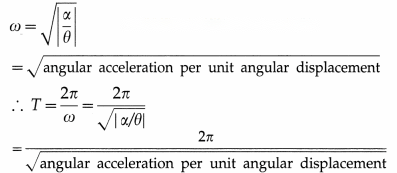
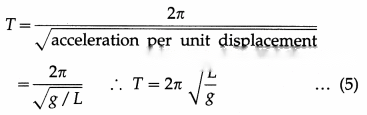
Therefore, acceleration per unit displacement
= || = ….. (4)
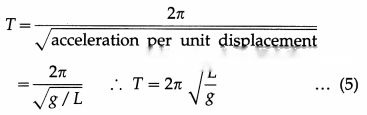
Period of SHM,
This gives the expression for the period of a simple pendulum.
iv) State the laws of simple pendulum.
Answer:
The period of a simple pendulum at a given place is
T = 2π
where L is the length of the simple pendulum and g is the acceleration due to gravity at that place. From the above expression, the laws of simple pendulum are as follows :
(1) Law of length : The period of a simple pendulum at a given place (g constant) is directly proportional to the square root of its length.
∴ T ∝
(2) Law of acceleration due to gravity : The period of a simple pendulum of a given length (L constant) is inversely proportional to the square root of the acceleration due to gravity.
∴ T ∝
(3) Law of mass : The period of a simple pendulum does not depend on the mass or material of the bob of the pendulum.
(4) Law of isochronism : The period of a simple pendulum does not depend on the amplitude of oscillations, provided that the amplitude is small.
v) Prove that under certain conditions a magnet vibrating in uniform magnetic field performs angular S.H.M.
Answer:
Consider a bar magnet of magnetic moment μ, suspended horizontally by a light twistless fibre in a region where the horizontal component of the Earth’s magnetic field is Bh. The bar magnet is free to rotate in a horizontal plane. It comes to rest in approximately the North-South direction, along Bh. If it is rotated in the horizontal plane by a small
displacement θ from its rest position (θ = 0), the suspension fibre is twisted. When the magnet is released, it oscillates about the rest position in angular or torsional oscillation.
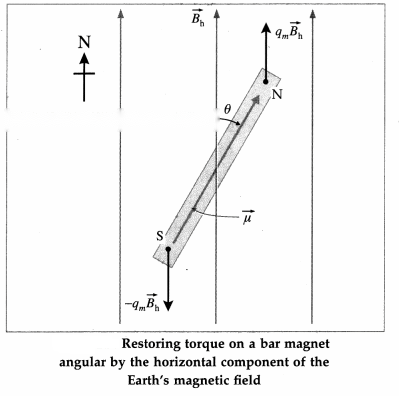
The bar magnet experiences a torque due to the field Bh. Which tends to restore it to its original orientation parallel to Bh. For small θ, this restoring torque is
= – μBhsin θ = – μBhμ …. (1)
where the minus sign indicates that the torque is opposite in direction to the angular displacement θ. Equation (1) shows that the torque (and hence the angular acceleration) is directly proportional in magnitude of the angular displacement but opposite in direction. Hence, for small angular displacement, the oscillations of the bar magnet in a uniform magnetic field is simple harmonic.

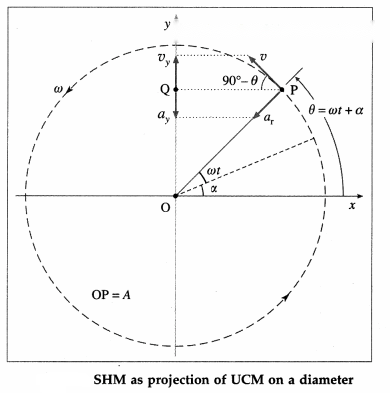
The tangential velocity of the reference particle is v = ωA. Its y-component at time t is vy= ωA sin (90° – θ) = ωA cos θ
∴ vy= ωA cos (ωt + α)
The centripetal acceleration of the reference particle is ar= ω2A, so that its y-component at time t is ax= arsin ∠OPQ
∴ ax= – ω2A sin (ωt + α)
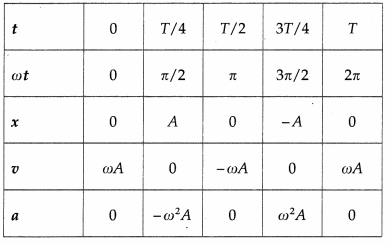

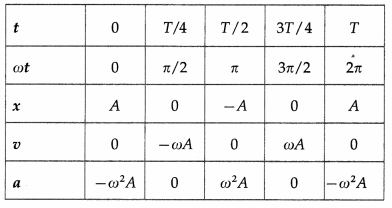
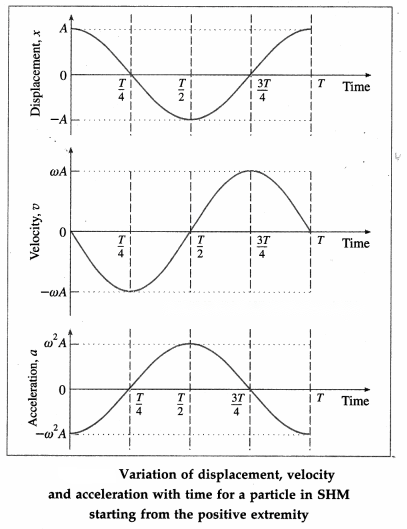
Consider a particle performing linear SHM with amplitude A and period T = 2π/ω, starting from the positive extreme position, where ω is the angular frequency. Its displacement from the mean position (x), velocity (y) and acceleration (a) at any instant (t) are
x = A cos ωt = A cos (∵ω = )
v = -ωA sin ωt = – ωA sin
a = -ω2A cos ωt = -ω2A cos
Using these expressions, the values of x, y and a at the end of every quarter of a period, starting from t = 0, are tabulated below.
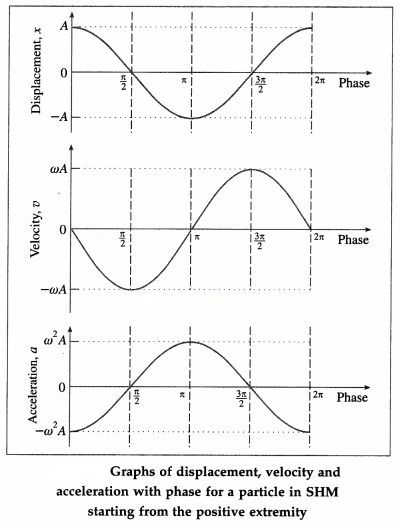
Using these values, we can plot graphs showing the variation of displacement, velocity and acceleration with time.
Conclusions :
Explanations :
(1) v-t graph : It is a sine curve, i.e., the velocity is a periodic (harmonic) function of time which repeats after a phase of 2π rad. There is a phase difference of π/2 rad between a and v.
v is minimum (equal to zero) at the extreme positions (i.e., at x = ± A) and v is maximum ( = ± ωA) at the mean position (x = 0).
(2) a-t graph : It is a cosine curve, i.e., the acceleration is a periodic (harmonic) function of time which repeats after a phase of 2π rad. There is a phase difference of π rad between v and a. a is minimum (equal to zero) at the mean position (x = 0) and a is maximum ( = ω2A) at the extreme positions (x = ±A).
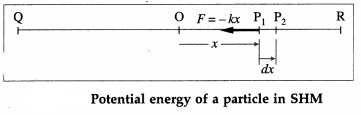
(2) Potential energy : The potential energy of a particle in linear SHM is defined as the work done by an external agent, against the restoring force, in taking the particle from its mean position to a given point in the path, keeping the particle in equilibirum.
Suppose the particle in below figure is displaced from P1to P2, through an infinitesimal distance dx against the restoring force F as shown.
The corresponding work done by the external agent will be dW = ( – F)dx = kx dx. This work done is stored in the form of potential energy. The potential energy (PE) of the particle when its displacement from the mean position is x can be found by integrating the above expression from 0 to x.
∴ PE = dW = kx dx = kx2… (3)
The displacement of the particle at an instant t being
x = A sin (wt + α)
its PE at that instant is
PE = kx2= kA2sin2(ωt + α) … (4)
Therefore, the PE varies with time as sin2θ.
(3) Total energy : The total energy of the particle is equal to the sum of its potential energy and kinetic energy.
From Eqs. (1) and (2), total energy is E = PE + KE
= kx2+ k(A2– x2)
= kx2+ kA2– kx2
∴ E = kA2= mω2A2… (5)
As m is constant, ω and A are constants of the motion, the total energy of the particle remains constant (or its conserved).
In practice, a small but heavy sphere, called the bob, is used. The distance from the point of suspension to the centre of gravity of the bob is called the length of the pendulum.
Consider a simple pendulum of length L1– suspended from a rigid support O. When displaced from its initial position of rest through a small angle θ in a vertical plane and released, it performs oscillations between two extremes, B and C, as shown in below figure. At B, the forces on the bob are its weight and the tension in the string. Resolve into two components : mg cos θ in the direction opposite to that of the tension and mg sin θ perpendicular to the string.
mg cos θ balanced by the tension in the string. mg sin θ restores the bob to the equilibrium position.
Restoring force, F = – mg sin θ
If θ is small and expressed in radian,
sin θ θ = = =
∴ F = – mgθ = -mg …. (1)
Since m, g and L are constant,
F ∝ (-x) …. (2)
Thus, the net force on the bob is in the direction opposite to that of displacement x of the bob from its mean position as indicated by the minus sign, and the magnitude of the force is proportional to the magnitude of the displacement. Hence, it follows that the motion of a simple pendulum is linear SHM.
Acceleration, a = = –x … (3)
Therefore, acceleration per unit displacement
= || = ….. (4)
Period of SHM,
This gives the expression for the period of a simple pendulum.
The period of a simple pendulum at a given place is
T = 2π
where L is the length of the simple pendulum and g is the acceleration due to gravity at that place. From the above expression, the laws of simple pendulum are as follows :
(1) Law of length : The period of a simple pendulum at a given place (g constant) is directly proportional to the square root of its length.
∴ T ∝
(2) Law of acceleration due to gravity : The period of a simple pendulum of a given length (L constant) is inversely proportional to the square root of the acceleration due to gravity.
∴ T ∝

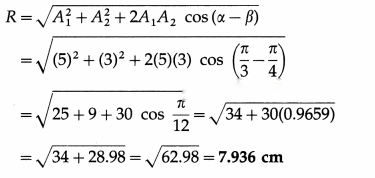
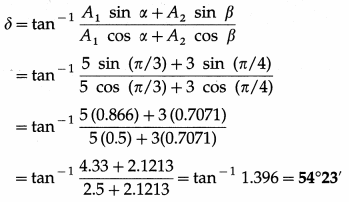
(ii) Epoch of the resultant SHM,

12th Physics Digest Chapter 5 Oscillationsof Waves Intext Questions and Answers
Can you tell? (Textbook Page No. 112)
Can you tell? (Textbook Page No. 114)
Can you tell? (Textbook page 76)
Can you tell? (Textbook Page No. 109)