Maharashtra State Board 12th Physics Solutions Chapter 6 Superposition of Waves
1. Choose the correct option.
i) When an air column in a pipe closed at one end vibrates such that three nodes are formed in it, the frequency of its
vibrations is …….times the fundamental frequency.
(A) 2
(B) 3
(C) 4
(D) 5
Answer:
(D) 5
ii) If two open organ pipes of length 50 cm and 51 cm sounded together produce 7 beats per second, the speed of sound is.
(A) 307 m/s
(B) 327m/s
(C) 350m/s
(D) 357m/s
Answer:
(D) 357m/s
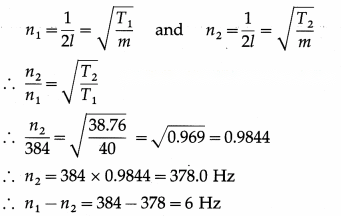
iii) The tension in a piano wire is increased by 25%. Its frequency becomes ….. times the original frequency.
(A) 0.8
(B) 1.12
(C) 1.25
(D) 1.56
Answer:
(B) 1.12
iv) Which of the following equations represents a wave travelling along the y-axis?
(A) x = A sin(ky – ωt)
(B) y = A sin(kx – ωt)
(C) y = A sin(ky) cos(ωt)
(D) y = A cos(ky)sin(ωt)
Answer:
(A) x = A sin(ky – ωt)
v) A standing wave is produced on a string fixed at one end with the other end free. The length of the string
(A) must be an odd integral multiple of λ/4.
(B) must be an odd integral multiple of λ/2.
(C) must be an odd integral multiple of λ.
(D) must be an even integral multiple ofλ.
Answer:
(A) must be an odd integral multiple of λ/4.
2. Answer in brief.
i) A wave is represented by an equation y = A sin (Bx + Ct). Given that the constants A, B and C are positive, can you tell in which direction the wave is moving?
Answer:
The wave is travelling along the negative x-direction.
ii) A string is fixed at the two ends and is vibrating in its fundamental mode. It is known that the two ends will be at rest. Apart from these, is there any position on the string which can be touched so as not to disturb the motion of the string? What will be the answer to this question if the string is vibrating in its first and second overtones?
Answer:
Nodes are the points where the vibrating string can be touched without disturbing its motion.
When the string vibrates in its fundamental mode, the string vibrates in one loop. There are no nodes formed between the fixed ends. Hence, there are no point on the string which can be touched without disturbing its motion.
When the string vibrates in its first overtone (second harmonic), there are two loops of the stationary wave on the string. Apart from the two nodes at the two ends, there is now a third node at its centre. Hence, the string can be touched at its centre without disturbing the stationary wave pattern.
When the string vibrates in its second overtone (third harmonic), there are three loops of the stationary wave on the string. So, apart from the two end nodes, there are two additional nodes in between, at distances one-third of the string length from each end. Thus, now the string can be touched at these two nodes.
iii) What are harmonics and overtones?
Answer:
A stationary wave is set up in a bounded medium in which the boundary could be a rigid support (i.e., a fixed end, as for instance a string stretched between two rigid supports) or a free end (as for instance an air column in a cylindrical tube with one or both ends open). The boundary conditions limit the possible stationary waves and only a discrete set of frequencies is allowed.
The lowest allowed frequency, n1, is called the fundamental frequency of vibration. Integral multiples of the fundamental frequency are called the harmonics, the fundamental frequency being the fundamental or 2n1, the third harmonic is 3n1, and so on.
The higher allowed frequencies are called the overtones. Above the fundamental, the first allowed frequency is called the first overtone, the next higher frequency is the second overtone, and ‘so on. The relation between overtones and allowed harmonics depends on the system under consideration.
iv) For a stationary wave set up in a string having both ends fixed, what is the ratio of the fundamental frequency to the
second harmonic?
Answer:
The fundamental is the first harmonic. Therefore, the ratio of the fundamental frequency (n) to the second harmonic (n1) is 1 : 2.
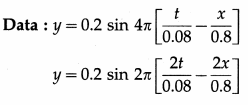
v) The amplitude of a wave is represented by y = 0.2 sin 4π[ – ] in SI units. Find
(a) wavelength,
(b) frequency and
(c) amplitude of the wave. [(a) 0.4 m (b) 25 Hz (c) 0.2 m]
Answer:
y = 0.2 sin 2π[ – ]
Let us compare above equation with the equation of a simple harmonic progressive wave:
y = A sin 2π[ – ] = 0.2 sin 2π[ – ]
Comparing the quantities on both sides, we get,
A = 0.2 m, T = 0.04 s, λ = 0.4 m
∴ (a) Wavelength (λ) = 0.4 m
(b) Frequency (n) = = = 25 Hz
(c) Amplitude (A) = 0.2 m
[Note : Since the nodes are points where the particles are always at rest, energy cannot be transmitted across a node. The energy of the particles within a loop remains localized, but alternates twice between kinetic and potential energy during each complete vibration. When all the particles are in the mean position, the energy is entirely kinetic. When they are in their extreme positions, the energy is entirely potential.]
Consider two simple harmonic progressive waves, of the same amplitude A, wavelength A and frequency n = ω/2π, travelling on a string stretched along the x-axis in opposite directions. They may be represented by
y1= A sin (ωt – kx) (along the + x-axis) and … (1)
y2= A sin (ωt + kx) (along the – x-axis) …. (2)
where k = 2π/λ is the propagation constant.
By the superposition principle, the resultant displacement of the particle of the medium at the point at which the two waves arrive simultaneously is the algebraic sum
y = y1+ y2= A [sin (ωt – kx) + sin (ωt + kx)]
Using the trigonometrical identity,
sin C + sin D = 2 sin cos ,
y = 2A sin ωt cos (- kx)
= 2A sin ωt cos kx [∵ cos(- kx) = cos(kx)]
= 2A cos kx sin ωt … (3)
∴ y = R sin ωt, … (4)
where R = 2A cos kx. … (5)
Equation (4) is the equation of a stationary wave.
Here, L = 3
∴ Wavelength, λ = = = 20 cm.
The stationary waves in the air column in this case are subject to two boundary conditions that there must be a node at the closed end and an antinode at the open end.
Taking into account the end correction e at the open end, the resonating length of the air column is L = l + e.
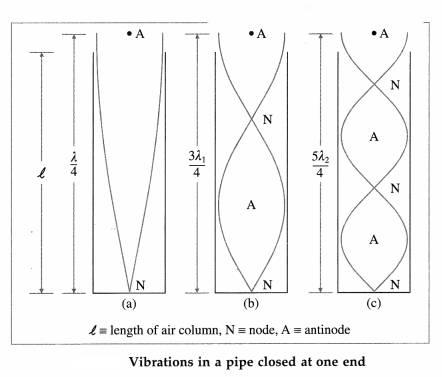
Let v be the speed of sound in air. In the simplest mode of vibration, there is a node at the closed end and an antinode at the open end. The distance between a node and a consecutive anti-node is , where λ is the wavelength of sound. The corresponding wavelength λ and frequency n are
λ = 4L and n = = = …… (1)
This gives the fundamental frequency of vibration and the mode of vibration is called the fundamental mode or first harmonic.
In the next higher mode of vibration, the first overtone, two nodes and two antinodes are formed. The corresponding wavelength λ1and frequency n1are
λ1= and n1= = = = 3n … (2)
Therefore, the frequency in the first overtone is three times the fundamental frequency, i.e., the first overtone is the third harmonic.
In the second overtone, three nodes and three antinodes are formed. The corresponding wavelength λ2and frequency n2are
which is the fifth harmonic.
Therefore, in general, the frequency of the pth overtone (p = 1, 2, 3,,..) is
np= (2p + 1)n … (4)
i.e., the pth overtone is the (2p + 1)th harmonic.

Equations (1), (2) and (3) show that allowed frequencies in an air column in a pipe closed at one end are n, 3n, 5n, …. That is, only odd harmonics are present as overtones.
The stationary waves in the air column in this case are subject to the two boundary conditions that there must be an antinode at each open end.
Taking into account the end correction e at each of the open ends, the resonating length of the air column is L = l + 2e.
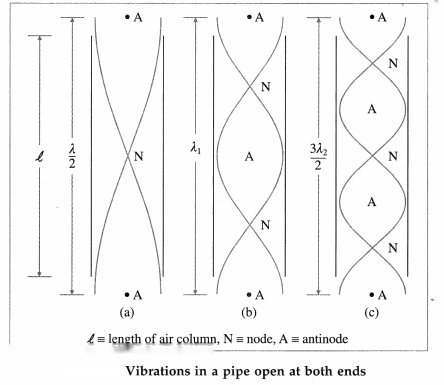
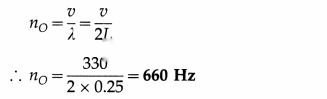
Let v be the speed of sound in air. In the simplest mode of vibration, the fundamental mode or first harmonic, there is a node midway between the two antinodes at the open ends. The distance between two consecutive antinodes is λ/2, where λ is the wavelength of sound. The corresponding wavelength λ and the fundamental frequency n are
λ = 2L and n = = = …. (1)
In the next higher mode, the first overtone, there are two nodes and three antinodes. The corresponding wavelength λ1and frequency n1
λ1= L and n1= = = = 2n …. (2)
i.e., twice the fundamental. Therefore, the first overtone is the second harmonic.
In the second overtone, there are three nodes and four antinodes. The corresponding wavelength λ2and frequency n2are
λ2= and n2= = = = 3n …. (3)
or thrice the fundamental. Therefore, the second overtone is the third harmonic.
Therefore, in general, the frequency of the pth overtone (p = 1, 2, 3, …) is
np= (p + 1)n … (4)
i.e., the pth overtone is the (p + 1)th harmonic.
Equations (1), (2) and (3) show that allowed frequencies in an air column in a pipe open at both ends are n, 2n, 3n, …. That is, all the harmonics are present as overtones.
(b) Phase difference = 45° = rad
∴ Path difference = × Phase difference
= × = 0.0875 m
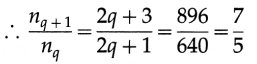
Data : nq= 640 Hz, nq-1= 896 Hz, nq+2= 1152 Hz
Since only odd harmonics are present as overtones, nq= (2q +1) nC
and nq+1= [2(q + 1) + 1] nC= (2q + 3) nC
∴ 14q + 7 = 10q + 15 ∴ 4q = 8 ∴ q = 2
Therefore, the three given frequencies correspond to the second, third and fourth overtones, i.e., the fifth, seventh and ninth harmonics, respectively.
∴ 5nC= 640 ∴ bC= 128Hz
12th Physics Digest Chapter 6 Superposition of Waves Intext Questions and Answers
Can you tell? (Textbook Page No. 132)
Do you know? (Textbook Page No. 140)