Maharashtra State Board Class 12 Secretarial Practice Solutions Chapter 4 Issue of Debentures
1A. Select the correct answer from the options given below and rewrite the statements.
1B. Match the pairs.
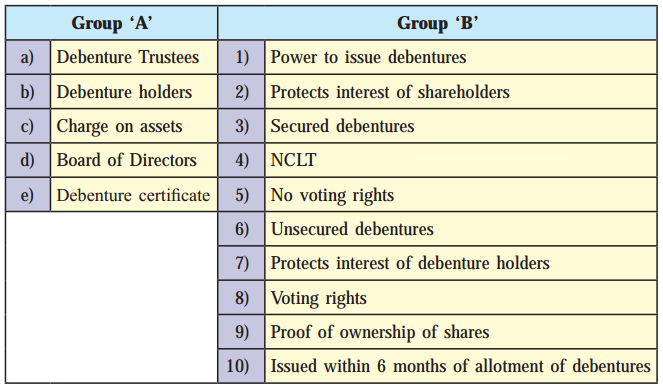
Group ‘A’ | Group ‘B’ |
a) Debenture Trustees | 7) Protects interest of debenture holders |
b) Debenture holders | 5) No voting rights |
c) Charge on assets | 3) Secured debentures |
d) Board of Directors | 1) Power to issue debentures |
e) Debenture certificate | 10) Issued within 6 months of allotment of debentures |
1C. Write a word or term or a phrase that can substitute each of the following statements.
1D. State whether the following statements are True or False.
1E. Find the odd one.
1F. Complete the sentences.
1G. Select the correct option from the bracket.
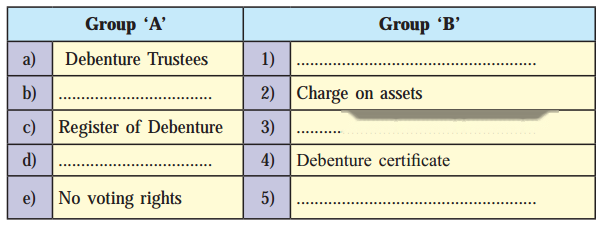
Group ‘A’ | Group ‘B’ |
(1) Debenture Trustees | (a) Trust deed |
(2) Secured debenture | (b) Charge on assets |
(3) Register of Debenture | (c) Name of debenture holders |
(4) Issued within 6 months of allotment | (d) Debenture certificate |
(5) No voting rights | (e) Debenture holder |
1H. Answer in one sentence.
1I. Correct the underlined word and rewrite the following sentences.
1J. Arrange in proper order.
2. Explain the following terms/concepts.
3. Study the following case/situation and express your opinion:
1. Rose limited company proposes to issue debenture to the public to raise funds. After discussion, the Board of directors has decided to issue secured, Redeemable non-convertible debentures with a tenure of ten years. Please advise the board on the following matters:
Question (a).
Should the company appoint a Debenture trustee?
Answer:
The company should appoint debenture trustees as they are responsible to protect the interests of debenture holders and they are the link between the company and Debenture holders.
Question (b).
Should the company create a charge on its assets?
Answer:
The company should create a charge on its assets because if the company failed to repay the amount to debenture holders, assets can be realized and the claim can be settled.
Question (c).
Can the tenure of debentures be less than ten years?
Answer:
The maximum tenure of redemption of secured debenture is 10 years. It can be less than 10 years. It shows the strong liquidity position of a company.
2. Violet Ltd. Company plans to raise ₹ 10 crores by issuing debentures. The Board of Directors has some queries. Please advise them on the following:
Question (a).
Can the company issue unsecured debentures?
Answer:
In India, as per the guidelines of SEBI, the issue of unsecured debenture is prohibited. So, the company can’t issue unsecured debenture.
Question (b).
Can they issue irredeemable debentures?
Answer:
The company can issue irredeemable debenture if it is permitted by the Ministry or department of central government or by RBI. It can be issued for a maximum period of 30 years.
Question (c).
As the company is offering debenture to its members, can such debentures have normal voting rights?
Answer:
As the company is offering debentures to its members, such debentures have no normal voting rights. It can enjoy the voting rights on the matters associated with them.
3. DDS financial plans to raise ₹ 10 crores by issuing secured, Non-convertible debentures. However, as per the Articles of Association, the board of directors has authority only to raise up to 5 crores. They are also considering whether to go for a private placement or make a public offer. Please advise them on the following:
Question (A).
What can be the maximum tenure of the debentures to be issued?
Answer:
All the secured debentures should be redeemed for 10 years. Only those companies permitted by RBI/ Dept. Of corporate affairs can issue debentures of more than 10 years but less than 30 years.
Question (b).
Is the proposed issue within the borrowing powers of the board?
Answer:
The proposed issue is not within the borrowing powers of the Board of Directors. If they want to increase their borrowing powers, they have to get the approval of shareholders.
Question (c).
Within what period should the company issue a Debenture certificate?
Answer:
A debenture certificate should be issued within 6 months from the date of allotment of debentures.
4. Answer in brief.
2. Payment of interest and redemption:
A debenture holder is responsible to get fixed interest on their investment from the company. The rate of interest is decided at the time of the issue of the debenture. A Company shall redeem the debentures after a specific period of time. It is a temporary capital of a company.
3. Debenture Certificate:
The company issues debenture certificates to the debenture holders. It should be issued by the company within six months from the date of allotment of debentures.
4. Create Debenture Redemption Reserve:
The company has to create a Debenture Redemption Reserve Account out of the profits of the company. Debenture Redemption Reserve is created for the payment of dividends and redemption of debentures only As per the Companies Amendment Act, 2019 no Listed companies, NBFC’s and Housing Finance Companies require Debenture Redemption Reserve.
5. Justify the following statements.
6. Answer the following questions.
2. Types of Debentures:
There are various types of debentures like secured and unsecured debentures, convertible and non-convertible debentures, redeemable and irredeemable debentures, registered and bearer debentures, etc. All the debentures are redeemable in nature. A special resolution is to be passed in the general meeting for issuing convertible debentures.
3. Payment of interest and redemption:
A debenture holder is responsible to get fixed interest on his investment from the company. The rate of interest is decided at the time of the issue of the debenture. A Company shall redeem the debentures after a specific period of time. It is a temporary capital of a company.
4. Debenture Certificate:
The company issues debenture certificates to the debenture holders. It should be issued by the company within six months from the date of allotment of debentures.
5. Create Debenture Redemption Reserve:
The company has to create a Debenture Redemption Reserve Account out of the profits of the company. Debenture Redemption Reserve is created for the payment of dividends and redemption of debentures only. As per the Companies Amendment Act, 2019 no Listed companies, NBFC’s and Housing Finance Companies require Debenture Redemption Reserve.
6. Appointment of Debenture Trustees:
The company issuing debentures for more than 500 people or issuing prospectus has to appoint one or more Debenture Trustees. They are responsible to protect the interest of the debenture holders. Trustees are appointed by entering into the contract with the company which is called Debenture Trust Deed.
7. Debenture Trustees can approach NCLT:
Debenture Trustees have to redress the problem of debenture holders. Debenture Trustees can approach National Company Law Tribunal (NCLT) if the company fails to repay the principal amount on maturity or paying interest. NCLT can direct a defaulting company to repay the principal amount of interest.
8. Impose Restrictions:
Debenture Trustees can also approach NCLT when the company is not able to pay the principal amount of debentures, even after selling the company assets. In such a case, NCLT can order a company to restrict incurring further liabilities so as to protect the interest of the debenture holders.
9. Punishment for not complying with the provisions of the Companies Act:
If the company or any of its officers fails to comply with any of the provisions, then the company or the responsible officer who is in default will be liable to pay a fine or imprisonment or both as prescribed in the Act.
1. Board Meeting and Resolution:
2. EOGM and Shareholder’s Approval:
If the issue of debenture exceeds the limit of paid-up capital and free reserve, then the company needs to conduct extraordinary general meetings. An extraordinary General Meeting is held for passing a special resolution and getting the shareholder’s approval related to the increase in the issue of debentures.
3. Filing with Registrar of Companies:
Secretary has to file the special resolution and copy of the prospectus with the Registrar of Companies. It has to be filed within 30 days of the board meeting.
4. Approval and Permission:
Permission of SEBI is compulsory, in case the issue of debenture exceeds ₹ 1 crore or more. Simultaneously, approval of the stock exchange is required to be taken before a prospectus is issued to the public. It is mandatory to list the debentures on the recognized stock exchange before issuing them to the public.
5. Credit Rating:
As per SEBI guidelines, the company has to get its debenture rated by two recognized credit rating agencies such as CRISIL, CARE, ICRA, etc.
6. Underwriting contract:
The company may enter into an underwriting agreement with underwriters for its public issue of debentures. The appointment of underwriters must be mentioned in the prospectus.
7. Trust Deed:
The Trust Deed has to be executed between the company and trustees. Trustees give a guarantee of protection of debenture holder’s interest.
8. Issue of Prospectus/Letter of Offer/Offer Letter:
Company issues prospectus, if it is inviting the general public. An offer letter is issued if the company makes a private placement. Letter of Offer is issued for Right Issue (Offer to exist shareholders).
9. Appointment of Banker:
Issuing Company must appoint a ‘Scheduled Bank’ as a banker of the company. The company must open a separate account in the name of the company. This account is opened to receive the money from the applicants.
10. Receiving and Allotment of debenture:
A board meeting is held to decide and approve the allotment of debentures. Board also approves the creation of charges on the company assets. The company must make the arrangement to receive the application with application money. After Board Meeting, the company allows debentures to the applicants.
11. Issue of Debenture Certificate:
The allotment procedure has to be completed within 60 days from the receipt of application money. Debenture certificates are prepared by the secretary and issued to the debenture holders within 180 days from the date of allotment.
12. Entries in Register of Debenture:
If the debentures are issued in DEMAT form, the company does not maintain the Register of Debenture holders. After allotment, all details of debenture holders are entered in the register of the debenture. In case of debenture holders exceed 50, the company should maintain the ‘Index of Debenture holders.