Maharashtra Board Class 6 History Solutions Chapter 10 Ancient India: Cultural
Class 6 History Chapter 10 Ancient India: Cultural Textbook Questions and Answers
1. Answer in one sentence:
Solution & Step-by-Step Answer:
The ancient Indian universities are Takshashila, Vamasi, Valabhi, Nalanda, Vikramshila and Kanchi.
Solution & Step-by-Step Answer:
Indian goods like fine textiles, ivory, precious stones, spices, beautifully made earthen ; pottery were in great demand in foreign countries.
2. Name the following:
Solution & Step-by-Step Answer:
Epics Silappadhikaram and Manimekhalai and Arsha epics Ramayana and Mahabharata and Paumchariya a poetic work are composition of ancient India.
3. Fill in the blanks:
Solution & Step-by-Step Answer:
(b) Valmiki
Solution & Step-by-Step Answer:
(a) Ayurveda
Solution & Step-by-Step Answer:
(c) Nalanda
4. Answer in brief:
Solution & Step-by-Step Answer:
Tipitaka is a Buddhist religious text written in Pali. It contains three categories of texts.
Solution & Step-by-Step Answer:
Solution & Step-by-Step Answer:
Ayurveda is a very old traditional Indian medical science. Ayurveda not only seeks to understand the symptoms, diagnosis and treatment of an illness but also takes into account the prevention of the illness.
Solution & Step-by-Step Answer:
Sangham means a gathering of learned men. The literature that is compiled in such gathering is known as Sangham literature.
5. Discuss:
Solution & Step-by-Step Answer:
6. What would you do ?
Solution & Step-by-Step Answer:
I will try to get information about Ayurveda from different literature that is available either in bookstores or on internet. I will try to deal with minor ailments like cough, cold, acidity, aches and pains in day to day life through ayurvedic stores. I will try to improve my health in order to prevent ailments by taking ayurvedic medicines to improve my immunity.
Solution & Step-by-Step Answer:
When on a trip to a historical site, I see my friend write his name on the structure, I will gently tell him the importance of historical monuments and also how the ancient Indians must have built it with lots of effort, without modern technology and equipment. Thus invoking respect for the ancient fellow Indians is my friend. Also telling him how proud we Indians should be of their art and talents.
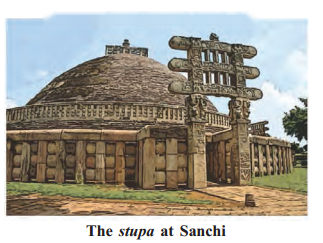
7. Observe the picture of the stupa at Sanchi and obtain more information about it.
Answer:
Sanchi is an outstanding specimen of Buddhist art and architecture. The Sanchi stupa is one of the best preserved early stupa in central India. The Sanchi stupa is surrounded by a railing with four carved gateways facing in all four directions. An interesting characteristic about Sanchi stupa is that Lord Buddha has been symbolically represented by footsteps, wheels, thrones, etc. rather than by his own image. The Sanchi stupa is one of the most wonderful structures of ancient India.
Activity:
Class 6 History Chapter 10 Ancient India: Cultural Additional Important Questions and Answers
Complete the sentence by choosing the correct option:
Solution & Step-by-Step Answer:
(b) Sangham
Solution & Step-by-Step Answer:
(c) Vardhaman Mahavir
Solution & Step-by-Step Answer:
(a) Rama
Solution & Step-by-Step Answer:
(b) Pali
Solution & Step-by-Step Answer:
(c) Learned
Solution & Step-by-Step Answer:
(c) Mahabharata
Solution & Step-by-Step Answer:
(b) eighth
Solution & Step-by-Step Answer:
(a) Arthashastra
Solution & Step-by-Step Answer:
(c) Mahabhashya
Solution & Step-by-Step Answer:
(a) Arsha
Solution & Step-by-Step Answer:
(c) composed
Solution & Step-by-Step Answer:
(a) Shri Ram
Solution & Step-by-Step Answer:
(b) Vyas
Solution & Step-by-Step Answer:
(a) story
Solution & Step-by-Step Answer:
(c) Panchatantra
Solution & Step-by-Step Answer:
(a) Trade
Solution & Step-by-Step Answer:
(b) Kushana
Solution & Step-by-Step Answer:
(c) vaidya
Solution & Step-by-Step Answer:
(c) Indians
Solution & Step-by-Step Answer:
(a) mathematical
Solution & Step-by-Step Answer:
(b) astronomer
Solution & Step-by-Step Answer:
(c) Takshashila
Solution & Step-by-Step Answer:
(a) Nalanda
Solution & Step-by-Step Answer:
(b) Dharmapal
Solution & Step-by-Step Answer:
(c) Kanchi
Solution & Step-by-Step Answer:
(a) sculpture
Solution & Step-by-Step Answer:
(b) Temple
Solution & Step-by-Step Answer:
(c) bronze
Solution & Step-by-Step Answer:
(a) iron
Answer in one sentence:
Solution & Step-by-Step Answer:
Ancient Indian literature was written in Sanskrit, Ardhamagadhi, Pali and Tamil languages.
Solution & Step-by-Step Answer:
Ancient Indian literature included varieties like religious literature, treatises on grammar, epics, plays, stories, etc.
Solution & Step-by-Step Answer:
Sangham means a gathering of learned men.
Solution & Step-by-Step Answer:
The two prominent epics are ‘Silappadhikarm’ and Manimekhalai’.
Solution & Step-by-Step Answer:
From the Sangham literature we learn about the political and social life in south India during the period.
Solution & Step-by-Step Answer:
The important religious texts are Agamgranth, Tipitaka and Bhagwad Gita.
Solution & Step-by-Step Answer:
The Jain Agamgranthas are written in the Prakrit languages of Ardhamagadhi, Shaurseni and Maharashtri.
Solution & Step-by-Step Answer:
Agamgranthas are a collection of the teachings of Vardhaman Mahavir.
Solution & Step-by-Step Answer:
Haribhadrasuri’s literary work Samaraichchakaha is well known.
Solution & Step-by-Step Answer:
Sutta Pitaka includes texts of Gautam Buddha’s teachings or sermons.
Solution & Step-by-Step Answer:
The Vinay Pitaka gives the rules of behaviour which bhikkhus and bhikkhunis in the Bauddha Sangha should follow in their day- to-day lives.
Solution & Step-by-Step Answer:
The Bhagvad Gita is the sacred text of the Hindus.
Solution & Step-by-Step Answer:
Kautilya wrote the Arthashastra.
Solution & Step-by-Step Answer:
Ashtadhyayi is a treatise in grammar written by the grammarian Panini.
Solution & Step-by-Step Answer:
Ramayana and Mahabharata are the two ‘Arsha’ epics of ancient India.
Solution & Step-by-Step Answer:
Arsha means composed by rishis or sages.
Solution & Step-by-Step Answer:
Rishi Valmiki composed the Ramayana.
Solution & Step-by-Step Answer:
The Mahabharata has been composed by sage Vyas.
Solution & Step-by-Step Answer:
Panchatantra composed by Pandit Vishnusharma is an excellent example of narrative literature.
Solution & Step-by-Step Answer:
Organisations of traders and artisans are called shrenis.
Solution & Step-by-Step Answer:
The concept of stitching clothes was introduced in India during the Kushana period.
Solution & Step-by-Step Answer:
The Charaka Samhita contains detailed information about clinical diagnosis and pharmacy.
Solution & Step-by-Step Answer:
Indians invented the concept of decimal system in which the value of a digit changes according to its place ekam, daham, (units, terms, etc).
Solution & Step-by-Step Answer:
A famous vaidya, Jeevaka, Chandragupta Maurya, the grammarian Panini and vaidya Charaka are some of the students of the Takshashila University.
Solution & Step-by-Step Answer:
The famous Chinese Bauddha bhikkhu, Fa-hien visited the Takshashila University.
Solution & Step-by-Step Answer:
Yuan Chwang and Itsing, the Chinese Bauddha Bhikkhus visited Valabhi.
Solution & Step-by-Step Answer:
Emperor Harshavardhan made generous donation to Nalanda University.
Solution & Step-by-Step Answer:
Students seeking admission to the university had to appear for an examination at the entrance gate.
Solution & Step-by-Step Answer:
Vikramshila University was established by a king named Dharmapal in the eighth century
Solution & Step-by-Step Answer:
During the reign of the Pallava dynasty, Kanchi in Tamil Nadu emerged as an important centre of education.
Solution & Step-by-Step Answer:
The stone pillars erected by Emperor Ashoka at various places are excellent examples of Indian sculptures.
Answer in brief:
Solution & Step-by-Step Answer:
Sometimes there is such a period in the history of language, literature and art and that its glory remains undiminished even later on such a period is said to be classical.
Solution & Step-by-Step Answer:
India has an ancient tradition of telling a story through songs, music and dance. When these arts are presented with supporting dialogues they are known as ‘theatre’.
Solution & Step-by-Step Answer:
(a) The famous surgeon Sushruta has discussed the diagnosis of different ailments and their remedies in his treatiste the ‘Sushruta Samhita’.
(b) The importance of this text is that it discusses the different causes leading to injuries, fractures, their types and the various types of surgeries required for them.
Answer the following:
Solution & Step-by-Step Answer:
(a) Takshashila was an important city on the ancient Indian trade route.
(b) Gautama Buddha and a famous vaidya, had studied at Takshashila University.
(c) Chandragupta Maurya the founder of the Mauryan Empire was educated at this university.
(d) The Greek historians who accompanied Alexander have also given a description of if the university. They have stated that such a university did not exist anywhere in Greece.
(e) The famous Chinese Bauddha bhikkhu, Fa- Hien who came to India around 400 CE also visited the Takshashila University. The university provided education in various subjects such as Vedic literature, Buddhist philiosophy, economics, logic, etc.