Maharashtra State Board Class 6 Science Solutions Chapter 1 Natural Resources – Air, Water and Land
Class 6 Science Chapter 1 Natural Resources – Air, Water and Land Textbook Questions and Answers
1. Fill in the blanks and rewrite the completed statements.
Question a.
The layer of ozone gas absorbs ……………. rays that come from the sun to the earth.
Answer:
Ultraviolet (U.V) rays
Question b.
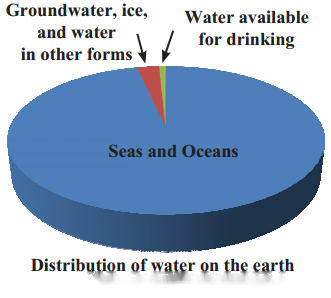
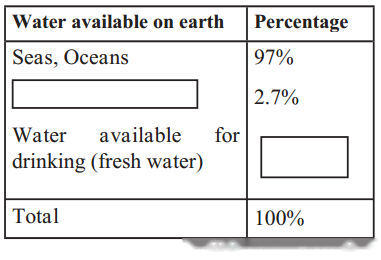
Of the total water available on the earth, fresh water forms ……….. percent.
Answer:
0.3 %
Question c.
Both …………. and ………… constituents are present in the soil.
Answer:
biotic, abiotic
2. why is it said that?
Question a.
The ozone layer is a protective shell of earth.
Answer:
Question c.
Sea water is useful even though it is not potable.
OR
In what way is sea water useful even though it is salty?
Answer:
3. What will happen if
Question a.
Question a.
Microbes in soil get destroyed.
Answer:
Question b.
The number of vehicles and factories in your surroundings increases.
Answer:
Question c.
The total supply of potable water is finished.
Answer:
4. Match the following.
Question a.
Group ‘A’ | Group ‘B’ |
1. Carbon dioxide | a. Generation of soil |
2. Oxygen | b. Rain |
3. Water vapour | c. Plants and food production |
4. Microbes | d. Combustion |
Answer:
Group ‘A’ | Group ‘B’ |
1. Carbon dioxide | c. Plants and food production |
2. Oxygen | d. Combustion |
3. Water vapour | b. Rain |
4. Microbes | a. Generation of soil |
5. Name the following.
Question a.
Constituents of biosphere.
Answer:
Atmosphere, hydrosphere, lithosphere and all living things on earth.
Question b.
Biotic constituents of soil.
Answer:
Microbes, worms, insects, burrowing rhodents like rats, mice, roots of trees and plants.
Question c.
Fossil fuel.
Answer:
Crude oil from which we get kerosene, petrol, diesel, paraffin wax and tar.
Question d.
Inert gases in air.
Answer:
Neon, argon, helium, krypton, xenon.
Question e.
Gases that are harmful to ozone layer.
Answer:
Chlorofluorocarbon and carbon tetrachloride.
6. True or False?
Question a.
Land and soil is the same thing.
Answer:
False – Land consists of stones, soil and big rocks.
Question b.
The water in a lake is called ground water.
Answer:
False – Water trapped below the ground over the bedrocks is called ground water.
Question c.
It takes about thousand years to form a 25 cm thick layer of soil.
Answer:
False – It almost takes around thousand years to form a 2.5 cm thick layer of soil.
Question d.
Radon is used in decorative lights.
Answer:
False – Neon is used in decorative lights.
7. Answer in your own words.
Question a.
Explain with the help of a diagram how soil is formed.
Answer:
Question b.
Why is there a shortage of water even though it occupies about 71% of the earth’s surface?
Answer:
Question c.
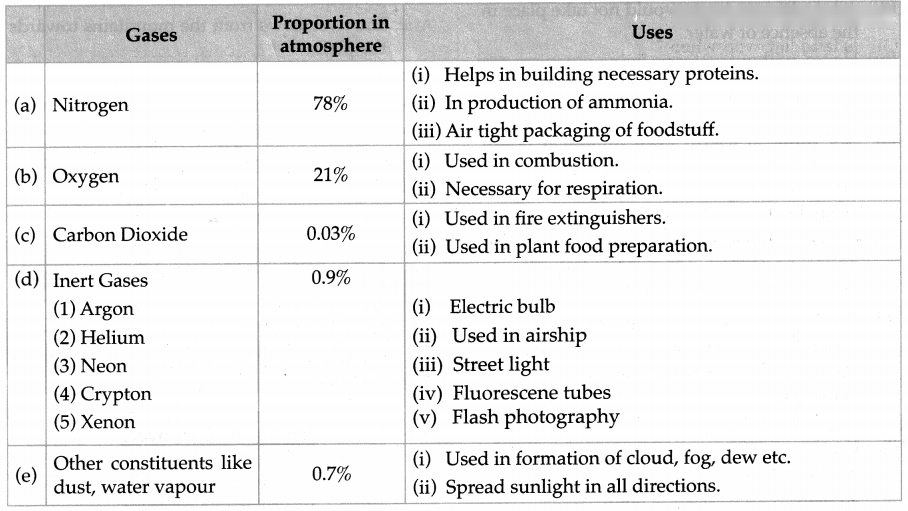
What are the various constituents of air? Write their uses.
Answer:
Air contains gases like oxygen, carbon dioxide, nitrogen, inert gases, water vapour and dust particles. The uses of constituents of air are as follows.
Question d.
Why are air, water and land considered to be valuable natural resources?
Answer:
Activity:
Natural Resources Air, Water And Land Class 6 Questions And Answers Question 1.
Obtain detailed information about the work of the India Meteorological Department.
Natural Resources Air Water And Land Class 6 Questions And Answers Question 2.
Find a remedy for water scarcity.
Class 6 Science Chapter 1 Natural Resources – Air, Water and Land Important Questions and Answers
Fill in the blanks and rewrite the completed statements.
Class 6 Science Chapter 1 Natural Resources Air, Water And Land Exercise Question 1.
……………. gas, used for refrigeration and air conditioning, destroys the ozone layer.
Answer:
Chlorofluorocarbon or carbon tetrachloride
Natural Resources Air Water And Land Class 6 Exercise Question 2.
Air becomes ……………. at higher altitudes.
Answer:
rarer
Natural Resources Air Water And Land Class 6 Question 3.
………….. of land is reduced if green trees and bushes are grown in it.
Answer:
Erosion
Natural Resources Air Water And Land Question 4.
16th September is celebrated as ………. Day all over the world.
Answer:
Ozone Protection
Natural Resources Air Water And Land Question Answer Question 5.
………….. is the layer of air that surrounds the earth.
Answer:
Atmosphere
Natural Resources Air, Water And Land Question 6.
……………. occupies the largest part of the earth’s surface.
Answer:
Hydrosphere
Natural Resources Air Water And Land Class 6 Question 7.
Gases are not found in the …………… and beyond.
Answer:
exosphere
Choose the correct alternative:
Match the following:
Group ‘A’ | Group’B’ |
1. Argon | a. temperature for obtaining low |
2. Neon | b. Used in electric bulb |
3. Xenon | c. Decorative lights |
4. Chlorofluoro – carbon | d. Flash photography |
5. Helium | e. Ozone depletion |
Group ‘A’ | Group’B’ | |||||||||||||||||||||||||||||||||||||||||||||||||||
1. Argon | b. Used in electric bulb | |||||||||||||||||||||||||||||||||||||||||||||||||||
2. Neon | c. Decorative lights | |||||||||||||||||||||||||||||||||||||||||||||||||||
3. Xenon | d. Flash photography | |||||||||||||||||||||||||||||||||||||||||||||||||||
4. Chlorofluoro – carbon | e. Ozone depletion | |||||||||||||||||||||||||||||||||||||||||||||||||||
5. Helium | a. temperature for obtaining low Name the following:
Question 1
Maharashtra Board Solution
Substances formed when fuel burns.
Solution & Step-by-Step Answer:
Carbon dioxide, carbon monoxide, nitrogen dioxide, sulphur dioxide and smoke.
Question 2
Maharashtra Board Solution
Layers of the atmosphere.
Solution & Step-by-Step Answer:
Troposphere, stratosphere, mesosphere, ionosphere and exosphere.
Question 3
Maharashtra Board Solution
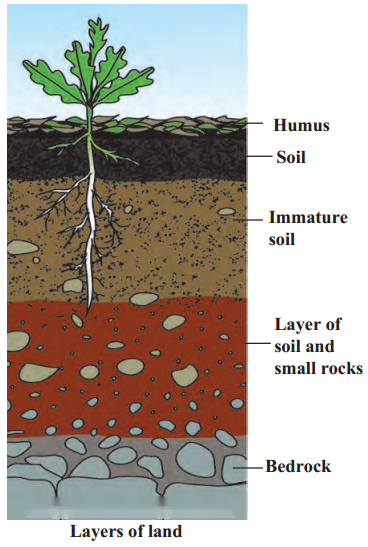
Layers of land.
Solution & Step-by-Step Answer:
Humus, mature soil, immature soil, small rocks and stones and bedrock.
Question 4
Maharashtra Board Solution
Gas necessary for building proteins.
Solution & Step-by-Step Answer:
Nitrogen.
State whether True or False. Correct if False.
Question 1
Maharashtra Board Solution
The amount of gases in the air is greatest near the surface and becomes rarer at higher altitudes.
Solution & Step-by-Step Answer:
True.
Question 2
Maharashtra Board Solution
Fogs, clouds, snow, and rain are produced in the exosphere.
Solution & Step-by-Step Answer:
False – Fogs, clouds, snow and rain are formed in the troposphere and lower stratosphere of the atmosphere.
Question 3
Maharashtra Board Solution
Fossil fuels are formed from the dead remains of animals and plants buried underground for a long period.
Solution & Step-by-Step Answer:
True.
Explain what will happen if:
Question 1
Maharashtra Board Solution
Forests are destroyed.
Solution & Step-by-Step Answer:
Question 2
Maharashtra Board Solution
What would have happened if there was no air on the earth?
Solution & Step-by-Step Answer:
Answer the following:
Question 1
Maharashtra Board Solution
What is humus?
Solution & Step-by-Step Answer:
Humus is the topmost layer of the soil formed d by decomposition of remains of plants and animals and it makes the soil fertile.
Question 2
Maharashtra Board Solution
What is land made up of?
Solution & Step-by-Step Answer:
Land is made up of stones, soil, sand and big rocks.
Question 3
Maharashtra Board Solution
Is land flat everywhere?
Solution & Step-by-Step Answer:
No, land is not flat everywhere. It is flat in some regions and hilly in some regions.
Question 4
Maharashtra Board Solution
Does man produce soil/ land?
Solution & Step-by-Step Answer:
No, man does not produce soil/land, it is produced naturally.
Question 5
Maharashtra Board Solution
What do you see on land?
Solution & Step-by-Step Answer:
We see mountains, rivers, valleys, ocean, also terrestrial animals and plants. We also see roads, bridges, buildings etc.
Question 6
Maharashtra Board Solution
What has man created on land?
Solution & Step-by-Step Answer:
Man has dug wells, borewells to lift ground water. He has also constructed bunds and dams. He has also built many industries, buildings, roads for transport.
Question 7
Maharashtra Board Solution
If a deep pit is dug in the ground, what do you see there?
Solution & Step-by-Step Answer:
We see different layers of land.
Answer in your own words.
Question 1
Maharashtra Board Solution
Explain with the help of diagram various layers of land.
Solution & Step-by-Step Answer:
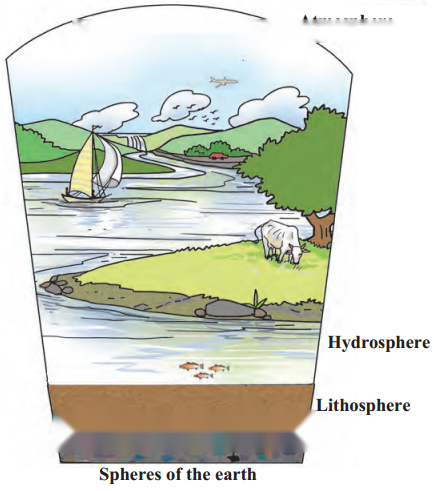
Observe the picture and answer the questions.
Question 1
Maharashtra Board Solution
Where do you see the birds?
Solution & Step-by-Step Answer:
The birds are flying in the sky.
Question 2
Maharashtra Board Solution
Where is the cow grazing?
Solution & Step-by-Step Answer:
The cow is grazing in the pasture (field).
Question 3
Maharashtra Board Solution
Locate the trees.
Solution & Step-by-Step Answer:
The trees are seen along the river bank.
Question 4
Maharashtra Board Solution
Where does the river come from?
Solution & Step-by-Step Answer:
The river flows from the mountains towards the plains.
Question 5
Maharashtra Board Solution
Where is the aeroplane?
Solution & Step-by-Step Answer:
The aeroplane is in the sky above the clouds.
Question 6
Maharashtra Board Solution
Where are fishes seen?
Solution & Step-by-Step Answer:
Fishes are seen swimming in the river water.
Question 7
Maharashtra Board Solution
On what is the sail boat floating?
Solution & Step-by-Step Answer:
Sail boat is floating on the water.
Observe and discuss:
Question 1
Maharashtra Board Solution
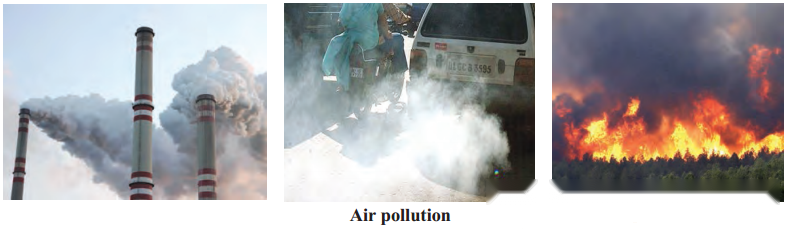
What is the similarity in the three pictures given above?
Solution & Step-by-Step Answer:
All the pictures given above show large scale emission of smoke through different agencies. This smoke directly mixes with the atmosphere, disturbing the balance between the constituents of air and causing air pollution.
Observe and discuss:
Observe the distribution of water on the earth surface and complete the table.
Question 1
Maharashtra Board Solution
Solution & Step-by-Step Answer:
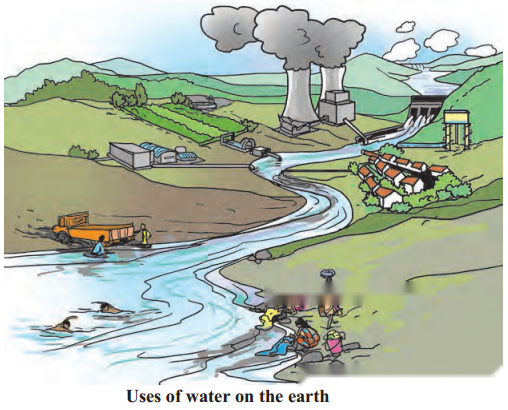
Observe given figure carefully and answer the following.
Question 1
Maharashtra Board Solution
For which purpose is water being used?
Solution & Step-by-Step Answer:
Water is being used for washing clothes, for bathing, farming, drinking, and industries.
Question 2
Maharashtra Board Solution
Do other living things use water like we do?
Solution & Step-by-Step Answer:
Animals do not use water like us. They use water only for drinking. Some animals like buffaloes, rhinoceros, elephants use water for cooling themselves during summers.
Question 3
Maharashtra Board Solution
What are the constituents of soil? Classify them as biotic and abiotic constituents.
Solution & Step-by-Step Answer:
The constituents of soil are humus, soil, sand, gravel, stones, bedrock, insects, worms, microbes, roots of trees and dead leaves, burrowing rodents like mice and rats.
Answer the following:
Question 1
Maharashtra Board Solution
How would you save water? Give some measures you will adopt.
Solution & Step-by-Step Answer:
Water can be saved in the following ways:
Question 2
Maharashtra Board Solution
What measures would you take to prevent soil erosion?
Solution & Step-by-Step Answer:
Let’s try this
Observe it the next day and answer.
Question 1
Maharashtra Board Solution
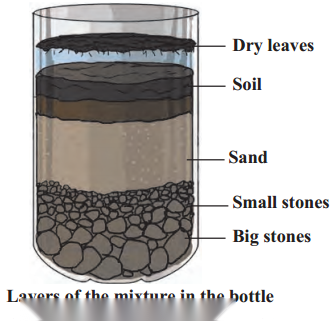
How does the mixture in the bottle look now?
Solution & Step-by-Step Answer:
The mixture gets segregated into various layers. Heaviest substances settle down and lighter forms topmost layer.
Question 2
Maharashtra Board Solution
Do you see the layers in it?
Solution & Step-by-Step Answer:
Yes, we see the layers of soil.
Question 3
Maharashtra Board Solution
What is seen in the different layers from top to bottom?
Solution & Step-by-Step Answer:
The dry leaves are floating above the water at the top. Then the layer of the soil, which forms a layer above the sand. Below the sand we see a layer of small stones, and the big ones have settled down at the bottom of the bottle.
Question 4
Maharashtra Board Solution
Obtain specimens of soil from various places and note the differences in the specimen with respect to colour, feel, texture and size of the particles.
Solution & Step-by-Step Answer:
Question 5
Maharashtra Board Solution
Observe how much water is used and for what purposes it is used in your house for a whole day. Record it in a chart. Discuss this data and find out how much water each person needs in your house.
Solution & Step-by-Step Answer:
Total number of persons = 3 |