Maharashtra State Board Class 6 Science Solutions Chapter 2 The Living World
Class 6 Science Chapter 2 The Living World Textbook Questions and Answers
1. Write the answers to the following questions in your words.
Question a.
What are the differences between plants and animals?
Answer:
Plants | Animals |
1. Plants cannot move from one place to another. They are anchored to the soil. | 1. Animals can move from one place to another. |
2. Plants prepare their own food with the help of chlorophyll and sunlight. | 2. Animals cannot prepare their own food. They move in search of food from one place to another. |
3. Plants grow throughout their life. | 3. Animals grow only up to a certain period of their life. |
4. Plants respire with the help of microscopic pores present on their leaves and stems. | 4. Animals respire with the help of special organs like lungs, gills, trachea, etc. |
5. Plants excrete their waste by storing them in the leaves and bark of plants and then shedding them seasonally. | 5. Animals excrete their waste with the help of special organs regularly. |
6. Plants are only living things which take in carbon dioxide and give out oxygen during photosynthesis. | 6. Animals take in oxygen and give out carbon dioxide throughout their life. |
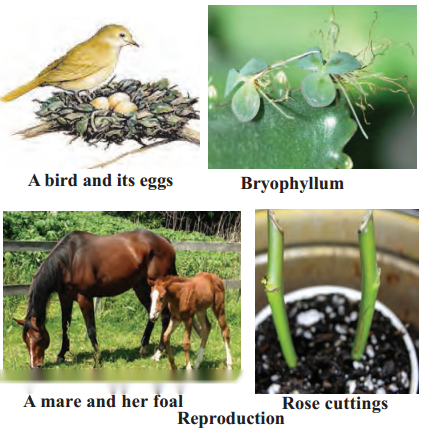
7. Plants reproduce with the help of seeds, stems, spores, bulbs etc. | 7. Animals reproduce by laying eggs or giving birth to young ones. |
Question b.
What are the similarities between plants and animals?
Answer:
Question c.
How is the plant kingdom useful to us?
Answer:
Question d.
How is the animal kingdom useful to us?
Answer:
Question e.
What makes living things different from non-living things?
Answer:
Living Things | Non-Living Things |
1. Living things can grow on their own in size, height and weight. | 1. Non-living things do not grow on their own in size, height and weight. |
2. Living things can move from one place to another on their own. | 2. Non-living things can move only if someone moves them. |
3. Living things can reproduce. | 3. Non-living things cannot reproduce. |
4. Living things exhibit responses to various stimuli. | 4. Non-living things do not exhibit responses to various stimuli. |
5. They require food for their growth. | 5. They do not require any food. |
2. What helps them to breathe?
Question a.
(a) A fish (b) A snake (c) A crane (d) An earthworm (e) Man (f) A banyantree (g) A caterpillar.
Answer:
Plant/Animal | Breathing Organ |
A fish | gills |
A snake | external nostrils and lungs. |
A crane | external nose and air sacs in lungs. |
An earthworm | moist skin. |
Man | nose and lungs. |
A banyan tree | microscopic pores (called stomata) present on leaves. |
A caterpillar | trachea which opens at the side in their skin. |
3. Fill in the blanks with the proper words from the brackets.
(plants, oxygen, dies, excretion, carbon- dioxide, photosynthesis, stimuli, cells, sunlight, chlorophyll, microscopic pores, responsiveness.)
Question a.
The process by which plants make their own food is called ……………….
Answer:
photosynthesis
Question b.
To inhale …………. and to exhale ……………. is called respiration.
Answer:
oxygen, carbon-dioxide
Question c.
The elimination of waste substances fr6m the body is called …………...
Answer:
excretion
Question d.
The ability to respond to an event is called ……….. to ………….
Answer:
responsiveness, stimuli
Question e.
On completing their lifespan, every living thing …………...
Answer:
dies
4. Write the uses of these animals and plants.
Animals: Honeybees, sharks, yaks, sheep, earthworms, dogs, bivalves, horses, mice.
Plants: Ginger, mango, eucalyptus, babul (acacia), teak, spinach, aloevera, turmeric, holy basil, karanja, moh, mulberry, grapevine.
Question a.
Write the uses of these animals and plants.
Answer:
Animals Uses:
Animals | Uses |
1. Honeybees | Honey and wax prepared by them is used by us. Beeswax is used in cosmetics like lip – balm, lipgloss, etc. |
2. Sharks | The ‘shark liver oil’ obtained from them is a rich source of vitamins. |
3. Yaks | Milk and meat obtained is used as food. Yaks are also used for carrying loads in mountainous regions. |
4. Sheep | Their fleece is used as a good source of wool. Their meat is used as food. |
5. Earthworms | They convert biodegradable waste to good manure (vermicompost)which can be used in fields and gardens. They are called “friends of farmers” as they make the soil fertile. |
6. Dogs | They are used as pets to guard houses and farms. |
7. Bivalves | Bivalves like oysters are used to obtain pearls used in jewellery making. They are also used as food. |
8. Horses | They are used for pulling carriages, heavy loads and also as means of transport in mountainous regions. |
9. Mice | They are used in research to test medicines, vaccines etc. |
10. Rabbits | They are used as pets and also in research. Their meat is used as food. |
Plants Uses:
Plants | Uses |
1. Ginger | Used as medicine to cure digestive problems of stomach. It is also used as a spice in food. |
2. Mango | It is used to prepare pickles when raw and as a fruit when ripe. It is also used to prepare jam, jelly and in ice-creams. |
3. Eucalyptus | Leaves and oil extracted from it is used as medicine to cure fever, cold and cough. |
4. Babul (Acacia) | It is used as a medicine. Also used as cattle feed. It is used to clean teeth. It was also used to cure leprosy and heal wounds. |
5. Teak (Sag) | Its wood is used to make furniture. |
6. Spinach (Palak) | It is used as a vegetable. |
7. Aloe vera (Korphad) | It is used to treat various skin diseases. Its gel is used as a moisturizer for skin and for treating hair fall. |
8. Turmeric | It is used as a spice and has medicinal properties. It is used for healing wounds and cuts due to its antiseptic properties (i.e. helps to prevent growth of bacteria). |
9. Holy basil (Tulsi) | It is used as medicine to cure cough and cold. It also reduces air pollution and drives away mosquitoes. |
10. Karanja (Jatropha) | It is used as a medicine and its seeds are used to prepare biodiesel. |
11. Moh (Mahwa) [Scientific name: Madhuca longifolia] | The fat extracted from its seeds is used in the manufacture of soaps and detergents. Its bark and flowers are used as medicine. Its leaves are used to feed silkworms which produce Tussar silk. Seeds and flowers are also used to make wine. |
12. Mulberry | The leaves of these trees are used for feeding silkworms which produce silk. The fruits are rich in vitamins. Jam and jelly are also made from these fruits. |
13. Grapevine | Grapes are fruits of a grapevine. They are used for making jam, jelly, juice, wine and are also eaten as fruits. Raisins are prepared from these grapes. |
5. What are the peculiarities of the movements of these living things?
Living things : Snakes, tortoises, kangaroos, eagles, chameleons, frogs, gulmohur, sweet potato creeper, dolphins, ants, rattlesnakes, grasshoppers, earthworms.
Question a.
What are the peculiarities of the movements of these living things?
Answer:
1. Snakes | They don’t have legs. They move in a S-shaped wavy motion. They cannot move over smooth surface. They move by contraction and relaxation of their body muscles. |
2. Tortoises | They are very slow and they walk on their four legs by raising their body off the ground. They are the slowest animals. |
3. Kangaroos | The hind legs of kangaroos are long and front legs are short. A kangaroo moves by hopping (jumping) on its muscular hind legs with the support of long tail outstretched behind. This movement is called penta pedal movement [Penta = 5, pedal = legs]. |
4. Eagles | Eagles fly at great heights and they can lift and fly away with prey which are heavier than them. Wings of eagles are strong and powerful. |
5. Chameleons | Chameleons can change the colour of their skin and camouflage (hide) in their surroundings. They move slowly with their four legs. They also use their tail and claws to grab a branch and balance themselves. |
6. Frogs | Their hind legs are long and front legs are short. Hence, they hop on their hind legs, when on land, and swim with the help of hind limbs when in water. |
7. Gulmohar | Gulmohar blooms in summer and the flowers which are red in colour reveal very few leaves. Their leaves fold up during evening. It grows to a height of 5 m to 12 m and it shed all its leaves in dry season. |
8. Sweet potato creeper | Sweet potato creepers are fastest growing creepers that cover the whole ground. If they find some support, they try to bend towards it. |
9. Dolphins | They move on surface of water by slapping their tail, exposing their head, leaping out of water, diving in the water and doing a side flop. 30 patterns are seen in their behaviour while moving on water. |
10. Ants | The ants move in a line and as they move, they leave a chemical called pheromone behind as a trail which attracts other ants. They have six legs and they can walk very fast. |
11. Rattle snakes | Rattle snake is a highly poisonous snake. The rattling sound is made by the shaking of the rattle located on its tail when it moves. |
12. Grasshoppers | They are insects with three pairs of walking legs and two pairs of wings which helps them to walk, fly and jump. They can leap vigorously due to powerful hind legs. |
13. Earthworms | Each segment on the body of earthworm contain group of bristles (called setae) which are used for movement. They move forward by repeated contractions and relaxations of their muscles. A slimy substances secreted by the earthworm helps in its movement. |
6. Write in detail about how the plants and animals found in your surroundings prove useful or harmful.
Question a.
Write in detail about how the plants and animals found in your surroundings prove useful or harmful.
Answer:
Some animals and plants around us are harmful to man.
Activity:
Class 6 Science Chapter 2 The Living World Question Answer Question 1.
Obtain information about the work of the Botanical Survey of India and the Zoological Survey of India by visiting the websites :
www.bsi.gov.in, W.zsi.gov.in
Class 6 Science Chapter 2 The Living World Question 2.
Collect information about the lifespan of various animals, make a chart and display it in your class.
The Living World Class 6 Questions And Answers Question 3.
Gather information about the poisonous snakes found in India and present it in a Science Exhibition.
Class 6 Science Chapter 2 The Living World Important Questions and Answers
Fill in the blanks with the proper words from the brackets.
(plants, cells, sunlight, chlorophyll, microscopic pores.)
The Living World Class 6 Question Answers Question 1.
Living things are made up of small units called ………...
Answer:
cells
The Living World Class 6 Question 2.
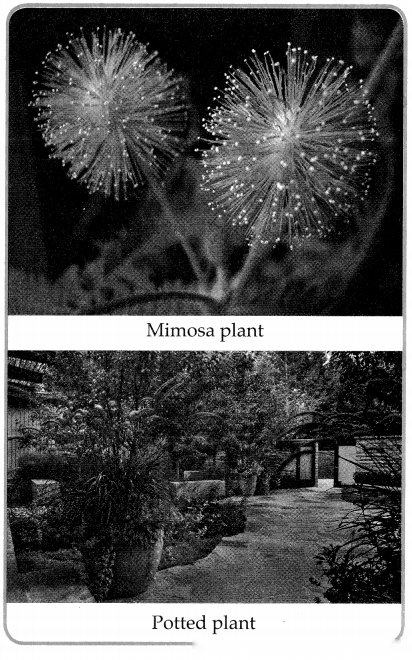
A potted plant placed in a window grows towards ………….
Answer:
sunlight
The Living World Class 6 Solutions Question 3.
Plants appear green in colour due to the presence of ………….
Answer:
chlorophyll
The Living World Class 6 Exercise Answers Question 4.
Plants respire by means of ………….. on their stems and leaves.
Answer:
microscopic pores
My Living World Book Class 6 Answers Question 5.
……………….. grow throughout their lifespan.
Answer:
Plants
Match the columns:
Column ‘A’ | Column ‘B’ |
1. Responsiveness to stimuli | a. plants shed leaves in Autumn |
2. Respiration | b. seeds sprout when sowed in soil |
3. Excretion | c. petals of lotus close when sun sets |
4. Reproduction | d. oxygen is taken in through moist skin in earthworms. |
Column ‘A’ | Column ‘B’ |
1. Responsiveness to stimuli | c. petals of lotus close when sunsets |
2. Respiration | d. oxygen is taken in through moist skin in earthworms. |
3. Excretion | a. plants shed leaves in Autumn |
4. Reproduction | b. seeds sprout when sowed in soil Plants carry out photosynthesis to prepare their food. With reference to this process of photosynthesis, match the columns given below.
Question 1
Maharashtra Board Solution
|
Column ‘A’ | Column ‘B’ |
1. Minerals | a. given out into the air |
2. Carbon dioxide | b. absorbed from the soil |
3. Heat from sunlight | c. absorbed from the air |
4. Oxygen | d. absorbed by chlorophyll. |
Column ‘A’ | Column ‘B’ | |||||||||||||||||||||||||||||||||||||||||||||||||||||||||||
1. Minerals | b. absorbed from the soil | |||||||||||||||||||||||||||||||||||||||||||||||||||||||||||
2. Carbon dioxide | c. absorbed from the air | |||||||||||||||||||||||||||||||||||||||||||||||||||||||||||
3. Heat from sunlight | d. absorbed by chlorophyll. | |||||||||||||||||||||||||||||||||||||||||||||||||||||||||||
4. Oxygen | a. given out into the air Can you tell?
Question 1
Maharashtra Board Solution
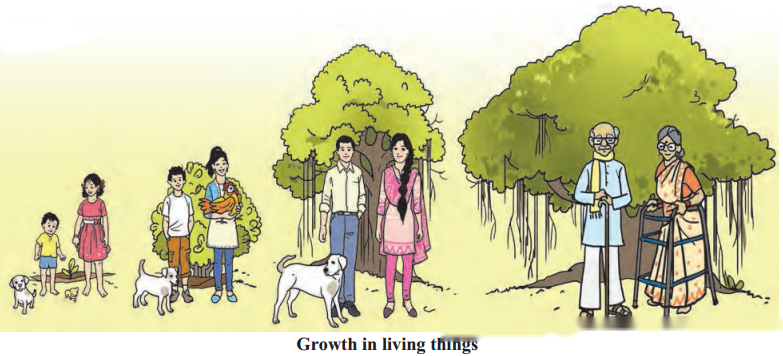
What differences do you see between the young ones and the adults in the picture?
Solution & Step-by-Step Answer:
Answer: The young ones are smaller in size, height and shape.
Question 2
Maharashtra Board Solution
What do we learn from these pictures?
Solution & Step-by-Step Answer:
We learn that all living beings whether plants or animals reproduce in different ways.
Question 3
Maharashtra Board Solution
Observe a honeycomb and a wall. What are they made up of?
Solution & Step-by-Step Answer:
Bricks are laid one over the other to form a wall. In a honeycomb, the beeswax is joined to form small compartments to form a honeycomb.
Question 4
Maharashtra Board Solution
In what ways are the plants and animals useful to us?
Solution & Step-by-Step Answer:
Use your brainpower!
Question 1
Maharashtra Board Solution
What differences do you see in the growth of trees like mango, banyan and peepal and that of bamboo, coconut and toddy palms?
Solution & Step-by-Step Answer:
Question 2
Maharashtra Board Solution
In each of the examples given below, what is the stimulus? What is the response?
Solution & Step-by-Step Answer:
Question 3
Maharashtra Board Solution
What is the main difference between movements of plants and animals?
Solution & Step-by-Step Answer:
Question 4
Maharashtra Board Solution
Why have so many plants and animals been able to survive on the earth even today?
Solution & Step-by-Step Answer:
Question 5
Maharashtra Board Solution
What is the sticky substance seen on the stems of the babul (acacia) or drumstick trees?
Solution & Step-by-Step Answer:
Observe and discuss.
Question 1
Maharashtra Board Solution
Hold your hand in front of your nose or keep your hand on your chest. What do you feel?
Solution & Step-by-Step Answer:
Find the life span and age of maturity of the given living beings.
Question 1
Maharashtra Board Solution
Find the life span and age of maturity of the given living beings.
Solution & Step-by-Step Answer:
Answer the following:
Question 1
Maharashtra Board Solution
Is all the food we eat used by the body?
Solution & Step-by-Step Answer:
No, non-essential and undigested food is thrown out of the body in the form of waste.
Question 2
Maharashtra Board Solution
What is the unused part of food converted into?
Solution & Step-by-Step Answer:
The unused part of food is converted into excreta.
|