Maharashtra State Board Class 6 Science Solutions Chapter 3 Diversity in Living Things and their Classification
Class 6 Science Chapter 3 Diversity in Living Things and their Classification Textbook Questions and Answers
1. Match the pairs.
diversity in living things and their classification class 6 exercise Question 1.
Column ‘A’ | Column ‘B’ |
1. Amphibians | a. A monkey |
2. Vertebrates | b. A snake |
3. With scales | c. A frog |
Answer:
Column ‘A’ | Column ‘B’ |
1. Amphibians | c. A frog |
2. Vertebrates | a. A monkey |
3. With scales | b. A snake |
2. Who is the odd one out?
Question a.
Fungus, mushroom, chrysanthemum, spirogyra
Answer:
Chrysanthemum (only flowering plants)
or
Spirogyra (only aquatic plant)
Question b.
Mango, banyan, palm, chickpea
Answer:
Chickpea (shrub, others are not)
or
Palm (tall tree without any branches, others have branches)
Question c.
Grape, orange, lemon, hibiscus
Answer:
Grape (only creeper, others are not)
or
Hibiscus (flower, others are fruits)
Question d.
Sunflower, banyan, jowar, bajra
Answer:
Banyan (perinnial, others are not)
Question e.
Guava, radish, carrot, beetroot
Answer:
Gauva (fruit, others are roots)
Question f.
Deer, fish, man, worms
Answer:
Worms (invertebrate, others are not)
or
Fish (aquatic animal, others are terristrial animals
3. What is the difference?
Question a.
Flowering plant and Non-flowering plant
Answer:
Flowering plant | Non-flowering plant |
1. Plants that bear flowers are called flowering plants. | 1. Plants that do not bear flowers are called nonflowering plants. |
2. They have roots, stems and leaves. | 2. They may not have roots, stems or leaves. |
e.g. Rose, sunflower, lotus | e.g. Pine, fern, algae |
Question b.
A Tree and a Shrub
Answer:
Tree | Shrub |
1. They have branches at some height above the ground. | 1. They give out branches close to the ground. |
2. They grow very tall compared to shrubs. | 2. They grow upto 2 to 3 metres in height. |
3. They have strong and hard stems. | 3. They have thick hard stems. |
e.g. Mango tree, banyan tree | e.g. Hibiscus, oleander |
Question c.
Vertebrates and Invertebrates
Answer:
Vertebrates | Invertebrates |
1. They have vertebral column. | 1. They do not have vertebral column. |
2. The brain is well developed. | 2. The brain if present may not be developed. |
e.g. Human, dog, fishes etc. | e.g. earthworm, insects etc. |
4. True or false?
Question a.
The snail is an aquatic animal.
Answer:
False
Question b.
Amphibians can live in air and in water.
Answer:
False
Question c.
The function of the brain is well developed in vertebrate.
Answer:
True
Question d.
The amoeba is a multicellular animal.
Answer:
False
5. Write two names of each.
Question a.
A flowering plant
Answer:
Rose, hibiscus
Question b.
A non-flowering plant
Answer:
Fern, algae
Question c.
A tree
Answer:
Mango, banyan
Question d.
A shrub
Answer:
Oleander, hibiscus
Question e.
A creeper
Answer:
Pumpkin, watermelon
Question f.
An annual plant
Answer:
Jowar, sunflower
Question g.
A biennial plant
Answer:
Carrot, beetroot
Question h.
A perennial plant
Answer:
Mango, gulmohar
6. Write answers to the following.
Question a.
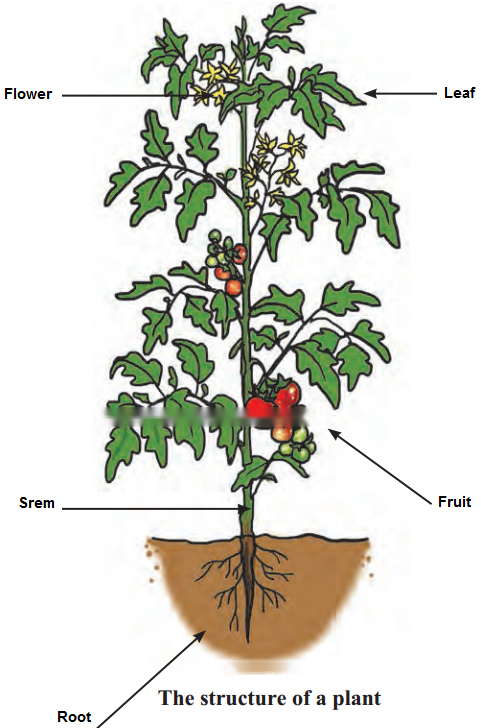
What are the parts of a plant?
Answer:
The parts of a plant are: root, stem, leaves, flowers, fruit and seed.
Question b.
What are the functions of root?
Answer:
The functions of root are:
Question c.
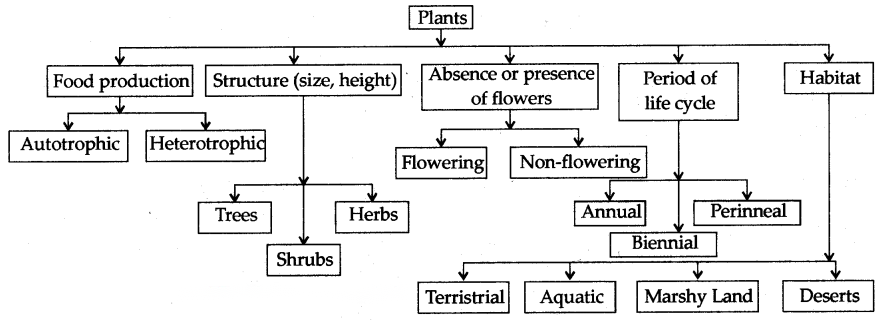
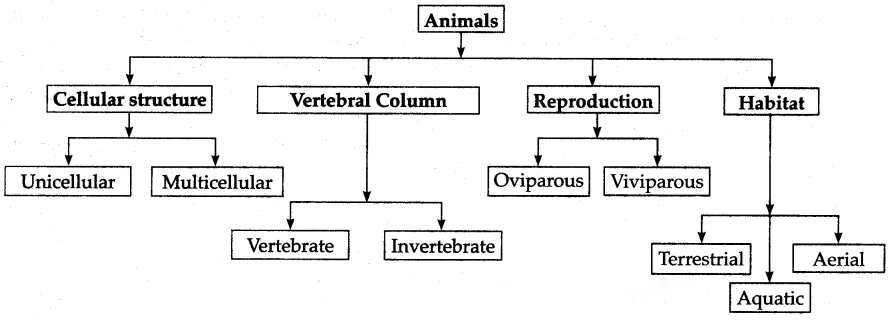
Why is it necessary to classify living things?
Answer:
Question d.
What are the criteria used to classify living things?
Answer:
Following are the criteria used to classify living things:
a. Plants:
b. Animals:
Question e.
Tell some characteristics of creepers.
Answer:
The characteristics of creepers are:
Question f.
Explain the characteristics of herbs with examples.
Answer:
Question g.
How is the body of animals protected?
Answer:
Body of animals are protected by special covering such as skins, feathers, scales, hair fur, etc.
Question h.
On the basis of which criteria will you classify plants and animals?
Answer:
7. Draw figures.
Question a.
Draw the figure of a plant to show the parts, namely, the root, stem and leaves in it.
Answer:
Activity:
Question 2
Maharashtra Board Solution
Visit a zoo and obtain information about the diversity in animals. |
Question 3. Write an essay on diversity in plants. |
Question 4. Collect seeds of various plants during summer and throw them in open spaces (fallow land, moorland, hill, etc.) during the rainy season. |
Class 6 Science Chapter3 Diversity in Living Things and their ClassificationImportant Questions and
Fill in the blanks:
Question 1
Maharashtra Board Solution
Plants that can prepare their own food are called ………….. plants.
Solution & Step-by-Step Answer:
block bg-white dark:bg-slate-900/80 border-l-4 border-emerald-500 rounded-r-xl p-5 my-3 shadow-xs border border-slate-200/60 dark:border-slate-800">
Solution & Step-by-Step Answer:
autotrophic
Question 2
Maharashtra Board Solution
Pitcher plants are …………...
Solution & Step-by-Step Answer:
insectivorous
Question 3
Maharashtra Board Solution
The ………….. is an important means of reproduction.
Solution & Step-by-Step Answer:
flower
Question 4
Maharashtra Board Solution
Animals that lay eggs are ………….. animals.
Solution & Step-by-Step Answer:
oviparous
Question 5
Maharashtra Board Solution
Animals that can live on land as well as water are called …………...
Solution & Step-by-Step Answer:
amphibians
Choose the correct alternative:
Question 1
Maharashtra Board Solution
The ………….. is a perennial. (a) beetroot (b) gulmohar (c) grass
Solution & Step-by-Step Answer:
(b) gulmohar
Question 2
Maharashtra Board Solution
The sunflower is a / an ………….. plant. (a) annual (b) biennial (c) perennial
Solution & Step-by-Step Answer:
(a) annual
Question 3
Maharashtra Board Solution
Cactus is a ………….. plant. (a) land (b) water (c) desert
Solution & Step-by-Step Answer:
(c) desert
Question 4
Maharashtra Board Solution
The …………….. is a unicellular animal. (a) cockroach (b) snail (c) paramoecium
Solution & Step-by-Step Answer:
(c) paramoecium
Question 5
Maharashtra Board Solution
Hen is a …………….. animal. (a) oviparous (b) viviparous (c) none of above
Solution & Step-by-Step Answer:
(b) oviparous
Question 6
Maharashtra Board Solution
Earthworm is a / an ……………. animal. (a) vertebrate (b) invertebrate (c) unicellular
Solution & Step-by-Step Answer:
(b) invertebrate
True or False:
Question 1
Maharashtra Board Solution
The pods of beans and peas are actually fruits.
Solution & Step-by-Step Answer:
True
Question 2
Maharashtra Board Solution
Fungus is heterotrophic.
Solution & Step-by-Step Answer:
True
Write two names of each.
Question 1
Maharashtra Board Solution
An invertebrate animal
Solution & Step-by-Step Answer:
Earthworm, cockroach
Question 2
Maharashtra Board Solution
An oviparous animal.
Solution & Step-by-Step Answer:
Hen, sparrow
Distinguish between:
Question 1
Maharashtra Board Solution
Autotrophic plant and Heterotrophic plant
Solution & Step-by-Step Answer:
Classify as directed.
Question 1
Maharashtra Board Solution
Into annual, biennial, perennial Sunflower, carrot, bajra, mango, jowar, oleander, beetroot, coconut
Solution & Step-by-Step Answer:
Question 2
Maharashtra Board Solution
Into vertebrates and invertebrates Fish, cat, earthworm, snail, hen, cockroach
Solution & Step-by-Step Answer:
Define. Class 6 Science Chapter 3 Diversity In Living Things and Their Classification Question 1. Diversity In Living Things And Their Classification Exercise Question 2. Diversity In Living Things and Their Classification Question 3.
Question 4
Maharashtra Board Solution
Invertebrate animals
Solution & Step-by-Step Answer:
Animals without vertebrate column are called invertebrate animals, e.g. Earthworm
Question 5
Maharashtra Board Solution
Oviparous animals
Solution & Step-by-Step Answer:
Animals which lay eggs and hatch them are called oviparous animals, e.g. Hen
Question 6
Maharashtra Board Solution
Viviparous animals
Solution & Step-by-Step Answer:
Animals which give birth to their young ones are called viviparous animals, e.g. Dog
Answer the following:
Question 1
Maharashtra Board Solution
Give the functions of:
Solution & Step-by-Step Answer:
a. Stem: 1. The stem gives support to the other parts of the plant. 2. The stem carries out the function of production, conduction and storage of the food. 3. In some cases it stores food. b. Leaves: They play an important role in the production of food. c. Flowers: The flowers are reproductive organ of plant. d. Fruits: Fruits have seeds which give rise to new plant. e. Seeds: From the seeds arise new plants.
Answer the following in short.
Question 1
Maharashtra Board Solution
What type of plants are toolstools and mushrooms?
Solution & Step-by-Step Answer:
Toolstools and mushrooms are heterotrophs.
Question 2
Maharashtra Board Solution
What type of plant is a fig?
Solution & Step-by-Step Answer:
Fig is a tree.
Question 3
Maharashtra Board Solution
Do ferns, algae and money plant bear flowers?
Solution & Step-by-Step Answer:
Ferns, algae and money plants do not bear flowers. They are non-flowering plants.
Question 4
Maharashtra Board Solution
Which is the largest flower and where is it found?
Solution & Step-by-Step Answer:
Rafflesia Arnoldi is the world’s largest flower. It is found in Indonesia.
Question 5
Maharashtra Board Solution
Where does pomegranate grow?
Solution & Step-by-Step Answer:
Pomegranate is a shrub which grows on land in soil.
Question 6
Maharashtra Board Solution
Where do bulrushes and railroad creepers grow?
Solution & Step-by-Step Answer:
Bulrushes is a water plant and railroad creepers grow along the ground.
Question 7
Maharashtra Board Solution
Where does lotus grow?
Solution & Step-by-Step Answer:
Lotus grows in water.
Question 8
Maharashtra Board Solution
Where does the dodder plant grow?
Solution & Step-by-Step Answer:
Dodder is a parasitic plant and grows on other plants.
Question 9
Maharashtra Board Solution
Why does water hyacinth float?
Solution & Step-by-Step Answer:
The stem of water hyacinth is filled with air and its leaves are specially modified, which helps it to float in water.
Question 10
Maharashtra Board Solution
Why is the stem of a cactus plant fleshy?
Solution & Step-by-Step Answer:
Cactus is a desert plant. As there is a shortage of water, cactus stores water in its stem and hence, stem of cactus is fleshy.
Question 11
Maharashtra Board Solution
Which spheres of the earth do living things exist?
Solution & Step-by-Step Answer:
Living things exists in all three spheres of earth, i.e. Atmosphere, lithosphere and hydrosphere.
Question 12
Maharashtra Board Solution
Are the plants and animals that you have seen all alike?
Solution & Step-by-Step Answer:
No. They are all of different types.
Question 13
Maharashtra Board Solution
What are the similarities between a mango, a banyan and a tamarind tree?
Solution & Step-by-Step Answer:
They are tall, big and perennial plants.
Question 14
Maharashtra Board Solution
What are the similarities between the hibiscus, oleander and lantana plants?
Solution & Step-by-Step Answer:
They are shorter and smaller than trees.
Question 15
Maharashtra Board Solution
What are the similarities between fenugreek and periwinkle plants?
Solution & Step-by-Step Answer:
They are smaller and shorter than trees and shrubs.
Question 16
Maharashtra Board Solution
Have you seen vines like the pumpkin, the railroad creeper, kavali, watermelon or the grapvine? How do they grow?
Solution & Step-by-Step Answer:
They have very soft, green and flexible stem. They grow with the help of a support.
Question 17
Maharashtra Board Solution
For how many years do crops like bajra, wheat, corn, radish, marigold live?
Solution & Step-by-Step Answer:
They live for about one year.
Question 18
Maharashtra Board Solution
To which part of plants are butterflies and insects attracted?
Solution & Step-by-Step Answer:
Butterflies and insects are attracted towards the flower of the plants.
Question 19
Maharashtra Board Solution
What is the chain of bones in the centre of our back called?
Solution & Step-by-Step Answer:
A vertibral column.
|