Latest Maharashtra State Board (SSC & HSC) 2026-27 Syllabus Digest & Solutions Updated!
Class 7Geography2026-27 Syllabus

Chapter 10 Human Settlements Solutions

Complete Maharashtra State Board Balbharati & Yuvakbharati textbook solutions for Chapter 10 Human Settlements. Step-by-step solved exercises, numerical problems, and digest answers.

77 Solved Questions7 Diagrams3246 words

Maharashtra State Board Class 7 Geography Solutions Chapter 10 Human Settlements

Class 7 Geography Chapter 10 Human Settlements Textbook Questions and Answers

1. Answer in short:

Human Settlements Std 7 Question 1.
Explain the various types of human settlements.
Answer:
(a) Scattered settlements:

(b) Nucleated settlements:

(c) Linear settlements:

Human Settlements Std 7 Chapter 10 Question 2.
Difference between nucleated and scattered settlements.
Answer:

Nucleated Settlements

Scattered Settlements

(i) Houses are close together.
(ii) These settlements are close to water sources. They are self dependent due to fertile plains, transport hubs, mining centres, defense, health, education and social factors.
(iii) People from different castes, religions, races and ideologies live together in these settlements and hence they have a better social life.

(i) Houses are far away from each other.
(ii) They depend on centrally located villages for their day to day requirements. Facilities and services in these settlements are not adequate.
(iii) These settlements have limited population, so they do not have much social life.

7th Maharashtra Board Geography Solutions Question 3.
Explain in natural factors affecting the location of human settlements
Answer:
(a) The natural factors like physiography, land / soils, climate, water supply, river banks, etc. affect the location of human settlements.

(b) Low population & few houses are found in regions of high relief forests, grasslands, hot deserts, etc. whereas high population & nucleated settlements are found in region of fertile plains.

(c) Regions having adequate supply of water has high population & nucleated settlements. Water is essential for occupation of agriculture. Hence early civilizations developed near sources of water like rivers, lakes, reservoirs etc.

(d) In region of extreme climate scattered settlements are found due to difficult living condition whereas in region of favourable climate, nucleated or linear settlements are found.

Human Settlement Class 10 Question 4.
Explain how human settlements have evolved.
Answer:

Class 7 Geography Chapter 10 Question 5.
Difference between a hamlet & a village
Answer:

Hamlet

Village

Size of population is small in a hamlet

(i)

Size of population is comparatively large in a village.

Most of people living in a hamlet are engaged a particular occupation which is dependent on locally available natural resource.

(ii)

People in a village are engaged in different occupations like agriculture, fishery, etc.

A hamlet is scattered settlement

(iii)

A village is majorly a nucleated settlement.

2. Identify the types of human settlements from the follwing statements:

Chapter 10 Human Settlements Notes Question 1.
Their money and time is saved by living on the farm.
Answer:
Scattered settlements.

Chapter 10 Human Settlements Question 2.
There is a lot of social life in this settlement.
Answer:
Nucleated settlements.

Human Settlement Class 7 Question 3.
Shops are located on both the sides of the road.
Answer:
Linear settlements.

Class 7th Geography Chapter 10 Question 4.
This settlement is found at the foothills of mountains or along the coast.
Answer:
Linear settlements.

Maharashtra State Board Class 7 Geography Solutions Question 5.
Each house is located away from the other.
Answer:
Scattered settlement.

Grade 7 Geography Textbook Answers Question 6.
This settlement is good from security point of view.
Answer:
Nucleated settlements.

Question 7 Maharashtra Board Solution
Having houses away from each other is good for health.
Solution & Step-by-Step Answer:
Scattered settlements.
Question 8 Maharashtra Board Solution
The houses are too close to each other.
Solution & Step-by-Step Answer:
Nucleated settlement.

3. Study the diagram and identify the types of settlements:
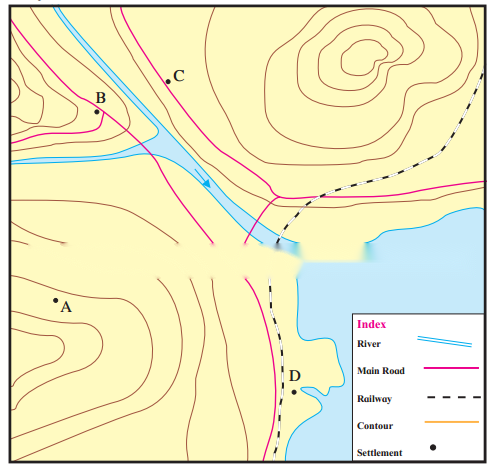
Question 1 Maharashtra Board Solution
Settlement ‘A’ has 5-6 houses and the place does not have other facilities.
Solution & Step-by-Step Answer:
Scattered settlement.

Question 2 Maharashtra Board Solution
‘B’ has a high school, a big market and a small theatre.
Solution & Step-by-Step Answer:
Nucleated settlement.
Question 3 Maharashtra Board Solution
‘C’ has houses, farmers, many shops and small industries.
Solution & Step-by-Step Answer:
Linear settlement.
Question 4 Maharashtra Board Solution
‘D’ has a natural harbour. Many industries have been established here.
Solution & Step-by-Step Answer:
Linear settlement.
Question 5 Maharashtra Board Solution
‘C’ is a settlement that has developed along the road side. Give two reasons of its location here.
Solution & Step-by-Step Answer:
The reasons for settlement ‘C’ developing along the roadside are:

ICT Activity :

With the help of the internet, find the image of your village/city. On that basis, write about the type and characteristics of your settlement.

Class 7 Geography Chapter 10 Human Settlements InText Questions and Answers

Try this

Look at the following picture. Find suitable location for human settlement and show them in picture:
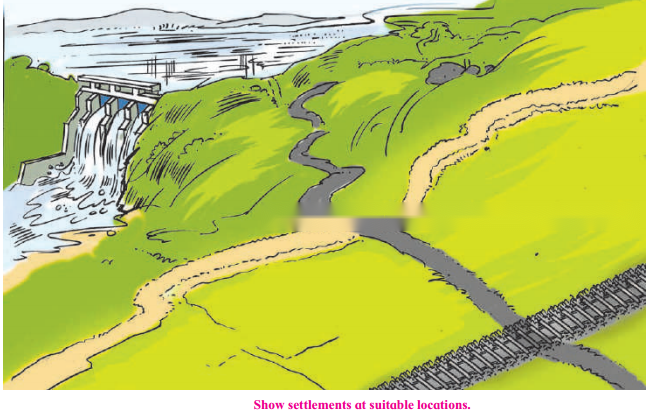
Question 1 Maharashtra Board Solution
Why were the settlements shown at specific places? Why should they be located there? Why can’t they be located in other places?
Solution & Step-by-Step Answer:
(i) Settlement A is located at a place which has direct access to main road as well as railway line which will help in easy movement of passenger as well as goods transport. (ii) Settlement ‘B’ is located on plain land. Its location near a water body will be beneficial for agricultural purpose. (iii) A large portion of the area shown in the picture is a region of uneven topography which is not favourable for human settlement

Can you tell?

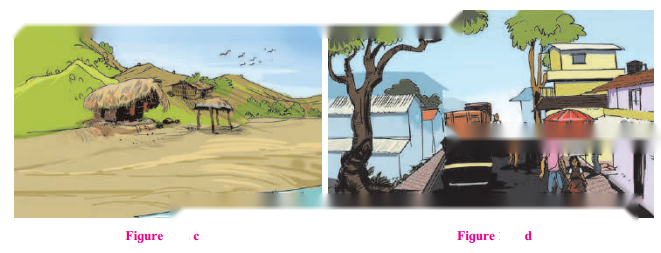
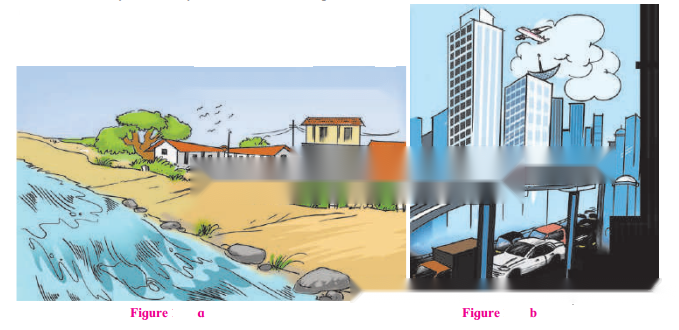
Observe the pictures given in figures (a, b, c, d). Think and answer the following questions:
Question 1 Maharashtra Board Solution
What all can you see in the picture?
Solution & Step-by-Step Answer:
(a) Rural: settlement small houses made of mud are seen with river flowing and farmland. (b) City: Monorail, sky scrapers and lot of traffic with vehicles moving. (c) Tribal hamlet: with sparse1 population. (d) Town: Vehicles moving, vendors, shops and small houses.
Question 2 Maharashtra Board Solution
What are the familiar features?
Solution & Step-by-Step Answer:
All pictures show some type of human settlements.
Question 3 Maharashtra Board Solution
Which picture shows sparse settlements?
Solution & Step-by-Step Answer:
Tribal Hamlet shows sparse population.
Question 4 Maharashtra Board Solution
Which picture shows agriculture?
Solution & Step-by-Step Answer:
Rural settlement shows agriculture.
Question 5 Maharashtra Board Solution
Which picture shows dense settlements?
Solution & Step-by-Step Answer:
City shows dense settlement.
Question 6 Maharashtra Board Solution
Which picture shows high rise building?
Solution & Step-by-Step Answer:
City shows high rise building.
Question 7 Maharashtra Board Solution
From the following, assign a suitable names for each of the pictures: Rural settlement, Tribal hamlet, Town, City.
Solution & Step-by-Step Answer:
(a) Rural settlements (b) City (c) Tribal Hamlet (d) Town.
Question 8 Maharashtra Board Solution
Arrange the picture according to the level of development in the settlements?
Solution & Step-by-Step Answer:
Tribal Hamlets, Rural Settlements, Towns, Cities.

Observe the Fig. and discuss the following questions:

Question 1 Maharashtra Board Solution
What is the difference between the human settlement at ‘A’ and ‘B’ ?
Solution & Step-by-Step Answer:
A is Nucleated settlement & ’B’ is a Linear settlement
Question 2 Maharashtra Board Solution
What is the difference between the settlement at B’ and C ?
Solution & Step-by-Step Answer:
B is Linear settlement & ‘C’ is a type of tribal hamlet.
Question 3 Maharashtra Board Solution
Where do you find less than 2 houses?
Solution & Step-by-Step Answer:
‘C’ is tribal hamlet having less than 2 houses.
Question 4 Maharashtra Board Solution
In what type of settlement do you live?
Solution & Step-by-Step Answer:
I stay in ‘A’ type of settlement. (Students may answer as per their settlement type)

Think about it:

Question 1 Maharashtra Board Solution
Think about the possible processes that take place during the growth and development of settlements. Make a list of such processes.
Solution & Step-by-Step Answer:
(i) Human settlements rise in places with favourable geographic conditions – such a availability of water, conducive climate, fertile land, etc.

(ii) In such settlements the occupations are majorly based on natural resources. These are called rural settlements.

(iii) With the passage of time, other associated occupations in these settlements grow & people of surrounding areas migrate & settle there, this leading to increase in the population of such settlements.

(iv) The proportion of people engaged in primary occupation declines & the importance of secondary & tertiary occupations increases
leading to transformation of rural settlements into urban settlements.

(v) Over a period of time when the population & the necessary amenities increase on a large scale, the urban areas grow into metropolitan cities.

Give it a try:
Question 1 Maharashtra Board Solution
Name the metropolitan cities of India.
Solution & Step-by-Step Answer:
Mumbai, Chennai, Delhi, Kolkata, Hyderabad, Bangalore, Pune, Ahmedabad, etc. are some of the metropolitian cities of India.
Question 2 Maharashtra Board Solution
Identify the type of settlement where you live.
Solution & Step-by-Step Answer:
Students are expected to answer this questions on their own.
Question 3 Maharashtra Board Solution
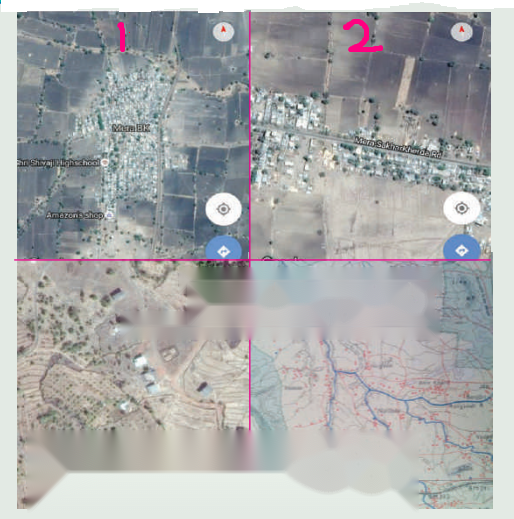
Observe the photographs given below. Identify the type of settlements shown here and write about them.
Solution & Step-by-Step Answer:
Fig. 1 is Urban settlement: Houses, schools shops are close to each other. Densely populated. Fig. 2 is Linear settlement: Houses are built along the Mera Sakharkevda road in three to four rows. Fig. 3 is a Scattered settlements: Houses are far from each other, sparse population, very little transport. In Fig. 4 Linear settlements can be seen along the roads whereas scattered settlements also seen

Make friends with maps:

Observe Fig. and answer the following questions:
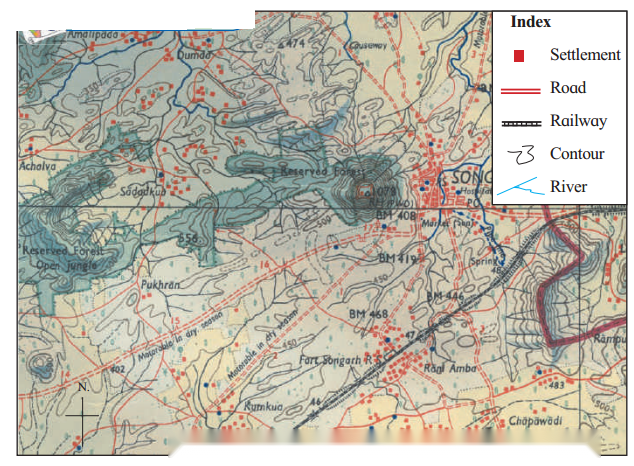
Question 1 Maharashtra Board Solution
Name some of the settlements shown in the map.
Solution & Step-by-Step Answer:
Amalipada, Achalva, Sadadkua, Dumda, Pukhram, Rani Amba, Kumkua, Chapawadi, are some settlements shown in the map.
Question 2 Maharashtra Board Solution
Which of the settlements in the map are in a scattered form?
Solution & Step-by-Step Answer:
Pukhran, Achalva, Chapawadi and Sadadkua have scattered settlements.
Question 3 Maharashtra Board Solution
How are the houses in the settlements along the roads arranged?
Solution & Step-by-Step Answer:
Houses are arranged in a line on both sides of the roads. They are linear settlement.
Question 4 Maharashtra Board Solution
In which settlements are the houses close together? What could be the reason behind this density?
Solution & Step-by-Step Answer:
The houses in Sangarh are close together. Reasons:
Question 5 Maharashtra Board Solution
Can you now classify the settlements on the basis of these pattern?
Solution & Step-by-Step Answer:

Class 7 Geography Chapter 10 Human SettlementsAdditional Important Questions and Answers

Fill in the blanks:

Question 1 Maharashtra Board Solution
Human settlements flourished at places with favorable ________ conditions.
Solution & Step-by-Step Answer:
geographic
Question 2 Maharashtra Board Solution
In the early settlements, the occupation of the people were dependent on the locally available ________ resources.
Solution & Step-by-Step Answer:
natural
Question 3 Maharashtra Board Solution
People along the sea coast are engaged in _______.
Solution & Step-by-Step Answer:
fishing
Question 4 Maharashtra Board Solution
Settlements have provided man with _______.
Solution & Step-by-Step Answer:
stability
Question 5 Maharashtra Board Solution
In ______ settlements, houses are few and far from each other.
Solution & Step-by-Step Answer:
scattered²
Question 6 Maharashtra Board Solution
Increase in the population of rural settlements is the beginning of _________.
Solution & Step-by-Step Answer:
urbanization
Question 7 Maharashtra Board Solution
____ settlements are seen along roads, railways, rivers, sea coasts and foot hill regions, etc.
Solution & Step-by-Step Answer:
Linear
Question 8 Maharashtra Board Solution
In the deserts of Rajasthan we find _______ settlements.
Solution & Step-by-Step Answer:
nucleated
Question 9 Maharashtra Board Solution
_______ is the first step towards a stable life in human history.
Solution & Step-by-Step Answer:
Rural settlement
Question 10 Maharashtra Board Solution
Life in urban settlement is more _____.
Solution & Step-by-Step Answer:
dynamic
Question 11 Maharashtra Board Solution
_______ settlements have limited population as in small hamlets.
Solution & Step-by-Step Answer:
Scattered

Complete the following sentence:

Question 1 Maharashtra Board Solution
Human settlement flourished at places with favourable geographical conditions such as ______.
Solution & Step-by-Step Answer:
availability of water, a conducive climate, fertile land, etc.
Question 2 Maharashtra Board Solution
When rural area converts into urban area, the importance of secondary and tertiary occupations increases and _______.
Solution & Step-by-Step Answer:
the proportion of people engaged in primary occupations decline
Question 3 Maharashtra Board Solution
If the population and the necessary amenities increase on a large scale ______.
Solution & Step-by-Step Answer:
the urban areas grow into metropolitan cities.
Question 4 Maharashtra Board Solution
Patterns of human settlements evolve in _______.
Solution & Step-by-Step Answer:
accordance with the natural conditions
Question 5 Maharashtra Board Solution
Increase in population of rural settlements is ______.
Solution & Step-by-Step Answer:
is the beginning of urbanization
Question 6 Maharashtra Board Solution
The day to day food requirement of the urban population is _______.
Solution & Step-by-Step Answer:
fulfilled by rural settlements
Question 7 Maharashtra Board Solution
In the deserts of Rajasthan we find _______.
Solution & Step-by-Step Answer:
nucleated settlements near assured sources of water
Question 8 Maharashtra Board Solution
Linear settlements are seen along _______.
Solution & Step-by-Step Answer:
roads, railways, rivers, sea coasts and in foothill regions
Question 9 Maharashtra Board Solution
There are large scale correlations _______.
Solution & Step-by-Step Answer:
between rural and urban settlements
Question 10 Maharashtra Board Solution
Urban settlements have evolved through _______.
Solution & Step-by-Step Answer:
the expansion² and growth of rural settlements

Match the column:

Question 1 Maharashtra Board Solution

Column ‘A’

Column ‘B’

(1) Limited population

(a) Linear settlements

(2) Tribal people

(b) Nucleated settlements

(3) Have better social life

(c) Scattered settlements

(4) On National or State highways

(d) Hamlets

Solution & Step-by-Step Answer:

1 – c
2 – d
3 – b
4 – a

Identify the types of human settlements from the following statements:

Question 1 Maharashtra Board Solution
These settlements are closer to nature, they are free from pollution.
Solution & Step-by-Step Answer:
Scattered settlements.
Question 2 Maharashtra Board Solution
Settlements found along the coastal tracts, major rivers and national or state highways.
Solution & Step-by-Step Answer:
Linear settlements.
Question 3 Maharashtra Board Solution
These settlements are found in fertile plains, transport hubs and mining centres, commercial centres.
Solution & Step-by-Step Answer:
Nucleated settlements.
Question 4 Maharashtra Board Solution
These settlements have limited population and inadequate facilities.
Solution & Step-by-Step Answer:
Scattered settlements.

Answer in one or two sentences:

Question 1 Maharashtra Board Solution
Where do human settlements flourish?
Solution & Step-by-Step Answer:
Human settlements flourish at places with favourable geographic conditions – such as availability of water, a conducive climate, fertile land, etc.
Question 2 Maharashtra Board Solution
What did forest dwellers or tribal people use for their livelihood?
Solution & Step-by-Step Answer:
Forest dwellers or tribal people used forest produce for their livelihood.
Question 3 Maharashtra Board Solution
Where do the farmer & his family live?
Solution & Step-by-Step Answer:
They live in a house built in or near the fields.
Question 4 Maharashtra Board Solution
Which settlements are called rural settlements?
Solution & Step-by-Step Answer:
The settlements where the original occupation of the majority of the people are based on natural resources are called rural settlements.
Question 5 Maharashtra Board Solution
Wnen do the urban areas grow into metropolitan cities?
Solution & Step-by-Step Answer:
When the population and the necessary amenities increase on a large scale, the urban areas grow into metropolitan cities.
Question 6 Maharashtra Board Solution
Where do we find scattered settlements?
Solution & Step-by-Step Answer:
Scattered settlements are found in the areas of high relief, dense forests, grasslands, hot deserts and extensive agricultural lands.
Question 7 Maharashtra Board Solution
Where do we find nucleated settlements?
Solution & Step-by-Step Answer:
Nucleated settlements are generally close to water sources like brooks, rivulets, rivers, lakes reservoirs, etc.
Question 8 Maharashtra Board Solution
Where do we see Linear settlements?
Solution & Step-by-Step Answer:
Linear settlements are seen along roads, railways, rivers, sea coasts, in foothill regions, etc.
Question 9 Maharashtra Board Solution
What makes a city a metropolis?
Solution & Step-by-Step Answer:
A metropolis is a large city or urban area, which is a significant economic, political and cultural center for a country or region and an important hub for regional or international connections, commerce and communications.

Answer in one or two sentences:

Question 1 Maharashtra Board Solution
Where do human settlements flourish?
Solution & Step-by-Step Answer:
Human settlements flourish at places with favourable geographic conditions – such as availability of water, a conducive climate, fertile land, etc.
Question 2 Maharashtra Board Solution
What did forest dwellers or tribal people use for their livelihood?
Solution & Step-by-Step Answer:
Forest dwellers or tribal people used forest produce for their livelihood.
Question 3 Maharashtra Board Solution
Where do the farmer & his family live?
Solution & Step-by-Step Answer:
They live in a house built in or near the fields.
Question 4 Maharashtra Board Solution
Which settlements are called rural settlements?
Solution & Step-by-Step Answer:
The settlements where the original occupation of the majority of the people are based on natural resources are called rural settlements.
Question 5 Maharashtra Board Solution
When do the urban areas grow into metropolitan cities?
Solution & Step-by-Step Answer:
When the population and the necessary amenities increase on a large scale, the urban areas grow into metropolitan cities.
Question 6 Maharashtra Board Solution
Where do we find scattered settlements?
Solution & Step-by-Step Answer:
Scattered settlements are found in the areas of high relief, dense forests, grasslands, hot deserts and extensive agricultural lands.
Question 7 Maharashtra Board Solution
Where do we find nucleated settlements?
Solution & Step-by-Step Answer:
Nucleated settlements are generally close to water sources like brooks, rivulets, rivers, lakes reservoirs, etc.
Question 8 Maharashtra Board Solution
Where do we see Linear settlements?
Solution & Step-by-Step Answer:
Linear settlements are seen along roads, railways, rivers, sea coasts, in foothill regions, etc.
Question 9 Maharashtra Board Solution
What makes a city a metropolis?
Solution & Step-by-Step Answer:
A metropolis is a large city or urban area, which is a significant economic, political and cultural center for a country or region and an important hub for regional or international connections, commerce and communications.

Answer in short:

Question 1 Maharashtra Board Solution
Distinguish between Scattered Settlements & Linear Settlements.
Solution & Step-by-Step Answer:

Scattered Settlements

Linear Settlements

(i) In scattered settlements houses are far away from each other.
(ii) There settlements have limited population as in small hamlets.
(iii) These settlements are found in the areas of high relief, dense forest, grasslands, hot deserts and extensive agricultural land

(i) In Linear settlements houses are spread along a straight line.
(ii) These settlements have comparatively more population.
(iii) These settlements grow along the coastal tracts, major rivers, national or state highways, railways in the foothill regions, etc.

Question 2 Maharashtra Board Solution
Describe Linear Settlements.
Solution & Step-by-Step Answer:
Question 3 Maharashtra Board Solution
What leads to transformation of rural settlement into urban settlement?
Solution & Step-by-Step Answer:
(i) The settlements where the original occupations of the majority of the people are based on natural resources are called rural settlements. Agriculture, fishery, etc. are some of these occupation

(ii) With the passage of time other associated occupations also develop gradually in these rural settlement.

(iii) As a result people from surrounding areas migrate & settle there leading to an increase in rural population.

(iv) Houses are built & different facilities are developed for the growing population.

(v) Importance of secondary & tertiary occupations increases & the proportion of primary occupations declines.

This process leads to the transformation of rural settlement into urban settlements

Question 4 Maharashtra Board Solution
Describe man’s future plans in terms of settlements.
Solution & Step-by-Step Answer: