Maharashtra State Board Class 8 History Solutions Chapter 8 Civil Disobedience Movement
Class 8 History Chapter 8 Civil Disobedience Movement Textbook Questions and Answers
1. Rewrite the statements by choosing the appropriate options :
(Mahatma Gandhi, Khuda-i-Khidmatgar, [ Ramsay Mac Donald, Sarojini Naidu)
2. Explain the following statements with reasons :
Therefore, he was court-martialled and severely punished.
Therefore, Martial law was imposed in Solapur by the government.
Thus, the deliberation in the First Round Table Conference proved to be meaningless.
3. Answer the following questions in 25 to 30 words :
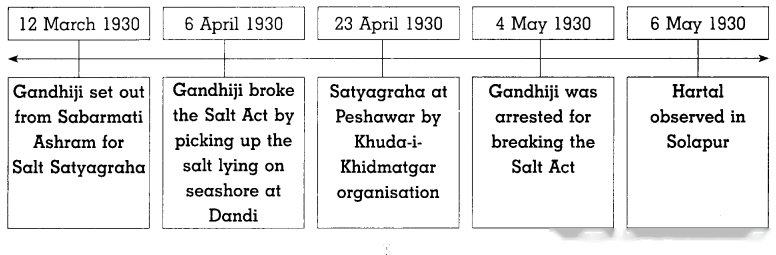
4. Complete the following timeline of Civil Disobedience Movement:

Do you Know?
Features of the Civil Disobedience Movement :
1. All the movements, till now, were limited only to urban areas. But this movement became a nationwide movement. People from rural areas registered their participation. Women also took part in large numbers. Kasturba Gandhi, Kamladevi Chattopadhyay, Ayantikaba I Gokha le, Lilavati Munshi, Hansaben Mehta led the satyagraha.
2. This movement was based on complete nonviolence. The British Government was trying to greatly suppress the movement, but the people protested unarmed. Due to this, the Indian people became fearless.
project:
Question 2
Maharashtra Board Solution
The plot on an outline map of India, the places mentioned in the chapter where the Civil Disobedience Movement took place. |
Class 8 History Chapter 8 Civil Disobedience Movement Additional Important Questions and
Rewrite the statements by choosing the appropriate options :
Question 1
Maharashtra Board Solution
After the re
Solution & Step-by-Step Answer:
of Complete Independence was passed in Lahore session, Gandhiji decided to launch ……………. Movement. (a) Home Rule (b) Non-co-operation (c) Quit India (d) Civil Disobedience
Solution & Step-by-Step Answer:
(d) Civil Disobedience
Question 2
Maharashtra Board Solution
During Civil Disobedience Movement, government imposed Martial law in …………….. (a) Peshawar (b) Solapur (c) Pune (d) Mumbai
Solution & Step-by-Step Answer:
(b) Solapur
Question 3
Maharashtra Board Solution
Gandhiji withdrew the Civil Disobedience Movement in …………….. (a) April 1934 (b) March 1930 (c) November 1932 (d) May 1933
Solution & Step-by-Step Answer:
(a) April 1934
Question 4
Maharashtra Board Solution
Gandhiji broke the Salt Act at …………….. (a) Dandi (b) Peshawar (c) Dharasana (d) Yerwada
Solution & Step-by-Step Answer:
(a) Dandi
Question 5
Maharashtra Board Solution
The British government gave orders to regiment in Peshawar to ……………. open fire on the satyagrahis. (a) Garhwal (b) Sikh (c) Maratha (d) Rajput
Solution & Step-by-Step Answer:
(a) Garhwal
Name the following :
Question 1
Maharashtra Board Solution
Follower of Gandhiji known as Frontier Gandhi.
Solution & Step-by-Step Answer:
Khan Abdul Gafar Khan
Question 2
Maharashtra Board Solution
Volunteer who died in firing at Solapur satyagraha.
Solution & Step-by-Step Answer:
Shankar Shivdare
Question 3
Maharashtra Board Solution
Laid down his life in front of the truck boycotting foreign goods in Mumbai.
Solution & Step-by-Step Answer:
Babu Genu Said
Question 4
Maharashtra Board Solution
Attended the Second Round Table Conference as representative of Dalits.
Solution & Step-by-Step Answer:
Dr. Babasaheb Ambedkar.
Answer the following questions in one sentence :
Question 1
Maharashtra Board Solution
What was the objective of Gandhiji in starting the Civil Disobedience?
Solution & Step-by-Step Answer:
The objective of Gandhiji was to break the oppressive and unjust laws of the British Government through peace and Satyagraha.
Question 2
Maharashtra Board Solution
From which place and when did the Dandi March start?
Solution & Step-by-Step Answer:
The Dandi March started from Sabarmati Ashram in Ahmedabad on 12 March, 1930.
Question 3
Maharashtra Board Solution
Name the leaders present at the First Round Table Conference.
Solution & Step-by-Step Answer:
Dr. Babasaheb Ambedkar, Sir Tej Bahadur Sapru, Barrister Jinnah were the leaders present at the First Round Table Conference.
Question 4
Maharashtra Board Solution
Which issues were discussed in the First Round Table Conference?
Solution & Step-by-Step Answer:
The issues like Responsible Government at centre and establishment of Federal State in India were discussed.
Question 5
Maharashtra Board Solution
What decision was made in the Poona Pact?
Solution & Step-by-Step Answer:
According to the Poona Pact, separate electorates for the Dalits was cancelled and a provision for reserved seats was made.
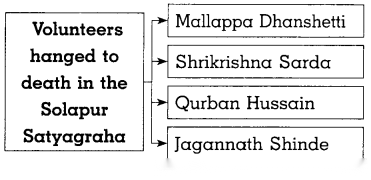
Do as Directed : Complete the graphical presentation :
Question 1
Maharashtra Board Solution
Solution & Step-by-Step Answer:
Question 2
Maharashtra Board Solution
Solution & Step-by-Step Answer:
Question 3
Maharashtra Board Solution
Solution & Step-by-Step Answer:
Write short notes :
Question 1
Maharashtra Board Solution
Gandhi-Irwin Pact :
Solution & Step-by-Step Answer:
1. On the appeal of the Prime Minister, the Viceroy released Gandhiji and other political leaders from prison. 2. In this conducive atmosphere, a pact was signed between Gandhiji and Viceroy Irwin. It is known as Gandhi-Irwin Pact.
Question 2
Maharashtra Board Solution
Second Round Table Conference :
Solution & Step-by-Step Answer:
Question 3
Maharashtra Board Solution
Poona Pact :
Solution & Step-by-Step Answer:
Question 4
Maharashtra Board Solution
The Round Table Conference :
Solution & Step-by-Step Answer:
Answer the following questions in 25 to 30 words :
Question 1
Maharashtra Board Solution
Write about the sacrifice of Babu Genu.
Solution & Step-by-Step Answer:
Question 2
Maharashtra Board Solution
Write features of Civil Disobedience Movement.
Solution & Step-by-Step Answer:
The Civil Disobedience Movement launched in 1930 had the following features :
Question 3
Maharashtra Board Solution
What suppressive measures were adopted by the British government after the Second Round Table Conference?
Solution & Step-by-Step Answer:
Explain the following statements with reasons :
Question 1
Maharashtra Board Solution
Gandhiji was arrested on 4th May 1930.
Solution & Step-by-Step Answer:
The British government found itself in a difficult situation. So, Gandhiji was arrested on 4th May 1930.
Question 2
Maharashtra Board Solution
Gandhiji returned disappointed from the Second Round Table Conference.
Solution & Step-by-Step Answer:
Read the passage and answer the questions given below: Passage:
Question 1
Maharashtra Board Solution
Who led the Dharasana Satyagraha?
Solution & Step-by-Step Answer:
Sarojini Naidu led the Dharasana Satyagraha in Gujarat.
Question 2
Maharashtra Board Solution
At which places in Maharashtra did Salt Satyagraha take place?
Solution & Step-by-Step Answer:
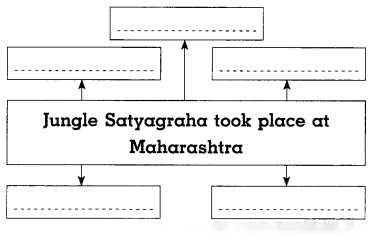
The Salt Satyagraha in Maharashtra took place at Wadala, Malvan and Shiroda.
Question 3
Maharashtra Board Solution
Give a brief account of the Dharasana Satyagraha.
Solution & Step-by-Step Answer:
Answer the following in detail:
Question 1
Maharashtra Board Solution
Explain the extensive nature of Civil Disobedience Movement.
Solution & Step-by-Step Answer:
Question 2
Maharashtra Board Solution
Write information of Dandi March.
Solution & Step-by-Step Answer:
Question 3
Maharashtra Board Solution
Do you feel Gandhiji’s Civil Disobedience technique can be used in present times?
Solution & Step-by-Step Answer:
|