Latest Maharashtra State Board (SSC & HSC) 2026-27 Syllabus Digest & Solutions Updated!
Class 8Science & Technology2026-27 Syllabus

Chapter 1 Living World and Classification of Microbes Solutions

Complete Maharashtra State Board Balbharati & Yuvakbharati textbook solutions for Chapter 1 Living World and Classification of Microbes. Step-by-step solved exercises, numerical problems, and digest answers.

37 Solved Questions12 Diagrams2557 words

Maharashtra State Board Class 8 Science Solutions Chapter 1 Living World and Classification of Microbes

Class 8 Science Chapter 1 Living World and Classification of Microbes Textbook Questions and Answers

1. Use Whittaker method to classify bacteria, protozoa, fungi, algae, prokaryotic, eukaryotic, microbes.

Living World And Classification Of Microbes Exercises  Question 1.
Use Whittaker method to classify bacteria, protozoa, fungi, algae, prokaryotic, eukaryotic, microbes.
Answer:

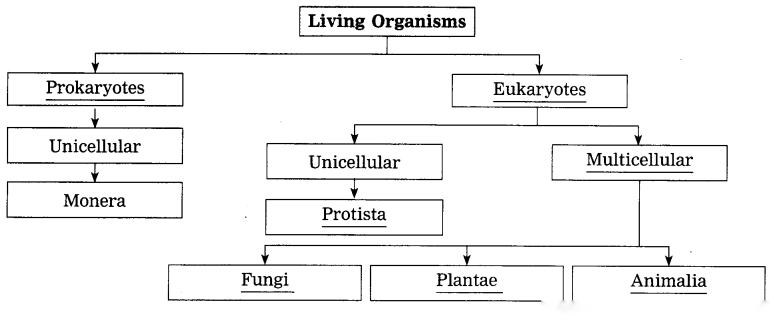
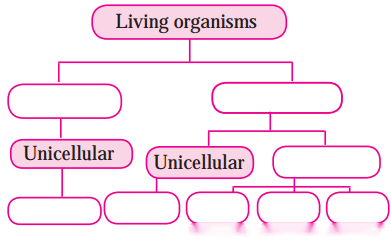
2.  Complete the five kingdom method of classification using-living organism, prokaryotes, eukaryotes, multicellular, unicellular, protista, animals, plants, fungi.

Living World And Classification Of MicrobesQuestion 1.
Complete the five kingdom method of classification using-living organism, prokaryotes, eukaryotes, multicellular, unicellular, protista, animals, plants, fungi.

Answer:
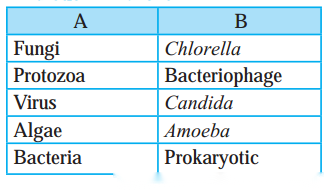
3. Find out my partner
Question 1 Maharashtra Board Solution
Solution & Step-by-Step Answer:

A

B

1. Fungi

Candida

2. Protozoa

Amoeba

3. Virus

Bacteriophage

4. Algae

Chlorella

5. Bacteria

Prokaryotic.

4. State whether the following statements are True or False. Explain your statement:

Question a.
Lactobacilli are harmful bacteria.
Answer:
False.
Explanation Lactobacilli are useful bacteria. They are used for curdling the milk. They are also used for preparing variety of milk products.

Question b.
Cell wall of fungi is made up of chitin.
Answer:
True.
Explanation The cell wall of the plants is made up of cellulose while the cell wall of fungi is made up of complex sugar called chitin. Inside the fungal cell wall there is cytoplasm which contains many nuclei.

Question d.
Organ of locomotion in amoeba is pseudopodia.
Answer:
True.
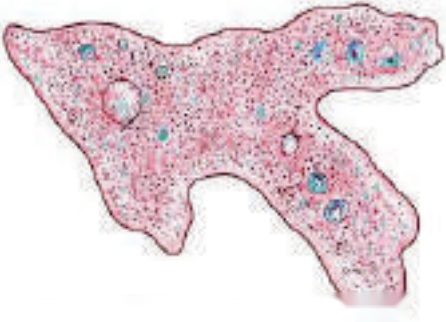
Explanation Amoeba is a protozoan, primitive organism which possesses pseudopodia as the organ for locomotion.

Question e.
Tomato wilt is a viral disease.
Answer:
True.
Explanation: Tomato wilt is a viral disease. These viruses are able to infect only plant cells.

5. Give answers

Question a.
State the merits of Whittaker’s method of classification.
Answer:
For the answer of Merits of Whittaker’s method refer to point I of answer given on this Digest’s page no. 11; under “Use your brain power!”

Question b.
Write the characteristics of viruses.
Answer:
1. Viruses are extremely minute of the size range of 10 nrn to 100 nm. They are on the borderline of living and non-living. They are 10 to 100 times smaller than bacteria and are visible only through the electron microscope.

2. Though they are not considered as living, they can make replica of their own.
3. They exist in the form of independent particles. They are long molecules of DNA or RNA which are covered by a protein coat.

4. Their survival is possible only inside the living plant or animal cells. When they infect the host cells, they produce their own proteins with the machinery of the host cell. These proteins form many replicas of the infecting virus.

5. This infection destroys the host cell and the virus replicas are released. These free replicas re-infect the other adjoining cells of the host.
6. Most of the viruses are pathogenic, they cause diseases in plants and animals.

Question c.
Explain the nutrition in fungi.
Answer:
Most of the fungi are saprophytic in their nutrition. They absorb the nourishment from dead and decaying matter. By taking the organic matter from dead bodies of plants and animals, fungi survive. In this process they degrade the organic matter completely.

Question d.
Which living organisms are included in the kingdom Monera?
Answer:

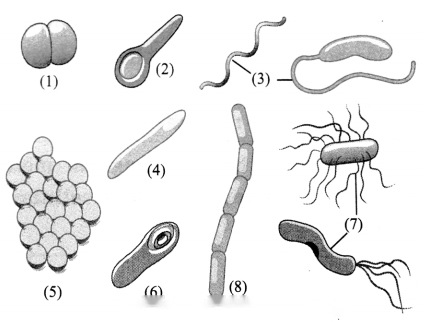
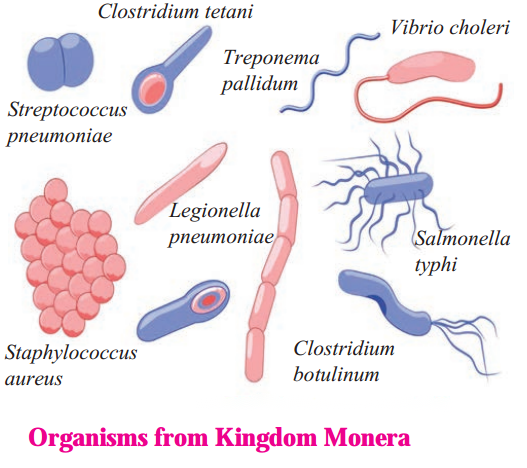
E.g. Bacteria Clostridium titani, Vibrio choleri, Treponema pallidum, Streptococcus pneumoniae, Legionella pneumoniae, Salmonella typhi, Staphylococcus aureus, Clostridium botulinum.

6. Who am I?

Question a.
I don’t have true nucleus, cell organelles or plasma membrane.
Answer:
Microbe from Monera

Question b.
I have nucleus and membrane bound cell organelles.
Answer:
Protozoan from Protista/I am any one of Eukaryote

Question c.
I live on decaying organic matter.
Answer:
Fungus

Question d.
I reproduce mainly by cell division. (*Binary fission)
Answer:
Bacteria and some Protozoa.

Question e.
I can produce my replica.
Answer:
Virus

Question f.
I am green, but don’t have organs.
Answer:
Algae

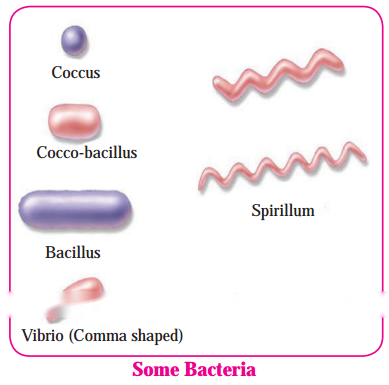
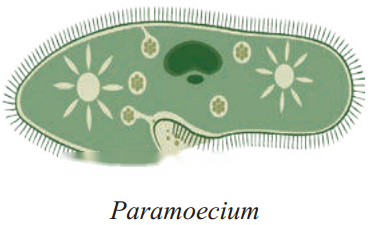
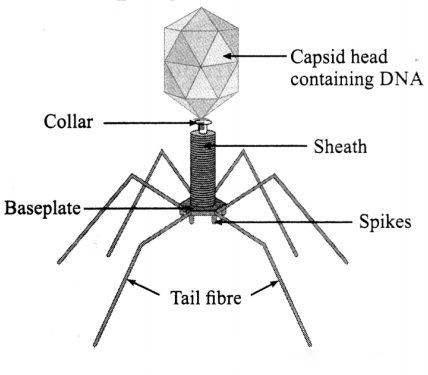
7. Draw neat and labelled diagrams.

Question a.
Different types of bacteria:
Answer:
Question b.
Paramoecium:
Answer:
Question c.
Bacteriophage
Answer:
8. Arrange the following in ascending order of size Bacteria, Fungi, Viruses, Algae.

Question a.
Arrange the following ¡n ascending order of size Bacteria, Fungi, Viruses, Algae.
Answer:
Viruses, Bacteria, Fungi, Algae.

Project:

Question 1 Maharashtra Board Solution
Prepare a chart showing infectious bacteria and the diseases caused by them.

Question 2 Maharashtra Board Solution
Visit a nearby pathology lab. Get the information about pathogenic microbes, methods to observe them, different microscopes from the technicians there.

Class 8 Science Chapter 1 Living World and Classification of Microbes Additional Important Questions and

Solution & Step-by-Step Answer:
s

Rewrite the sentences after filling the blanks:

Question 1 Maharashtra Board Solution
The process of dividing living organism into groups and subgroups is called …………….
Solution & Step-by-Step Answer:
block bg-white dark:bg-slate-900/80 border-l-4 border-emerald-500 rounded-r-xl p-5 my-3 shadow-xs border border-slate-200/60 dark:border-slate-800">
Solution & Step-by-Step Answer:
Biological classification.
Question 2 Maharashtra Board Solution
Organisms with cell wall but not able to perform photosynthesis are called …………….
Solution & Step-by-Step Answer:
Fungi.
Question 3 Maharashtra Board Solution
Most of the fungi are …………….
Solution & Step-by-Step Answer:
saprotrophic.
Question 4 Maharashtra Board Solution
Viruses can be seen only with …………….
Solution & Step-by-Step Answer:
electron microscope.
Question 5 Maharashtra Board Solution
…………… viruses attack bacteria.
Solution & Step-by-Step Answer:
Bacteriophage
Question 6 Maharashtra Board Solution
In fungi the cell wall is made up of j tough and complex sugar called …………….
Solution & Step-by-Step Answer:
‘Chitin’.

State whether the following statements are True or False. Explain your statement:

Question 1 Maharashtra Board Solution
Plasmodium causes dysentery.
Solution & Step-by-Step Answer:
False. Explanation Plasmodium causes malaria. Entamoeba histolytica causes amoebic dysentery or amoebiasis.

Find out my partner

Question 1 Maharashtra Board Solution

Scientist

Pattern of classification

1. Carl Linnaeus

(a) 5 groups of living organisms

2. Haeckel

(b) 2 groups as Prokaryotes and Eukaryotes

3. Chatton

(c) 4 groups as Monera, Protista, Plants and Animals

4. Kopland

(d) 3 kingdoms – Protista, Plants and Animals.

5. Whittaker

(e) 2 kingdoms of living organisms

Solution & Step-by-Step Answer:

Scientist

Pattern of classification

1. Carl Linnaeus

(e) 2 kingdoms of living organisms

2. Haeckel

(d) 3 kingdoms – Protista, Plants and Animals.

3. Chatton

(b) 2 groups as Prokaryotes and Eukaryotes

4. Kopland

(c) 4 groups as Monera, Protista, Plants and Animals

5. Whittaker

(a) 5 groups of living organisms

Question 2 Maharashtra Board Solution

Living organism

Group

1. Clostridium titani

(a) Heterotrophic Protista

2. Paramoecium

(b) Fungi

3. Chlamydomonas

(c) Bacteria belonging to Monera

4. Baker’s yeast

(d) Algae

(e) Virus

Solution & Step-by-Step Answer:

Living organism

Group

1. Clostridium titani

(c) Bacteria belonging to Monera

2. Paramoecium

(a) Heterotrophic Protista

3. Chlamydomonas

(d) Algae

4. Baker’s yeast

((b) Fungi

(e) Virus

Question 3 Maharashtra Board Solution

Microbes

Size

1. Virus

(a) 1 μm to 10 μm

2. Algae

(b) 200 μm

3. Protozoa

(c) 10 μm to 100μm

4. Bacteria

(d) 10 nm to 100 nm

Solution & Step-by-Step Answer:

Microbes

Size

1. Virus

(d) 10 nm to 100 nm

2. Algae

(c) 10 μm to 100 μm

3. Protozoa

(b) 200 μm

4. Bacteria

(a) 1 μm to 10 μm

Name the following/ Give examples

Question 1 Maharashtra Board Solution
Three organs of locomotion in Protista
Solution & Step-by-Step Answer:
Question 2 Maharashtra Board Solution
Two autotrophic Protista
Solution & Step-by-Step Answer:
Question 3 Maharashtra Board Solution
Institute in India which is involved in research on viruses
Solution & Step-by-Step Answer:
National Institute of Virology, Pune
Question 4 Maharashtra Board Solution
Two methods of asexual reproduction in Fungi
Solution & Step-by-Step Answer:
Question 5 Maharashtra Board Solution
Two pathogenic protozoans and the diseases caused by them
Solution & Step-by-Step Answer:

Answer the following questions in one sentence:

Question 1 Maharashtra Board Solution
What are the types of living organisms according to their lifestyle?
Solution & Step-by-Step Answer:
Producers, consumers and decomposers are the types of living organisms according to their lifestyle.
Question 2 Maharashtra Board Solution
What are the characteristics of prokaryotic cells?
Solution & Step-by-Step Answer:
Absence of nuclear membrane, well- formed nucleus and lack of cell organelles are the characteristics of the prokaryotic cells.
Question 3 Maharashtra Board Solution
When do virus destroy the host cells?
Solution & Step-by-Step Answer:
After synthesising their own proteins and creating numerous replica of their own type, then the virus destroys the host cells.

Give answers:

Question 1 Maharashtra Board Solution
Which criteria were considered for classification method of Whittaker?
Solution & Step-by-Step Answer:
The criteria considered for classification by Whittaker are as follows: 1. Complexity of cell structure: Whether the cells of the organisms are prokaryotic or eukaryotic.

2. Complexity of organisms Whether the organisms are unicellular or multicellular is considered.

3. Mode of nutrition Whether the organism is autotrophic and is performing photosynthesis on its own or it is heterotrophic is considered. Plants are autotrophic, fungi are saprotrophic while animals use food from plants or other animals and hence they are heterotrophic.

4. Lifestyle According to nutrition, every living organism is at certain trophic level. This is called lifestyle. Plants are producers, animals are consumers while fungi are decomposers.

5. Phylogenetic relationship When the evolution proceeded gradually, there was transition from prokaryotes to eukaryotes, unicellular to multicellular. In this order the different groups of living organisms were evolved. This is known as phylogenetic relationship.

Use your brain power!
(Textbook page 3)

Question 1 Maharashtra Board Solution
Explain merits and demerits of Whittaker’s classification.
Solution & Step-by-Step Answer:
I. Merits of Whittaker’s classification:

II. Demerits of Whittaker’s method of classification:

1. Some organisms belonging to Monera and Protista have ability to perform photosynthesis. Thus they show mode of nutrition as autotrophic, while others are heterotrophic. Similarly some monerans have cell wall and some Protists also have cell wall. This becomes confusing during their placement.

2. In kingdom Protista, organisms show varied characteristics. In spite of this they are placed together.

3. In kingdoms, Plantae, Animalia and Fungi the organisms having primitive characters and were initial examples during evolution are not included. E.g. In Kingdom Animalia, amoeba is not included though it is said to be unicellular animal. This creates confusion.

4. Similarly if algae are unicellular, they are placed in kingdom Protista and if they are multicellular they are placed in kingdom Plantae. In reality, unicellular and multicellular algae both show much similarity. But due to Whittaker’s classification system they are placed away from each other.

5. Species of algae such as Chlorella, Chlamydomonas are not included in Kingdom Protista.

6. Viruses are not included in any of the kingdoms by Whittaker. Their classification has become a point of debate among the biologists.

Write short notes:

Question 1 Maharashtra Board Solution
Characteristics of Fungi.
Solution & Step-by-Step Answer:
Question 2 Maharashtra Board Solution
Characteristics of Bacteria.
Solution & Step-by-Step Answer:
Question 3 Maharashtra Board Solution
Characteristics of Protozoa.
Solution & Step-by-Step Answer:

E.g. Euglena is autotrophic as it does photosynthesis with the help of 5 chloroplasts present in its body. Amoeba and Paramoecium are heterotrophic and free living seen in contaminated water.

Complete the paragraph using the words given in the brackets

[Monera, Euglena, autotrophic, cell organelles, chitin, nuclear, prokaryotic, viruses, replicas, saprotrophic, viral particles]

In Kingdom ……….. bacteria were included but not ………….. Viruses are on the border line of living and non-living. Do we really call them living? If they are making …………. of their own type, are they not considered as living? Throughout the world they spread hazardous epidemics. Antibiotics do not act on ………… However, bacteria can be controlled by antibiotics. All the living organisms belonging to Monera are with …………… cell. They do not have ………….. membrane and neither they have ……………… But a nice nucleus is seen in …………….., Euglena is ………… protist. The fungi with cell wall of …………….. are ………….. in their mode of nutrition.
Answer:
In KingdomMonerabacteria were included but notviruses.Viruses are on the border line of living and non-living. Do we really call them living? If they are makingreplicasof their own type, are they not considered as living? Throughout the world they spread hazardous epidemics. Antibiotics do not act onviral particles.However, bacteria can be controlled by antibiotics. All the living organisms belonging to Monera are withprokaryoticcell. They do not havenuclearmembrane and neither they havecell organelles. But a nice nucleus is seen inEuglena. Euglena isautotrophicprotist. The fungi with cell wall ofchitinaresaprotrophicin their mode of nutrition.

Complete the chart:

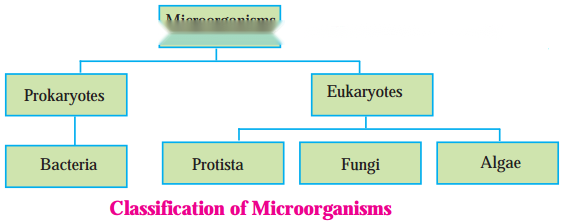
Question 1 Maharashtra Board Solution
Draw a chart showing different types of Microorganisms.
Solution & Step-by-Step Answer:

Draw neat and labelled diagrams:

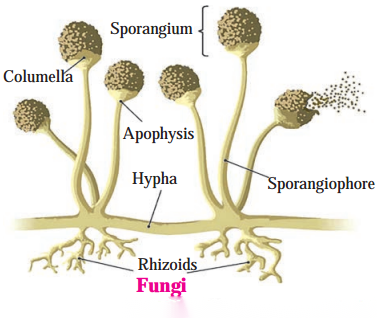
Question 1 Maharashtra Board Solution
Fungi:
Solution & Step-by-Step Answer:

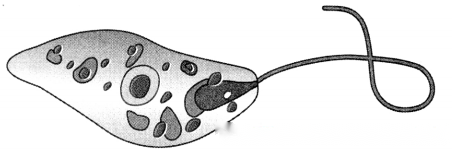
Question 2 Maharashtra Board Solution
Euglena:
Solution & Step-by-Step Answer:

Question 3 Maharashtra Board Solution
Amoeba:
Solution & Step-by-Step Answer:

Question 4 Maharashtra Board Solution
Correctly label the various organisms shown in the Kingdom Monera:
Solution & Step-by-Step Answer:

Activity-based questions

1. Try this:
Activity Take a small drop of curd or buttermilk on a clean glass slide. Dilute it with a little water. Carefully keep a coverslip. Observe it under high power of compound microscope. What did you see?
Answer:
In the slide we can see Lactobacilli \ bacteria.

2. Try this:
Activity Prepare a temporary mount of one drop of pond water on a glass slide. Observe it under low power and high power microscope.
Answer:
The drop on the slide shows motile microscopic organisms which have irregular shape. They are amoeba.

3. Try this:
Activity Take a moist piece of bread or bhakri and keep it in a container with lid for 2-3 days. After 2-3 days a fine cotton thread like tuft is found growing on the surface of the bread. Prepare a temporary mount of few threads from this culture and observe it under the microscope.
Answer:
Upon observation of thread like structures the fungal hyphae ( fibre like body) are seen.

MCQs based on experiments:

Choose the appropriate alternative of the following:

Experiment 1: To observe lactobacilli in curd/buttermilk.

Question 1 Maharashtra Board Solution
Which of the following bacterium is used to make curds from milk? (a) Streptococcus (b) Lactobacillus (c) Staphylococcus (d) Clostridium
Solution & Step-by-Step Answer:
(b) Lactobacillus
Question 2 Maharashtra Board Solution
In which kingdom is Lactobacillus included? (a) Monera (b) Protista (c) Fungi (d) Plantae
Solution & Step-by-Step Answer:
(a) Monera
Question 3 Maharashtra Board Solution
Which is the other organism that has been added in kingdom Monera in addition to bacteria? (a) Virus (b) Blue-green algae (c) Fungi (d) Protozoa
Solution & Step-by-Step Answer:
(b) Blue-green algae

Experiment 2: To observe fungus on the bread

Question 1 Maharashtra Board Solution
In which kingdom is fungus growing on the bread included? (a) Fungi (b) Protozoa (c) Monera (d) Protista
Solution & Step-by-Step Answer:
(a) Fungi
Question 2 Maharashtra Board Solution
What are dark coloured particles which are seen when the fungus is growing on the bread? (a) Sporangiophore (b) Rhizoids (c) spores d) Columella
Solution & Step-by-Step Answer:
(c) spores
Question 3 Maharashtra Board Solution
Why is there growth of fungus on all the stale food? (a) Fungus has affinity for food. (b) Fungus grows on decaying organic matter. (c) As food is open, the fungus drops on it and starts growing. (d) None of the alternative is correct.
Solution & Step-by-Step Answer:
(b) Fungus grows on decaying organic matter.