Maharashtra State Board Class 8 Science Solutions Chapter 3 Force and Pressure
Class 8 Science Chapter 3 Force and Pressure Textbook Questions and Answers
1. Write proper word In the blank space:
Question a.
The SI unit of force is the ………..
(dyne, newton, joule)
Answer:
The SI unit of force is thenewton.
Question b.
The air pressure on our body is equal to the …………. pressure.
(atmospheric, sea bottom, space)
Answer:
The air pressure on our body is equal to theatmosphericpressure.
Question c.
For a given object, the buoyant force in liquids of different ………… is …………...
(the same, density, different, area)
Answer:
For a given object, the buoyant force in liquids of differentdensityisthe same.
Question d.
The SI unit of pressure is ………………
(N/m3, N/m2, kg/m2, Pa/m2)
Answer:
The SI unit of pressure isN/m2.
2. Make a match.
Question a.
Group ‘A’ | Group ‘B’ |
1. Fluid | a. Higher pressure |
2. Blunt knife | b. Atmospheric pressure |
3. Sharp needle | c. Specific gravity |
4. Relative density | d. Lower pressure |
5. Hectopascal | e. Same pressure in all directions |
Answer:
Group ‘A’ | Group ‘B’ |
1. Fluid | e. Same pressure in all directions |
2. Blunt knife | d. Lower pressure |
3. Sharp needle | a. Higher pressure |
4. Relative density | c. Specific gravity |
5. Hectopascal | b. Atmospheric pressure |
3. Answer the following questions in brief.
Question a.
A plastic cube is released in water. Will it sink or come to the surface of water?
Answer:
It will come to the surface of water.
[Note: This is because its density is less than that of water. When it floats, the unbalanced force acting on it is zero.]
Question b.
Why do the load carrying heavy vehicles have large number of wheels?
Answer:
The pressure produced by a given force depends on the area of the surface on which the force acts. The greater the surface area, the less is the pressure produced. Load carrying heavy vehicles have large number of wheels so that the load (weight, force) is distributed over large surface area of the wheels in contact with the road. Hence, the pressure decreases and the tyres do not burst.
Try this :
Pressure of a liquid:
Activity 1:
Take a plastic bottle. Take a 10 cm long piece of a glass tube on which a rubber balloon can be fitted. Warm up one end of the glass tube and gently push it into the bottle at about balloon inflates. What is observed? The pressure of water acts on the side of the bottle as well.
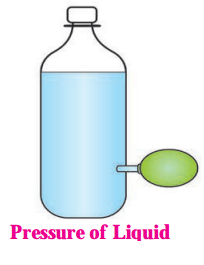
[Note: Here, the area of cross section of the tube remains the same. As the level of the water in the bottle rises, the mass of the water increases resulting in increase in the weight. As the applied force increases, the pressure increases. Therefore, the balloon increases in size.]
Activity 2:
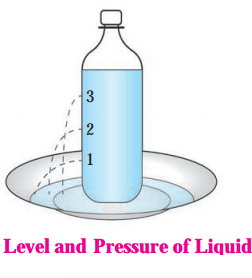
Take a plastic bottle. Pierce it with a thick needle (or with a hot nail) at the points 1, 2, 3 as shown in the Fig. Fill water in the bottle up to full height. A shown in the figure, water jets will be seen emerging and projecting out. The water jet emerging from the hole at the top will fall closest to the bottle. The jet from the lowest hole falls farthest from the bottle.
Also, jets coming out from the two holes at the same level fall at the same distance from the bottle. What is understood from this? At any one level, the liquid pressure is the same. Also, the pressure increases as the depth of the liquid increases.
Question c.
How much pressure do we carry on our heads? Why don’t we feel it?
Answer:
The air pressure at the sea level is about 101 × 103Pa. This is the pressure that we carry on our heads. The cavities in our body are filled with air, and arteries and veins are filled with blood. Their pressure balances the pressure due to the atmosphere. Hence, we don’t feel the atmospheric pressure.
4. Why does it happen?
Question a.
Why does it happen? A ship dips to a larger depth in freshwater as compared to marine water.
Answer:
The buoyant force acting on a body is proportional to the density of the fluid in which the body is immersed. The density of freshwater is less than that of marine water. Hence, the buoyant force on a body in freshwater is less than that in marine water. Therefore, a ship dips to a larger depth in freshwater as compared to marine water.
Question b.
Why does it happen? Fruits can easily he cut with a sharp knife.
Answer:
Question c.
Why does it happen? The wall of a dam is broad at its base.
Answer:
1. The pressure at a point in a liquid is proportional to the height of the liquid column above it. Hence, the pressure of water in a dam is much greater at the bottom of the dam than at the top.
2. To withstand this high pressure, the wall of a dam is made stronger and thicker (broad) at the base than at the top.
Question d.
Why does it happen? If a stationary bus suddenly speeds up, passengers are thrown in the backward direction.
Answer:
1. When passengers sit or stand in a stationary bus, they are in a state of rest. When the bus suddenly speeds up, the lower (parts of their body in contact with the bus acquire the speed of the bus.
2. The upper parts of their body, however, continue to be in the state of rest due to inertia. Hence, they are thrown in the backward direction.
5. Complete the following tables.
Question a.
Answer:
Using the formula,
density = mass/volume:
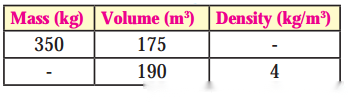
Mass (Kg) | Volume (m3) | Density (Kg/m3) |
350 | 175 | 2 |
760 | 190 | 4 |
Question b.
Answer:
Using the formula, relative density = density of a metal/density of water:
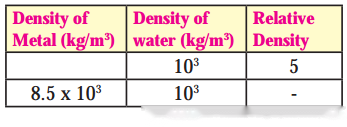
Density of Metal (Kg/m3) | Density of water (Kg/m3) | Relative Density |
5 × 10³ | 103 | 5 |
8.5 × 10³ | 103 | 4 |
Question c.
Answer:
Using the formula, pressure = weight/area:
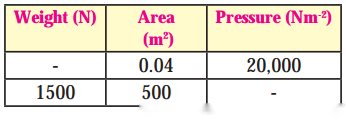
Weight (N) | Area (m2) | Pressure (N.m-2) |
800 | 0.04 | 20000 |
1500 | 500 | 3 |
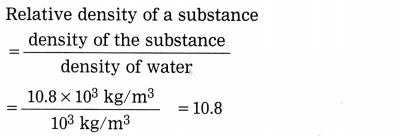
6. The density of a metal is 10.8 × 10³kg/m3. Find the relative density of the metal.
Question a.
The density of a metal is 10.8 × 10³kg/m3. Find the relative density of the metal.
Solution:
Data: Density of the metal = 10.8 × 10³kg/m3
density of water = 103kg/m3
relative density of the metal = ?
The relative density of the metal = 10.8.
7. The volume of an object is 20 cm3and the mass is 50 g. The density of water is 1 gm-3. Will the object float on water or sink in water?
Question a.
The volume of an object is 20 cm3and the mass is 50 g. The density of water is 1 gm-3. Will the object float on water or sink in water?
Solution :
It is greater than the density of water.
Hence, the object will sink in water.

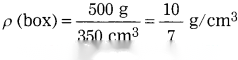
8. The volume of a plastic-covered sealed box is 350 cm3and the box has a mass 500 g. Will the box float on water or sink in water? What will be the mass of water displaced by the box?
Question a.
The volume of a plastic-covered sealed box is 350 cm3and the box has a mass 500 g. Will the box float on water or sink in water? What will be the mass of water displaced by the box?
Solution:
It is greater than that of water.
Hence, the box will sink in water.
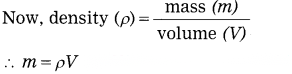
The volume of water displaced by the box (V) = the volume of the box = 350 cm3
∴ The mass of water displaced by the box = 1 g.cm-3× 350 cm3= 350 g.
Project:
Question a.
Video record all the experiments (Try it) in this chapter with the help of mobile phone and send to others.
Class 8 Science Chapter 3 Force and Pressure Additional Important Questions and Answers
1. Rewrite the sentences after filling the blanks

Write proper word In the blank space:
State whether the following statements are True or False:
Identify the odd term:
Rewrite the following table in such a way that Column 2 and Column 3 will match with Column 1:
Column 1 | Column 2 | Column 3 |
1. Pressure | Mass/volume | Specific gravity |
2. Density | Force/area | Decreases with increase in height above the sea level |
3. Atmospheric pressure | No unit | Useful to determine the purity of a substance |
4. Relative density | The pascal | Decreases with increase in area |
Column 1 | Column 2 | Column 3 |
1. Pressure | Force/area | Decreases with increase in area |
2. Density | Mass/volume | Useful to determine the purity of a substance |
3. Atmospheric pressure | The pascal | Decreases with increase in height above the sea level |
4. Relative density | No unit | Specific gravity Answer the following questions in one sentence:
Question 1
Maharashtra Board Solution
Which of the following has more inertia? A ₹ 10 coin and a ₹ 1 coin.
Solution & Step-by-Step Answer:
A ₹ 10 coin has more inertia than a ₹ 1 coin.
Question 2
Maharashtra Board Solution
Name the physical quantity expressed in pascal.
Solution & Step-by-Step Answer:
Pressure is expressed in pascal.
Question 3
Maharashtra Board Solution
State the SI unit of pressure.
Solution & Step-by-Step Answer:
The SI unit of pressure is N/m2, also called the pascal.
Question 4
Maharashtra Board Solution
Name the property of a liquid due to which it exerts an upward force on an object immersed in it.
Solution & Step-by-Step Answer:
Buoyancy is the property of a liquid due to which it exerts an upward force on an object immersed in it.
Question 5
Maharashtra Board Solution
Name the principle used in designing ships and submarines.
Solution & Step-by-Step Answer:
Archimedes’ principle is used in designing ships and submarines.
Question 6
Maharashtra Board Solution
What is specific gravity?
Solution & Step-by-Step Answer:
The specific gravity of a substance is another name used for relative density, i. e., the ratio of the density of the substance to the density of water.
Question 7
Maharashtra Board Solution
State any one factor on which the pressure exerted by a liquid at a point inside the liquid depends.
Solution & Step-by-Step Answer:
The pressure exerted by a liquid at a point inside the liquid depends on the density of the liquid.
Question 8
Maharashtra Board Solution
State any one factor on which the buoyant force due to a liquid depends.
Solution & Step-by-Step Answer:
The buoyant force due to a liquid depends on the density of the liquid.
Question 9
Maharashtra Board Solution
Name the device used to determine the purity of a sample of milk.
Solution & Step-by-Step Answer:
The lactometer is used to determine the purity of a sample of milk.
Question 10
Maharashtra Board Solution
Name the device used to determine the density of a liquid.
Solution & Step-by-Step Answer:
The hydrometer is used to determine the density of a liquid.
Question 11
Maharashtra Board Solution
Name two instruments whose working is based on Archimedes’ principle.
Solution & Step-by-Step Answer:
Working of the lactometer and hydrometer is based on Archimedes’ principle.
Answer the following questions:
Question 1
Maharashtra Board Solution
Give three examples to show that a force acts on two bodies through an interaction between them.
Solution & Step-by-Step Answer:
Question 2
Maharashtra Board Solution
What is a contact force? Give one example.
Solution & Step-by-Step Answer:
A force that acts through a direct contact of two objects or via one more object, is called a contact force. Example: If a ball at rest on the ground is kicked, it starts moving.
Question 3
Maharashtra Board Solution
What is a non contact force? Give one example.
Solution & Step-by-Step Answer:
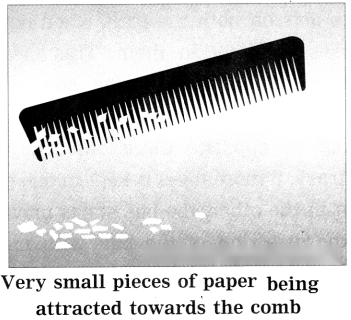
A force that acts between two objects even if the two objects are not in contact, is called a non contact force. Example: The earth revolves around the Sun.
Use your brainpower! 2. Some examples in which non contact forces are applied:
Question 4
Maharashtra Board Solution
In the following examples, state whether the force is a contact force or non contact force: |
Question 5
Maharashtra Board Solution
Give one example in which frictional force is useful.
Solution & Step-by-Step Answer:
While walking, we push the ground behind with our feet. In the absence of friction between the ground and the lower surface of our feet, we will slip and will not be able to walk. [Note: Frictional force is electromagnetic in origin.]
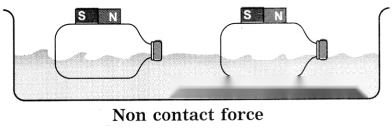
Try this: Fill a big plastic tray with water and leave the two bottles floating with magnets at the top. Take one bottle near the other. If the north pole of the magnet is near the south pole of the other magnet, the bottles will head towards each other, because unlike poles attract each other. Observe what will happen when the directions of the bottles are changed. We can observe change in the motion of the bottles without any direct contact. This means that there exists a non contact force between the two magnets.
Use your brain power! Question.
Try this:
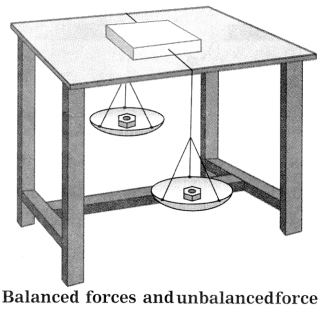
If more mass is kept in one of the pans than in the other, the box starts moving in the direction of that pan. Equal gravitational force acts on both the pans when equal masses are kept in them. This means balanced forces act on the box, with effective force equal to zero as these are acting in opposite directions. On the contrary, if more mass is kept in one pan than in the other, the box starts moving in the direction of the pan with more mass. When unequal forces are applied to the box on the two sides, an unbalanced force acts on the box resulting in imparting motion to the box. Children playing tug of war pull the rope in their respective directions. If the pull of the force is equal on the two sides, the rope does not move. If the force is more on one side, the rope moves in that direction. This means that initially, the two forces are balanced; the rope moves in the direction of higher force when the forces become unbalanced. Let us see one more example. When a big grain storage container is required to slide on the ground, it becomes easier if two persons push it rather than one person. When the force is applied by both in the same direction, the movement is easy. You may have experienced this. What do we understand from this example? Force is a vector quantity. If more than one force are acting on a body, then the effect on the body is due to the net force. When a force is applied on a stationary object it moves, its speed and direction change. Similarly, a force is required to stop an object in motion. An object can change its shape due to force. While kneading a dough made from flour, the dough changes its shape when a force is applied. A potter applies a force in a specific direction while shaping the pot. Rubber, when stretched, expands. There are many such examples.,
Question 6
Maharashtra Board Solution
What are balanced forces?
Solution & Step-by-Step Answer:
If a body is acted upon by two forces, equal in magnitude, opposite in direction and having the same line of action, the forces are called balanced forces. Here, the net force acting on the body is zero.
Question 7
Maharashtra Board Solution
What is an unbalanced force?
Solution & Step-by-Step Answer:
If two or more forces act on a body such that their resultant is not zero, the resultant is an unbalanced force. [Note: Unbalanced force acting on a body = mass of the body × acceleration of the body.]
Question 8
Maharashtra Board Solution
Explain: Force has magnitude as well as direction. OR Force is a vector quantity.
Solution & Step-by-Step Answer:
The effect of force applied to a body depends upon how much force we supply, i.e., the magnitude of the force, and the direction in which the force is applied. Consider a ball at rest on the ground. When ; we push it, it starts rolling. The greater the applied force, the greater is the speed acquired by the ball.
Consider a body moving in a straight line, If we apply a force in the direction of motion of the body, the speed of the body increases. On the contrary, if we apply a force in the direction opposite to that of motion of the body, the speed of the body decreases. These ( examples show that force has magnitude as well as direction, i.e., force is a vector quantity.
Question 9
Maharashtra Board Solution
Explain the term balanced forces.
Solution & Step-by-Step Answer:
Consider a rigid body acted upon by two forces, equal in magnitude, opposite in. direction and having the same line of action. These forces are called balanced forces as their net effect on the body is zero. Example: A glass slab kept on a table is acted upon by two balanced forces: (i) the weight of the slab acting downward and (ii) the upward force on the slab due to the table. Their net effect on the slab being zero, the slab remains at rest.
Question 10
Maharashtra Board Solution
Explain the term unbalanced force.
Solution & Step-by-Step Answer:
A single force acting on a body is an unbalanced force. It produces acceleration in the body. If two or more forces act on a body such that their resultant is not zero, the resultant is an unbalanced force responsible for accelerating the body. Example: When a ball lying on the ground is hit with a bat, the ball is set in motion by the applied force.
Question 11
Maharashtra Board Solution
What will happen if the force is removed completely when an object acquires a certain speed?
Solution & Step-by-Step Answer:
If the force is removed completely when an object acquires a certain speed, the object will move with the velocity it has at the instant the force is removed.
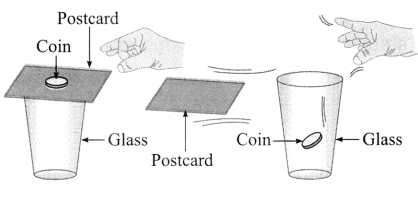
For example, a body moving with constant speed along a circular path in a horizontal plane will fly tangentially in the sense of motion if the centripetal force (the force directed towards the centre of the circle) is removed completely. Always remember: Types of inertia: 1. Inertia of the state of rest: An object in the state of rest cannot change its state of rest due to its inherent property. This property is called the inertia of the state of rest. 2. Inertia of motion: The inherent property of an object due to which its state of motion cannot change, is called its inertia of motion. For example, a revolving’ electric fan continues to revolve even after it is switched off, passengers sitting in the running bus get aerk in the forward direction if the bus suddenly stops. 3. Directional inertia: The inherent property of an object due to which the object cannot change the direction of its motion, is called directional inertia. For example, if a vehicle in motion along a straight line suddenly turns, the passengers sitting in it are thrown opposite to the direction of turning. Try this:
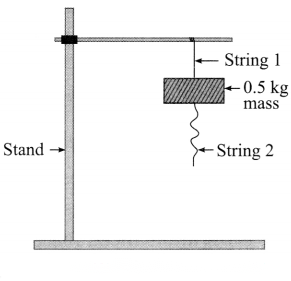
Activity 2: Hang a half a kg mass from a stand, with a string 1. Tie another string 2 to the mass and keep it hanging. Now pull the string 2 with a jerk. The string 2 breaks but the mass does not fall. Heavy mass does not move. Now pull the string 2 slowly. The string 1 breaks and the mass fall down. This is because of the tension developed in the string 2 due to the mass.
Question 12
Maharashtra Board Solution
What are the three types of inertia?
Solution & Step-by-Step Answer:
Types of inertia:
Question 13
Maharashtra Board Solution
What is inertia of rest ? Give two examples of inertia of rest.
Solution & Step-by-Step Answer:
The inherent property of a body by virtue of which it cannot change its state of rest is called the inertia of rest. Examples:
Question 14
Maharashtra Board Solution
What is inertia of motion? Give two examples of inertia of motion.
Solution & Step-by-Step Answer:
The inherent property of a body by virtue of which it cannot change its state of motion is called the inertia of motion. Examples:
Question 15
Maharashtra Board Solution
What is inertia of direction? Give two examples of inertia of direction.
Solution & Step-by-Step Answer:
The inherent property of a body by virtue of which it cannot change its direction of motion is called the inertia of direction. Examples:
Question 16
Maharashtra Board Solution
Why do we fall sideways when we are sitting in a bus and it takes a sharp turn?
Solution & Step-by-Step Answer:
When we sit in a bus and the bus is in motion, we are in a state of motion in the same direction. When the bus takes a sharp turn, our body tends to maintain the state of motion in the straight line due to inertia. The portion of our body in firm contact with the seat acquires the motion along the curved path, but the upper portion of our body, tends to move in the initial direction of motion. Hence, we fall sideways.
Question 17
Maharashtra Board Solution
What happens when you shake a wet piece of cloth? Explain your observation.
Solution & Step-by-Step Answer:
Question 18
Maharashtra Board Solution
If brakes are suddenly applied to a moving car, the passengers in the car are pushed in the forward direction. Explain why.
Solution & Step-by-Step Answer:
1. The passengers in a moving car have the same velocity as that of the car. When brakes are suddenly applied to the car, it stops suddenly and the lower parts of the passengers’ bodies in contact with the seats, come to rest.
2. The upper parts of their bodies, however, continue to be in a state of motion due to inertia. Hence, the passengers are pushed in the forward direction.
Question 19
Maharashtra Board Solution
A person alighting from a moving train is likely to fall in the direction of motion of the train. Explain why.
Solution & Step-by-Step Answer:
Try this: Activity 3: Take some sharp pointed nails and push them into a wooden plank by hammering on their heads. Now take? a nail and hold it with its head on the plank and hammer it down from the pointed end. When pressing the drawing pins into a drawing board, they get into the board easily. By applying a force using the thumb one can push the pins into the boards. On the contrary, while pressing ordinary pins into the board with a thumb, the thumb may get hurt. What does this simple experiment tell?
Question 20
Maharashtra Board Solution
Define pressure.
Solution & Step-by-Step Answer:
The force exerted perpendicularly on a unit area is called pressure.
Use your brain power!
Question 1
Maharashtra Board Solution
It is easy to cut vegetables, fruits with a sharp knife. A blunt knife does not work here. Why does this happen?
Solution & Step-by-Step Answer:
The effect of a given force varies l inversely as the area of the surface on ( which the force is applied. The less the surface area, the greater is the effect of the force. The cutting edge of a sharp ’ knife has less cross sectional area relative to that of a blunt knife. Hence, it is easy to cut vegetables, fruits with a sharp knife, rather than with a blunt knife. For a given force, pressure is inversely proportional to the area of the surface on which the force acts.
Question 21
Maharashtra Board Solution
State the formula for pressure, Hence, determine the unit of pressure.
Solution & Step-by-Step Answer:
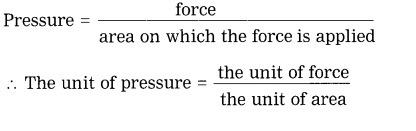
The SI unit of force is the newton (N) and that of area is m2. Therefore, the SI unit of pressure is N/m2. It is called the pascal (Pa). 1 Pa = 1 N/m2. [Note: The unit pascal is named in honour of Blaise Pascal (1623-62), French mathematician, physicist and philosopher.]
Question 22
Maharashtra Board Solution
State the CGS unit of pressure. State the relation betweeen the SI and CGS units of pressure.
Solution & Step-by-Step Answer:
The CGS unit of pressure is the dyne/cm2. IN = 105 dynes, 1m2 = (102 cm)2 = 104 cm2 1 Pa = 1 N/m2 = 105 dynes/104 cm2 = 10 dynes/cm2.
Question 23
Maharashtra Board Solution
State the factors on which pressure depends.
Solution & Step-by-Step Answer:
Pressure depends on the applied force and the area of the surface on which the force is applied.
Question 24
Maharashtra Board Solution
Explain with a suitable example that pressure varies inversely as the area of the surface on which the force is applied, if the force remains constant.
Solution & Step-by-Step Answer:
The tip of a pointed nail has an extremely small area, while that of a blunt nail has a comparatively large area. A given force creates a large pressure on the pointed nail and it can be easily hammered into the wood, while a very less pressure is created on the blunt nail and it cannot be easily hammered into the wood.
This shows that pressure varies inversely as the area of the surface on which the force is applied, if the force remains constant. If the same force is applied to surfaces having different areas, the pressure is more on the surface having a smaller area. [Note: The bottom surface of a camel’s feet is broad. Hence, the camel’s weight acts on a large surface area. This reduces the pressure on the sand. Hence, the camel’s feet do not penetrate deep into the sand. Therefore, it becomes easier for the camel to walk on sand.]
Question 25
Maharashtra Board Solution
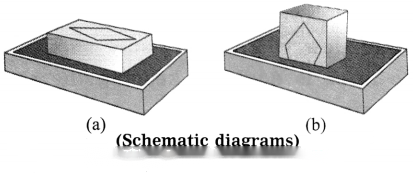
With neat diagrams, describe an experiment to show that pressure increases if the surface area is decreased, keeping the applied force the same.
Solution & Step-by-Step Answer:
Take a brick measuring 20 cm x 10 cm x 5 cm. Take some clay in a glass trough. Add water to it and knead it into a soft dough. Place the brick on the dough with one of its faces measuring 20 cm x 10 cm in contact with the dough. Observe how deep the brick penetrates into the dough.
Clean the brick and place it on the dough with one of its faces measuring 10 cm x 5 cm in contact with the dough. Observe how deep the brick penetrates into the dough. You will find that the brick penetrates deeper in this case than that in the first case.
Question 26
Maharashtra Board Solution
State the unit for pressure used in atmospheric science. How is it related to the unit pascal?
Solution & Step-by-Step Answer:
In atmospheric science, the unit used for pressure is the bar. 1 bar = 10 Pa (pascal).
Try this:
Question 1
Maharashtra Board Solution
Do the activity as depicted in Figure What is seen?
Solution & Step-by-Step Answer:
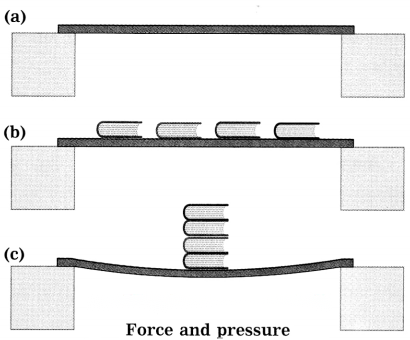
In Fig.(a), the plank is horizontal. In Fig.(b), four books are placed side by side on the plank. The plank bends slightly due to the pressure produced by the weight of the books. In Fig.(c), the four books are placed one above the other in the middle of the plank. Here the area of the surface of the plank on which the force acts is reduced by a factor of four relative to the earlier case. Hence, the plank bends considerably. [Note: This shows that for a given force, pressure varies inversely as the area of the surface on which the force acts.]
Use your brainpower!
Question 1
Maharashtra Board Solution
You must have seen a vegetable vendor carrying a basket on her head. She keeps a twisted piece of cloth on the head, below the basket. How does it help?
Solution & Step-by-Step Answer:
Keeping a twisted piece of cloth on the head increases the area of the surface on which the weight of the basket containing vegetables acts. Hence, the pressure produced by the force (weight) is reduced and it becomes easier to carry the basket.
Question 2
Maharashtra Board Solution
We cannot stand at one place for a long time. How then can we sleep on a place for 8 and odd hours?
Solution & Step-by-Step Answer:
When we stand, our weight acts on relatively small surface area, resulting in increased tension on the muscles of our legs. Hence, we cannot stand at one place for a long time. When we sleep, our weight acts on relatively large surface area, resulting in comparatively reduced tension. Therefore, we can sleep on a place for 8 and odd hours.
Question 3
Maharashtra Board Solution
For skiing on ice, why are long flat skis used?
Solution & Step-by-Step Answer:
The pressure produced by a given force depends on the area of the surface on which the force acts. The greater the surface area, the less is the pressure produced. The skis used to slide over snow are long and flat so that the area is increased and hence the pressure is decreased. This makes it easier to slide over snow.
Question 27
Maharashtra Board Solution
Why do the blades of a pair of scissors have sharp edges?
Solution & Step-by-Step Answer:
The pressure produced by a given force depends on the area of the surface on which the force acts. The less the surface! area, the greater is the pressure produced, The blades of a pair of scissors have sharp edges so that the area is decreased and hence the pressure is increased. This makes cutting • an object such as cloth easier. [Note: Answers to questions such as why is the blade of an axe sharp? or why is the blade of a saw sharp? can be written on the basis of the answer given above.]
Question 28
Maharashtra Board Solution
Why does a needle have s sharp point?
Solution & Step-by-Step Answer:
The pressure produced by a given force depends on the areas of the surface on which the force acts. The less the surface area, the greater is the pressure produced. A needle has a sharp point so that the area is decreased and hence the pressure is increased. This makes the action of piercing easier.
Question 29
Maharashtra Board Solution
Why do school bags have broad shoulder straps?
Solution & Step-by-Step Answer:
The pressure produced by a given force depends on the area of the surface on which the force acts. The greater the surface area, the less is the pressure produced. School bags have broad shoulder straps so that the weight of the bag is distributed over a large surface area thereby decreasing the pressure on the shoulders of the student carrying the bag.
Question 30
Maharashtra Board Solution
How will the pressure change if the area is doubled keeping the force the same?
Solution & Step-by-Step Answer:
If the area is doubled, keeping the force the same, the pressure will become half the initial pressure.
Question 31
Maharashtra Board Solution
How will the pressure change if the force is doubled, keeping the area the same?
Solution & Step-by-Step Answer:
If the force is doubled, keeping the area the same, the pressure will become double the initial pressure.
Question 32
Maharashtra Board Solution
State the characteristics of the pressure due to a liquid (or a fluid in general). OR Write a short note on the pressure due to a liquid (a fluid in general).
Solution & Step-by-Step Answer:
Characteristics of the pressure due to a liquid (or a fluid):
[Note: The pressure exerted by a liquid (or gas or fluid) at a depth h below the free surface of the liquid = hpg, where p is the density of the liquid (or gas or fluid) and g is the acceleration due to gravity.]
Question 33
Maharashtra Board Solution
Give two examples to show that air exerts equal pressure in all directions.
Solution & Step-by-Step Answer:
Question 34
Maharashtra Board Solution
Whatisafluid?Givetwoeamples.
Solution & Step-by-Step Answer:
A fluid is a substance which can flow. Examples:
[Note: Liquids and gases together are called fluids. Gases have very low viscosity compared to liquids. A liquid with low viscosity flows easily. A liquid with high viscosity does not flow easily.]
Question 35
Maharashtra Board Solution
Take two rubber balloons. Fill one with water and blow air into the other. Now prick both balloons with a pin. What do you observe?
Solution & Step-by-Step Answer:
Water and air both come out of the balloons. Air escapes quickly compared to water and produces a loud sound.
Question 36
Maharashtra Board Solution
State the characteristics of pressure exerted by a fluid. OR Write a short note on pressure exerted by a fluid.
Solution & Step-by-Step Answer:
Characteristics of pressure exerted by a fluid:
[Note: The pressure exerted by a fluid is a scalar quantity.]
Question 37
Maharashtra Board Solution
Take an empty can. Pour small quantity of water in it. Boil this water for a few minutes until the steam has driven out most of the air. Now close the can with the stopper tightly. Allow it to cool by pouring cold water over it. What do you observe?
Solution & Step-by-Step Answer:
The can gets gradually crushed. [Note: The steam inside the can condenses to form water as the can cools. Therefore, the pressure inside the can becomes much less than the external pressure of the air. Hence, the can gets crushed.]
Question 38
Maharashtra Board Solution
Put a folded newspaper on a plastic bag. Blow air into the bag. What do you observe?
Solution & Step-by-Step Answer:
The plastic bag inflates as air is blown into it. This raises the folded news¬paper put on the bag.
Question 39
Maharashtra Board Solution
What is meant by atmospheric pressure?
Solution & Step-by-Step Answer:
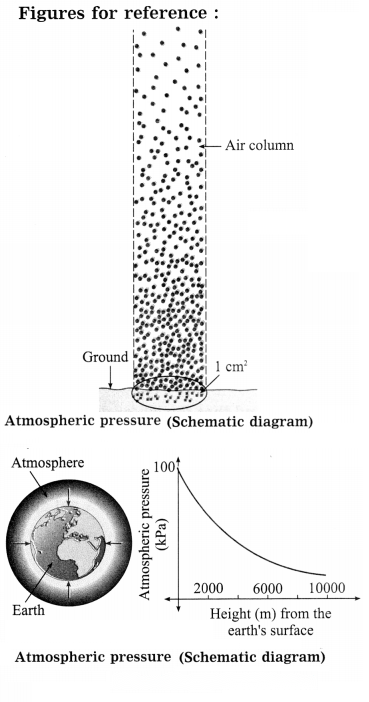
The earth is surrounded by air from all sides. This layer of air is called the atmosphere. Its density is high up to about 16 km from the earth’s surface. Beyond that, up to about 400 km, its density is very low. Air, due to its weight, exerts pressure on the surface of the earth.
The pressure exerted by air or the atmosphere surrounding the earth is known as the atmospheric pressure. It is the ratio of the weight of the air to the area of the surface of the earth. It decreases with altitude as the density of air decreases with altitude and also the weight of the air column above a given place.
Question 40
Maharashtra Board Solution
State the relation between 1 atmosphere and the pascal.
Solution & Step-by-Step Answer:
1 atmosphere = (about) 101 × 103 Pa (pascal) [Note: The air pressure at the sea level is (about) 1 atmosphere. 1 atmosphere = 101325 Pa. 1 bar = 103 mbar (millibar) 1 mbar w 103 Pa (hectopascal) Atmospheric pressure is expressed in mbar or hectopascal (hPa).]
Use your brain power!
Question 1
Maharashtra Board Solution
At the sea level the atmospheric pressure 101 × 103 Pa is acting on a table top of size 1 m2. Under such a heavy pressure, why doesn’t the table top crumble down?
Solution & Step-by-Step Answer:
The air below the table top exerts pressure 101 × 103 Pa on it in the upward direction. Hence, the table top doesn’t crumble down.
Question 41
Maharashtra Board Solution
Think – Why? Question i. Some people feel their ears popping at the top of a mountain.
Solution & Step-by-Step Answer:
Atmospheric pressure decreases with altitude. At the top of a mountain, it becomes less than the internal pressure in the ear. Hence, some people feel their ears popping at the top of a mountain.
Question ii. Question iii. Question iv.
Question 42
Maharashtra Board Solution
Why do some people have earache when they travel by an aeroplane?
Solution & Step-by-Step Answer:
When an aeroplane descends at a high speed, there is an increase in air pressure. This increases the pressure on the ear drum. Hence, some people have earache when they travel by an aeroplane.
Question 43
Maharashtra Board Solution
Explain why a person may bleed from the nose when at a great height above the sea level.
Solution & Step-by-Step Answer:
The pressure exerted by the blood in blood capillaries is slightly more than the atmospheric pressure and acts in a direction opposite to that of the atmospheric pressure. Atmospheric pressure decreases with height and at a great height above the sea level, it is very low.
As a result, there arises a difference in the internal and external pressures on the walls of the cells and blood capillaries. If the difference is large, it may cause the cell wall and the blood capillaries to burst. Thus, the capillaries in the nose (and ear) may burst causing bleeding.
Question 44
Maharashtra Board Solution
When a rubber sucker is pressed onto a flat glass surface, it sticks tightly on the surface. Why? You need a large force to separate it from the surface. Why?
Solution & Step-by-Step Answer:
When a rubber sucker is pressed onto a flat glass surface, practically all the air between the surfaces of the sucker and the glass is pushed out. The air pressure there becomes much less than the atmospheric pressure. Hence, the sucker sticks to the glass due to the external atmospheric pressure. The atmospheric pressure is about 105 Pa. It is very large. Hence, to work against it to separate the sucker from the glass, a large force is needed.
Question 45
Maharashtra Board Solution
Describe a simple experiment to demonstrate atmospheric pressure.
Solution & Step-by-Step Answer:
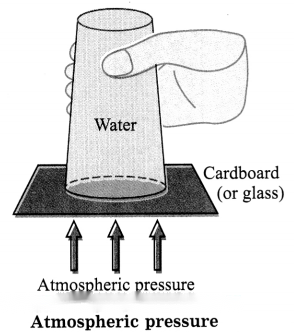
Fill a glass completely with water (to its brim) and cover it with a flat and stiff card paper (or a piece of glass). Holding your palm on the card, turn the glass upside down and take the palm away from the card. You will find that the water does not spill. The atmospheric pressure on the card (acting upward) is greater than the pressure of the water in the glass (acting downward). Hence, the water in the glass does not spill.
Question 46
Maharashtra Board Solution
Explain the working of an ink dropper. [Application]
Solution & Step-by-Step Answer:
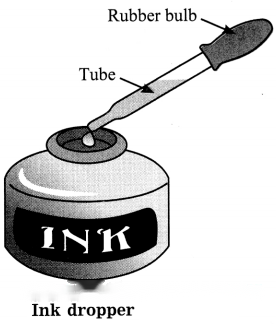
An ink dropper consists of a tube of glass or plastic, with one end tapering to a narrow opening and the other end fitted with a small rubber bulb. When the narrow open end is dipped into the ink and the rubber bulb is pressed, some air in the tube escapes through the open end. This reduces the air pressure inside the dropper. On releasing the bulb, the atmospheric pressure on the ink pushes the ink into the dropper. The dropper is then taken out and its open end is held over the open barrel of the pen. The bulb is then pressed so that the ink in the dropper enters the pen. [Note: The medicine dropper works in the same manner.]
Question 47
Maharashtra Board Solution
Why is the opening of a dropper very narrow?
Solution & Step-by-Step Answer:
The pressure produced by a given force is inversely proportional to the area of the surface on which the force acts. The opening of a dropper is very narrow. Hence, its area of cross-section is very small. As a result, even if the dropper has a small amount of ink it, its pressure can equal the atmospheric pressure. As the opening is narrow, it is easier to transfer the ink to the pen. The possibility of ink spilling is very low.
Question 48
Maharashtra Board Solution
What is the characteristic of the cap of eye drop bottles?
Solution & Step-by-Step Answer:
The cap of an eye drop bottle is fitted with a dropper.
Question 49
Maharashtra Board Solution
Explain the working of a syringe used by children when they play with coloured water. [Application]
Solution & Step-by-Step Answer:
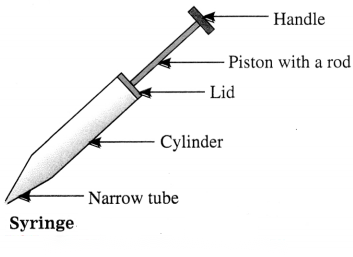
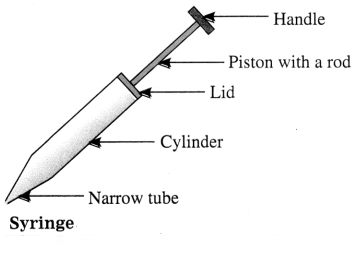
As shown in the figure, a syringe used by children when they play with coloured water consists of a cylinder made of plastic or metal fitted with a piston. One end of the cylinder is in the form of a narrow tube. The snugly fitting piston can slide in, and out smoothly. The rod connected to the i piston passes through a hole in the centre of the lid and has a handle at the other end. When the tip of the narrow tube is dipped in coloured water (or any other liquid) and the piston is pushed towards the tip, up to the bottom, most of the air in the cylinder escapes through the tube, reducing the pressure.
When the piston is moved up, the coloured water rises in the part of the cylinder below the piston due to the atmospheric pressure. Finally, the inner pressure equals the atmospheric pressure and no more coloured water enters in or comes out. To spray the coloured water, the tube is taken out and the piston is moved towards the opening of the tube. As the inner pressure is now greater than the atmospheric pressure, the coloured water gushes out of the narrow opening of the tube.
Question 50
Maharashtra Board Solution
How does the doctor’s syringe work?
Solution & Step-by-Step Answer:
As shown in the figure, a syringe used by children when they play with coloured water consists of a cylinder made of plastic or metal fitted with a piston. One end of the cylinder is in the form of a narrow tube. The snugly fitting piston can slide in, and out smoothly. The rod connected to the i piston passes through a hole in the centre of the lid and has a handle at the other end.
When the tip of the narrow tube is dipped in coloured water (or any other liquid) and the piston is pushed towards the tip, up to the bottom, most of the air in the cylinder escapes through the tube, reducing the pressure. When the piston is moved up, the coloured water rises in the part of the cylinder below the piston due to the atmospheric pressure. Finally, the inner pressure equals the atmospheric pressure and no more coloured water enters in or comes out. To spray the coloured water, the tube is taken out and the piston is moved towards the opening of the tube. As the inner pressure is now greater than the atmospheric pressure, the coloured water gushes out of the narrow opening of the tube. The tip of a syringe is fitted with a very fine and hollow needle. The required quantity of medicine can be taken in the syringe with the help of the piston. The medicine can then be injected into the body of a patient using the needle and the piston.
Question 51
Maharashtra Board Solution
Explain the origin of pressure due to a gas enclosed in a container.
Solution & Step-by-Step Answer:
Molecules of a gas are in a state of continuous random motion. These molecules possess energy due to motion. When the molecules collide with a wall of the container, they rebound. A large number of molecules collide with the wall every second. Hence, a significant force is exerted on the wall. Pressure is the force per unit surface area. Thus, a pressure is exerted by the gas on a wall of the container.
Try this: Buoyant force:
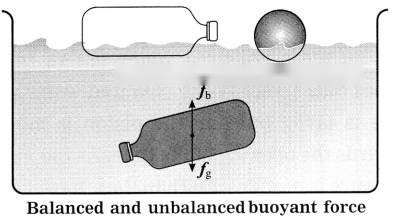
Such a bottle with water neither floats on the surface, nor does it go to the bottom. This means the force due to gravity acting downwards (fg), must have been balanced by an opposing force in the upward direction (fb) on the bottle filled with water. This force must have originated from the water surrounding the bottle. The upward force acting on the object in water or other fluid or gas is called buoyant force (fg).
Question 52
Maharashtra Board Solution
Define buoyant force.
Solution & Step-by-Step Answer:
The upward force acting on the object in water or other fluid or gas is called the buoyant force.
Question 53
Maharashtra Board Solution
State the factors on which the buoyant force depends.
Solution & Step-by-Step Answer:
The buoyant force depends upon the volume of the object immersed in the fluid (V), the density of the fluid (ρ1) and the acceleration due to gravity (g) at that place. [Note: Magnitude of the buoyant force = Vρ1 g.]
Use your brain power! Question. 2. The density of water is much greater than that of air. Therefore, the buoyant force acting on a bucket full of water while it is in water is much greater than that when it is out of water, i.e., in air. Hence, it appears to weigh less, while it is in water than when it has been pulled out of water. Try this:
Question 1
Maharashtra Board Solution
Take a piece of thin aluminum sheet and dip it in water in a bucket. What do you observe?
Solution & Step-by-Step Answer:
It sinks in the water.
Question 2
Maharashtra Board Solution
Now shape the same piece of aluminium into a small boat and place it on the surface of water. It floats, isn’t it?
Solution & Step-by-Step Answer:
Yes, the boat floats on the surface of water.
Question 54
Maharashtra Board Solution
A lemon sinks in a glass filled with water but it floats when we stir in two spoons of salt in the water. Explain why.
Solution & Step-by-Step Answer:
When salt is dissolved in water, the density of the water increases. The buoyant force is proportional to the density of the liquid. Hence, when the lemon is immersed in the water containing salt, the magnitude of the buoyant force acting on the lemon becomes greater than the magnitude of the weight of the lemon. Therefore, it floats in water.
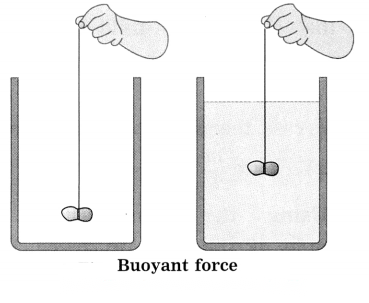
Do you know? How is it decided that an object left in a liquid will get sink in the liquid, will float on the surface, or will float inside the liquid? 2. Magnitude of the unbalanced force on the object = magnitude of the weight of the object – magnitude of the buoyant force on the object. The direction of the unbalanced force is the direction of the weight of the object. 3. Here, the unbalanced force is zero. Try this: Take a long rubberband and cut it at one point. At one of its ends tie a clean washed stone or a 50 g weight as shown in Figure Now take water in a pot and hold the rubberband at such a height that the stone sinks in it. Again measure the length of the rubberband up to the mark. What is observed? This length is shorter than the earlier length. While dipping the stone in water, length of the stretched rubber gets slowly reduced and is minimum when it sinks completely. What could be the reason for a shorter length of the rubberband in water?
Question 55
Maharashtra Board Solution
State Archimedes’ principle.
Solution & Step-by-Step Answer:
Archimedes’ principle: When an object is partially or fully immersed in a fluid, a force of buoyancy acts on it in the upward direction. This force is equal to the weight of the fluid displaced by the object. [Note: The two forces mentioned here are equal in magnitude and opposite in direction.]
Question 56
Maharashtra Board Solution
Using Archimedes’ principle, determine the magnitude of the buoyant force.
Solution & Step-by-Step Answer:
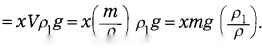
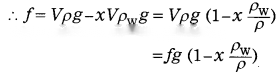
Let m = mass of the body (object) immersed in the fluid, V = volume of the body, ρ = density of the body, ρ1 = density of the fluid, g = magnitude of the acceleration due to gravity. Suppose that the body is completely immersed in the fluid. Then the volume of the fluid displaced by the body = V. According to Archimedes’ principle, magnitude of the buoyant force = magnitude of the weight of the fluid displaced by the body = mass of the displaced fluid × g = volume of the displaced fluid × density of the fluid × g (as density = mass/volume) If the body is partially immersed in the fluid, the volume of the fluid displaced by the immersed part of the body = xV ; here 0 < x < 1. In this case, the magnitude of the buoyant force
Question 57
Maharashtra Board Solution
Using the formula for the magnitude of the buoyant force, state under what conditions the body will 1. sink in the fluid 2. float in the fluid 3. remain in equilibrium anywhere within the fluid.
Solution & Step-by-Step Answer:
Magnitude of the buoyant force on the body = mg = magnitude of the weight of the body × 1. If the density of the fluid (ρ1) is less than the density of the body (ρ), the magnitude of the buoyant force on the body will be less than the magnitude of the weight of the body. Therefore, the body will sink in the fluid.|
2. If the density of the fluid is greater than that of the body, the magnitude of the buoyant force on the body will be greater than that of the weight of the body. Therefore, the body will float in the fluid. 3. If the density of the fluid is equal to that of the body, the magnitude of the buoyant force on the body will be equal to that of the weight of the body. Therefore, the body will remain in equilibrium anywhere within the fluid. Use your brain power! Question. 2. When the stone is immersed partially in water, f = fg – fb, where fb is the magnitude of the buoyant force exerted by water on the stone.
3. When the stone is completely immersed in water, x becomes maximum, equal to 1. Here, f = fg . This is the minimum value of. Here, the elongation of the rubberband is minimum, i.e., the length of the rubberband is minimum.
Question 58
Maharashtra Board Solution
State the applications of Archimedes’ principle.
Solution & Step-by-Step Answer:
Archimedes’ principle is used in the construction of ships and submarines. The working of the lactometer and hydrometer is based on Archimedes’ principle. [Note: The hydrometer is used to determine the density or relative density of a liquid.]
Question 59
Maharashtra Board Solution
If a spring balance is used to weigh a body, will the weight of the body be the same in vacuum and air? Explain why.
Solution & Step-by-Step Answer:
When a body is suspended in air, the buoyant force acts on the body. Hence, the magnitude of the net downward force on 1 the body = the magnitude of the weight of the body – the magnitude of the buoyant force on the body. Hence, when a spring balance is used to weigh a body, the weight of the body in air is less than that in vacuum.
Question 60
Maharashtra Board Solution
What is density of a substance? I Obtain its SI unit.
Solution & Step-by-Step Answer:
The density of a substance is the ratio of its mass to volume. The SI unit of density = = kg/m3 [Note: Density is useful in determining the purity of a substance. The CGS unit of density is g/cm3. 1 kg/m3 = 103g/(100 cm)3 = 10-3g/cm3 ∴ 1g/cm3 = 1000 kg/m3]
Question 61
Maharashtra Board Solution
What is relative density of a substance?
Solution & Step-by-Step Answer:
The relative density of a substance is the ratio of its density to the density of water. [Note: Relative density is also called specific gravity. It is a ratio of two equal (same) physical quantities. Hence, it has no unit.]
Question 62
Maharashtra Board Solution
A piece of wood floats both in water and kerosine. In which liquid does it sink more during floating? Why?
Solution & Step-by-Step Answer:
The piece of wood sinks more in kerosine than in water during floating. The density of kerosine is less than that of water. The buoyant force on a body is proportional to the density of the liquid in which the body is immersed. When a body floats, the magnitude of the buoyant force acting on the body is equal to that of the weight of the body.
Hence, the volume of the liquid displaced by a floating body is inversely proportional to the density of the liquid. As a result, when a piece of wood floats in kerosine, it displaces greater volume of kerosine compared to the volume of water displaced when the piece of wood floats in water. Hence, it sinks more in kerosine than in water.
Question 63
Maharashtra Board Solution
State whether the body will float or sink in a liquid if the density of the body is 1. greater than that of the liquid 2. less than that of the liquid 3. equal to that of the liquid.
Solution & Step-by-Step Answer:
Question 64
Maharashtra Board Solution
If the relative density of a body is greater than 1, will it float in water?
Solution & Step-by-Step Answer:
If the relative density of a body is greater than 1, it will not float in water. [Note: The relative density of a pin is much greater than 1. But when kept gently on the surface of water, it floats. This is due to the surface tension of water.]
Question 65
Maharashtra Board Solution
A glass of water has an ice cube floating in water. The water level must touches the rim of the glass. Will the water overflow when the ice melts? Give the reason.
Solution & Step-by-Step Answer:
The water will not overflow when the ice melts. The water level will remain the same. Ice floats on water because its density is less than that of water. When ice melts, the volume of the water formed is less than the volume of the ice which has melted.
When ice in water melts, this difference equals the volume of the water formed when the part of ice above the surface of water melts. Therefore, the water level remains the same. Hence, there is no overflow of water when the ice melts.
Question 66
Maharashtra Board Solution
A plastic ball is released underwater. State whether it will sink or come up to the surface of water. Give the reason.
Solution & Step-by-Step Answer:
A plastic ball released under water will come up to the surface of water. The density of water is greater than that of plastic. Hence, when a plastic ball is under water, the magnitude of the buoyant force exerted by water on the ball is greater than the magnitude of the weight of the ball.
Therefore, the ball will start moving upward. As it comes up with part of the ball above the water surface, the volume of the water displaced by the ball becomes less and hence at a certain stage, the buoyant force and the weight balance each other. Then the ball continues to remain in that state, as the net force on the ball becomes zero. Write short notes:
Question 1
Maharashtra Board Solution
Buoyant force.
Solution & Step-by-Step Answer:
1. When a body is immersed partially or completely in a liquid, the liquid exerts forces on all sides of the body. This force is perpendicular to the surface of the body and equals the product of pressure and area at that point.
2. The resultant of all these forces acts upward. It is called the upthrust or buoyant force. 3. The buoyant force is proportional to (i) the volume of the liquid displaced by the body (ii) the density of the liquid (iii) the acceleration due to gravity. Its magnitude equals the magnitude of the weight of the liquid displaced by the body.
Question 2
Maharashtra Board Solution
Applications of Archimedes’ principle.
Solution & Step-by-Step Answer:
1. The working of a lactometer, a device used to determine the purity of a sample of milk, and a hydrometer, a device used to determine the density of a liquid, is based on Archimedes’ principle. The extent to which a lactometer floats (or sinks) depends on the density (and hence purity) of the milk. The same thing is true for a hydrometer. The greater the density of a liquid, the less is the extent to which a body sinks in it.
2. Archimedes’ principle is used in design of ships and submarines. A submarine is provided with large tanks at the front and the back. Its weight can be increased by filling the tanks with sea water or air from compressed air reservoirs. The weight can be decreased by pumping out water from the tanks by forcing compressed air in them. By controlling the weight, it can be made to sink or rise to the surface as desired. 3. The density of a body that floats or sinks in water or kerosine can be determined by. Archimedes’ principle. Give scientific reasons:
Question 1
Maharashtra Board Solution
The tiles are placed over a slushy patch of ground to help cross It.
Solution & Step-by-Step Answer:
[Note: If there were no tiles, the feet will come in direct contact with the slushy ground. The area of the feet being less, the weight of the person will act over a smaller area. Therefore. there will be more pressure and hence the feet will sink into the slushy ground.]
Question 2
Maharashtra Board Solution
Drawing pins have flattened heads.
Solution & Step-by-Step Answer:
Question 3
Maharashtra Board Solution
An iron nail sinks in water but a ship made from iron floats on water.
Solution & Step-by-Step Answer:
1. An iron nail sinks in water because its density is more than that of water. 2. A ship made from iron, due to the particular shape given to it, displaces a large amount of water so that the buoyant force acting on the ship due to water balances the weight of the ship. Hence, the ship floats on water.
Question 4
Maharashtra Board Solution
A piece of iron sinks in water but floats on mercury.
Solution & Step-by-Step Answer:
The density of iron is more than that of water but less than that of mercury. Hence, a piece of iron sinks in water but floats on mercury.
Question 5
Maharashtra Board Solution
A sheet of metal that sinks in water can float if shaped like a pan.
Solution & Step-by-Step Answer:
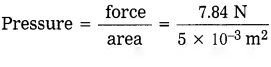
Solve the following examples: Problem 1.
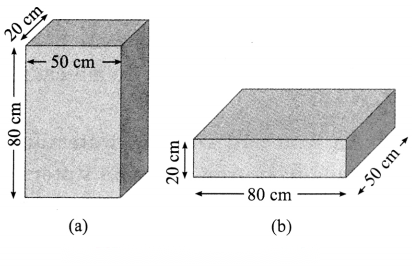
(ii) A = lb = 0.8 m × 0.5 m = 0.4 m2
Problem 2.
(ii) A = lb = 0.25 m × 0.1 m = 0.025 m2
Problem 3.
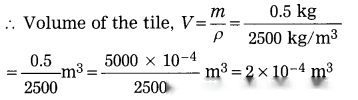
Problem 4.
Problem 5. Problem 6. Problem 7. Problem 8.
Examples For Practice: [g = 9.8 m/s2, ρ (water) = 103kg/m3= 1 g/cm3]
Question 1
Maharashtra Board Solution
Calculate the relative density of a metal having density 7.5 g/cm3.
Solution & Step-by-Step Answer:
7.5
Question 2
Maharashtra Board Solution
Find the density of steel if its relative density is 8 and the density of water is 10 kg/m3.
Solution & Step-by-Step Answer:
8 × 10³ g/cm3
Question 3
Maharashtra Board Solution
A body has mass 200 g and volume 100 cm3. Find its density and relative density.
Solution & Step-by-Step Answer:
2 g/cm3, 2
Question 4
Maharashtra Board Solution
If the relative density of a material is 2.5, find its density.
Solution & Step-by-Step Answer:
2.5 × kg/m3 or 2.5 g/cm3
Question 5
Maharashtra Board Solution
A force of 100 N is applied on an area 40 cm × 25cm. Find the corresponding pressure.
Solution & Step-by-Step Answer:
103 N/m2
Question 6
Maharashtra Board Solution
If the pressure exerted on an area 10 cm × 10 cm is 1000 dynes/cm2, find the applied force.
Solution & Step-by-Step Answer:
105 dynes
Question 7
Maharashtra Board Solution
A metal block of mass 10 kg is kept on a table. If the contact surface area Is 100 cm2, find the pressure on the table.
Solution & Step-by-Step Answer:
9.8 × 10³ N/m2 or 9.8 × 10³ Pa
Question 8
Maharashtra Board Solution
A body of volu.me 50 cm3 is immersed completely in water. Find the weight of the water displaced by the body.
Solution & Step-by-Step Answer:
0.49 N
Question 9
Maharashtra Board Solution
A block of mass 100 g and volume 20 cm3 is put in a bucket filled with water. Will it float or sink?
Solution & Step-by-Step Answer:
The body will sink in water.
Question 10
Maharashtra Board Solution
Will a block of mass 100g and volume 400 cm3 float or sink in water?
Solution & Step-by-Step Answer:
The block will float in water.
Question 11
Maharashtra Board Solution
The volume of a cube is 125 cm3 and its mass is 250 g. It is put in a tub containing water. Will it float or sink?
Solution & Step-by-Step Answer:
It will sink in water.
|