Maharashtra State Board Class 8 Science Solutions Chapter 5 Inside the Atom
Class 8 Science Chapter 5 Inside the Atom Textbook Questions and Answers
1. Answer the following.
Question a.
What is the difference in the atomic models of Thomson and Rutherford?
Answer:
Thomson’s atomic model | Rutherford’s atomic model |
1. According to Thomson’s atomic model, the negatively charged electrons are embedded in a gel of positive charge. | 1. According to Rutherford’s atomic model the negatively charged electrons revolve around the nucleus. |
2. Atom is homogenous sphere of positive charge. | 2. The positive charge is in the nucleus of the atom. |
Question b.
What is meant by valency of an element? What is the relationship between the number of valence electron and valency?
Answer:
Valency: The capacity of an ; element to combine with another element is known as valency.
Valence electrons: The electrons in the outermost shell of an atom of an element are called valence electrons.
Helium and neon, atoms of both these gaseous element do not combine with any other atom. These elements are chemically inert, i.e. their valency is zero.
Helium atom contains two electrons, indicates that the outermost shell of helium has an electron duplet. The valence shell of neon is completely filled, i.e. neon has an electron octet. Similarly argon contains eight electrons in the valence shell, i.e. argon has an electron octet. It is confirmed that the valency is zero when electron octet (or duplet) is complete.
Atoms of all the elements except inert gases have tendency to combine with other atoms, i.e. they have a non zero valency. The molecules formed by combination with hydrogen (E.g. H2, HCl) that valency of hydrogen is one. The electronic configuration of hydrogen shows that there is one electron less than the complete duplet state. This number ‘one’ matches with the valency of hydrogen which is also one.
It means that there is relationship between the valency of an element and the number of electrons in its valence shell.
Question c.
What is meant by atomic mass i number? Explain how the atomic number and mass number of carbon are 6 and 12 respectively.
Answer:
The total number of protons and neutrons in the nucleus of the atom is called the atomic mass number. The atomic number, i.e. the proton number of carbon is 6 and the mass number is total number of protons and neutrons in the carbon, i.e. 6 protons + 6 neutrons = 12. Therefore, the atomic number and mass number of carbon are 6 and 12 respectively.
Question d.
What is meant by subatomic particle? Give brief information of three subatomic particles with reference to electrical charge, mass and location.
Answer:
A particle which is a constituent of an atom hence smaller than the atom is called subatomic particle.
An atom is formed from the nucleus and the extranuclear part. These contain three types of subatomic particles.
The nucleus contains two types of subatomic particles together called nucleons. Protons and neutrons are the two types of nucleons or subatomic particles and electrons are subatomic particles in the extra nuclear part.
1. Proton (p): Proton is a positively charged subatomic particle in the atomic nucleus. The positive charge on the nucleus is due to the proton in it. A proton is represented by the symbol ‘p’. Each proton carries a positive charge of +1e. (1e = 1.6 × 10⁻¹⁹coulomb). When total positive charge on the nucleus is expressed in the unit ‘e’, its magnitude is equal to the number of proton in the nucleus.
The mass of one proton is approximately lu (1 Dalton).
(1u = 1.66 × 10⁻²⁷g) (The mass of one hydrogen atom is also approximately lu.)
2. Neutron (n): Neutron is an electrically neutral subatomic particle and is denoted by the symbol ‘n’. The number of neutron in the nucleus is denoted by the symbol ‘N’ Atomic nuclei of all the elements except hydrogen with atomic mass lu, contain neutrons. The mass of a neutron is approximately lu, which is almost equal to that of a proton.
3. Electron (e–): Electron is a negatively charged subatomic particle and is denoted by the symbol ‘e-’. Each electron carries one unit of negative charge (-1e). Mass of an electron is 1800 times less than that of a hydrogen atom. Therefore the mass of an electron can be treated as negligible. Electron in the extranuclear part revolve in the discrete orbits around the nucleus. The energy of an electron is determined by the shell in which it is present.
2. Give scientific reasons:
Question a.
All the mass of an atom is concentrated in the nucleus.
Answer:
Question b.
Atom is electrically neutral.
Answer:
Question c.
Atomic mass number is a whole number.
Answer:
Question d.
Atoms are stable though negatively charged electron are revolving within it.
Answer:
3. Define the following terms.
Question a.
Atom:
Answer:
An atom is the smallest particle of an element which retains its chemical identity in all physical and chemical changes.
Question b.
Isotope
Answer:
Atoms of the same element having the same atomic number, but different atomic mass numbers are called isotopes.
Question c.
Atomic number
Answer:
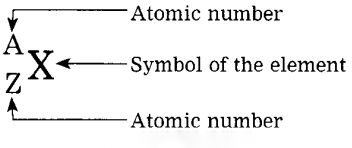
The number of electrons or protons in an atom is called the atomic number. It is denoted by Z.
Question d.
Atomic mass number
Answer:
The total number of protons and neutrons in the nucleus of the atom is called the atomic mass number. It is denoted by A.
Question e.
Moderator in nuclear reactor
Answer:
The substance which reduces the speed of fast-moving neutrons produced in a fission is called a moderator.
4. Draw a neal labelled diagram.
Question a.
Explain Rutherford’s scattering experiment.
Answer:

Alpha particles emitted by radioactive element bear a positive charge. Rutherford bombarded alpha particles through a very thin gold foil. He observed the path of α – particles by means of a fluorescent screen around the gold foil. It was expected that
Question b.
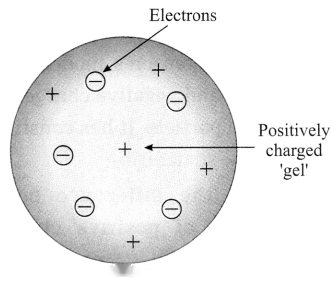
Thomson’s atomic model.
Answer:
Thomson’s plum pudding model of atom:
Question c.
Diagrammatic sketch of electronic configuration of magnesium (Atomic number 12).
Answer:
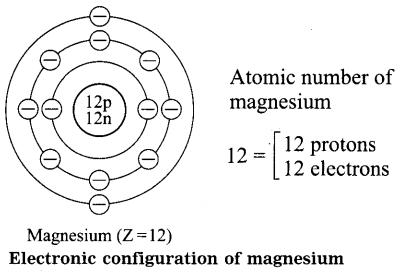
Question d.
Diagrammatic sketch of electronic configuration of argon (Atomic number 18).
Answer:
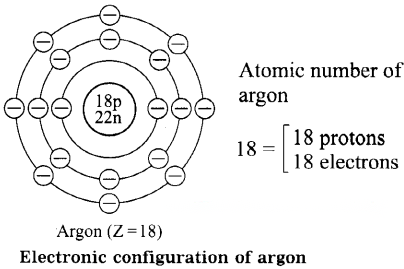
5. Fill in the blanks.
6. Match the pairs.
Column I | Column II |
1. Proton | a. Negatively charged |
2. Electron | b. Neutral |
3. Neutron | c. Positively charged |
Column I | Column II |
1. Proton | c. Positively charged |
2. Electron | a. Negatively charged |
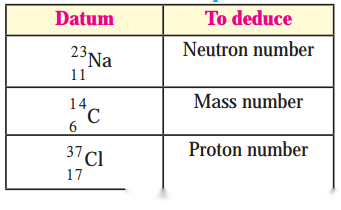
3. Neutron | b. Neutral 7. Deduce from the datum provided.
Question 1
Maharashtra Board Solution
Solution & Step-by-Step Answer:
1. There are 12 neutrons in the sodium . (N = A – Z) 23 – 11 = 12 2. Atomic mass number of is 14. 3. There are 17 protons in chlorine
Project: Explain the atomic models using the material such as old C.D., balloon, thread, marbles, etc. Class 8 Science Chapter 5 Inside the Atom Additional Important Questions and Answers Rewrite the sentences after filling the blanks:
Question 1
Maharashtra Board Solution
An atom is electrically ……………..
Solution & Step-by-Step Answer:
An atom is electrically neutral.
Question 2
Maharashtra Board Solution
Except hydrogen, the nuclei of all atoms contain …………...
Solution & Step-by-Step Answer:
Except hydrogen, the nuclei of all atoms contain neutrons.
Question 3
Maharashtra Board Solution
, …………… and …………. are isotopes of carbon.
Solution & Step-by-Step Answer:
, and are isotopes of carbon.
Question 4
Maharashtra Board Solution
An atom has 11 protons and …………. neutrons and hence its atomic mass number is 23.
Solution & Step-by-Step Answer:
An atom has 11 protons and 12 neutrons and hence its atomic mass number is 23.
Question 5
Maharashtra Board Solution
The element ………….. has two electrons in the K shell, but it is a noble gas.
Solution & Step-by-Step Answer:
The element helium has two electrons in the K shell, but it is a noble gas.
Question 6
Maharashtra Board Solution
Isotopes of the element have the same ……….. properties.
Solution & Step-by-Step Answer:
Isotopes of the element have the same chemical properties.
Question 7
Maharashtra Board Solution
Electrons must absorb …………….. to transit between orbits.
Solution & Step-by-Step Answer:
Electrons must absorb energy to transit between orbits.
Question 8
Maharashtra Board Solution
……….. discovered the electron.
Solution & Step-by-Step Answer:
J. J. Thomson discovered the electron.
Question 9
Maharashtra Board Solution
∝ – particles have ………….. charge.
Solution & Step-by-Step Answer:
∝ – particles have positive charge.
Question 10
Maharashtra Board Solution
Electrons revolve around the …………….. in certain discrete orbits.
Solution & Step-by-Step Answer:
Electrons revolve around the nucleus in certain discrete orbits.
Question 11
Maharashtra Board Solution
The shell-wise distribution of electrons is called the ………………….
Solution & Step-by-Step Answer:
The shell-wise distribution of electrons is called the electronic configuration.
Question 12
Maharashtra Board Solution
Democritus termed the smallest particles of matter as …………….
Solution & Step-by-Step Answer:
Democritus termed the smallest particles of matter as atoms.
Question 13
Maharashtra Board Solution
………………. discovered neutron.
Solution & Step-by-Step Answer:
James Chadwick discovered neutron.
Question 14
Maharashtra Board Solution
Electrons revolve around the nucleus in paths called …………...
Solution & Step-by-Step Answer:
Electrons revolve around the nucleus in paths called orbits.
Question 15
Maharashtra Board Solution
The second shell has the capacity of ……………….
Solution & Step-by-Step Answer:
The second shell has the capacity of 8 electrons.
Question 16
Maharashtra Board Solution
Electrons in the ………….. shell have minimum energy.
Solution & Step-by-Step Answer:
Electrons in the K or first shell have minimum energy.
Question 17
Maharashtra Board Solution
Electrons in an atom occupy shells in increasing order of …………….
Solution & Step-by-Step Answer:
Electrons in an atom occupy shells in increasing order of energy.
Question 18
Maharashtra Board Solution
Atomic masses are measured in a unit called …………….
Solution & Step-by-Step Answer:
Atomic masses are measured in a unit called dalton.
Question 19
Maharashtra Board Solution
According to the atomic model of …………….., electrons are embedded in a gel of positive charge.
Solution & Step-by-Step Answer:
According to the atomic model of Thomson, electrons are embedded in a gel of positive charge.
Question 20
Maharashtra Board Solution
All atoms, except ………….. contain neutrons in their nuclei.
Solution & Step-by-Step Answer:
All atoms, except normal hydrogen contain neutrons in their nuclei.
Question 21
Maharashtra Board Solution
The maximum capacity of the M shell is ………………… electrons.
Solution & Step-by-Step Answer:
The maximum capacity of the M shell is 18 electrons.
Question 22
Maharashtra Board Solution
The atom of the element ……………. has eight electrons in the outermost shell.
Solution & Step-by-Step Answer:
The atom of the element neon has eight electrons in the outermost shell.
Rewrite the following statements selecting the correct options:
Question 1
Maharashtra Board Solution
The symbol A is used to denote the ………….. (a) atomic number (b) atomic radius (c) atomic mass number (d) atomic mass
Solution & Step-by-Step Answer:
(c) atomic mass number
Question 2
Maharashtra Board Solution
The existence of isotopes is due to the presence of different number of ……………... (a) electrons (b) protons (c) neutrons (d) positrons
Solution & Step-by-Step Answer:
(c) neutrons
Question 3
Maharashtra Board Solution
In the nucleus of a sodium atom (), there are ……………… neutrons. (a) 11 (b) 12 (c) 10 (d) 9
Solution & Step-by-Step Answer:
(b) 12
Question 4
Maharashtra Board Solution
Isotopes of an element have the same number of ……………... (a) neutrons (b) nucleons (c) electrons (d) atoms
Solution & Step-by-Step Answer:
(c) electrons
Question 5
Maharashtra Board Solution
The great Indian philosopher ………….. proposed that matter is made up of invisible tiny particles. (a) Aryabhatta (b) Kanad (c) Bhaskaracharya (d) Chanakya
Solution & Step-by-Step Answer:
(b) Kanad
Question 6
Maharashtra Board Solution
The maximum capacity of the M shell is …………… electrons. (a) 2 (b) 8 (c) 18 (d) 32
Solution & Step-by-Step Answer:
(c) 18
Question 7
Maharashtra Board Solution
The mass of the electron is …………….. times less than that of a hydrogen atom. (a) 1800 (b) 8100 (c) 1550 (d) 1600
Solution & Step-by-Step Answer:
(a) 1800
Question 8
Maharashtra Board Solution
The L shell is the valence shell in ………….. (a) hydrogen (b) chlorine (c) oxygen (d) sodium
Solution & Step-by-Step Answer:
(c) oxygen
Question 9
Maharashtra Board Solution
The M shell is the valence shell in ………………... (a) fluorine (b) neon (c) carbon (d) chlorine
Solution & Step-by-Step Answer:
(d) chlorine
Question 10
Maharashtra Board Solution
The N shell is the valence shell in …………... (a) fluorine (b) chlorine (c) bromine (d) helium
Solution & Step-by-Step Answer:
(c) bromine
Question 11
Maharashtra Board Solution
The maximum capacity of the N shell is ……………. electrons. (a) 2 (b) 32 (c) 18 (d) 8
Solution & Step-by-Step Answer:
(b) 32
Question 12
Maharashtra Board Solution
The maximum number of electrons that can be accommodated in the third orbit is …………. (a) 3 (b) 8 (c) 32 (d) 18
Solution & Step-by-Step Answer:
(d) 18
Question 13
Maharashtra Board Solution
Rutherford alpha-particle scattering experiment was responsible for the discovery of the ……………….. (a) atomic nucleus (b) proton (c) electron (d) atomic mass
Solution & Step-by-Step Answer:
(d) atomic mass
Question 14
Maharashtra Board Solution
Isotopes of element have ……………... (a) different atomic numbers and different atomic mass (b) different atomic numbers but the same atomic mass number (c) the same atomic number but different atomic mass numbers (d) the same atomic number and the same atomic mass number
Solution & Step-by-Step Answer:
(c) the same atomic number but different atomic mass numbers
Question 15
Maharashtra Board Solution
The nucleus of an atom contains 19 protons and 21 neutrons. The atomic mass number of the element is …………... (a) 19 (b) 21 (c) 40 (d) 39
Solution & Step-by-Step Answer:
(c) 40
Question 16
Maharashtra Board Solution
The nucleus of an atom contains 18 protons and 22 neutrons. The atomic number of the element is ………………. (a) 18 (b) 40 (c) 22 (d) 4
Solution & Step-by-Step Answer:
(a) 18
Question 17
Maharashtra Board Solution
When writing the symbol of its …………… and ………….. are written. (a) atomic number, atomic mass number (b) protons, electrons (c) protons, neutrons (d) atomic number, electrons
Solution & Step-by-Step Answer:
(a) atomic number, atomic mass number
Question 18
Maharashtra Board Solution
The particles in the atomic nucleus are ……………... (a) protons and electrons (b) electrons (c) electrons and neutrons (d) protons and neutrons
Solution & Step-by-Step Answer:
(d) protons and neutrons
State whether the following statements are True or False:
Question 1
Maharashtra Board Solution
An atom as a whole is electrically neutral
Solution & Step-by-Step Answer:
True.
Question 2
Maharashtra Board Solution
The mass of an atom is distributed evenly within it.
Solution & Step-by-Step Answer:
False. (The mass of atom is not distributed evenly, practically all the mass is concentrated in the nucleus.)
Question 3
Maharashtra Board Solution
The electron has the same mass as that of the proton.
Solution & Step-by-Step Answer:
False. (The mass of the electron is much less than that of the proton.)
Question 4
Maharashtra Board Solution
The electron in the K shell has maximum energy.
Solution & Step-by-Step Answer:
False. (The electrons in the K shell has minimum energy.)
Question 5
Maharashtra Board Solution
Isotopes have same atomic number but different atomic mass number.
Solution & Step-by-Step Answer:
True.
Question 6
Maharashtra Board Solution
Matter is composed of molecules and molecules are made of atoms.
Solution & Step-by-Step Answer:
True.
Question 7
Maharashtra Board Solution
In India, total 22 nuclear reactors in eight places are functioning.
Solution & Step-by-Step Answer:
True.
Question 8
Maharashtra Board Solution
The number of electrons in a given orbit is given by the formula n
Solution & Step-by-Step Answer:
False. (The number of electrons in a given orbit is given by the formula 2n2)
Question 9
Maharashtra Board Solution
Atomic masses are measured in a unit called the dalton (u).
Solution & Step-by-Step Answer:
True.
Question 10
Maharashtra Board Solution
The chemical properties of isotopes are different.
Solution & Step-by-Step Answer:
False. (The chemical properties of isotopes are the same.)
Question 11
Maharashtra Board Solution
The maximum capacity of the N shell is 18 electrons.
Solution & Step-by-Step Answer:
False. (The maximum capacity of the N shell is 32 electrons.)
Question 12
Maharashtra Board Solution
Deuterium is an isotope of hydrogen.
Solution & Step-by-Step Answer:
True.
Question 13
Maharashtra Board Solution
Isotopes are used in the treatment of cancer.
Solution & Step-by-Step Answer:
True.
Question 14
Maharashtra Board Solution
Atoms of all elements, except normal hydrogen contain neutrons.
Solution & Step-by-Step Answer:
True.
Question 15
Maharashtra Board Solution
Electrons moving in different orbits possess the same amount of energy.
Solution & Step-by-Step Answer:
False. (Electrons moving in different orbits possess different amounts of energy.
Question 16
Maharashtra Board Solution
Rutherford discovered the neutron.
Solution & Step-by-Step Answer:
False. (Chadwick discovered the neutron.)
Question 17
Maharashtra Board Solution
The nth orbit contains at the most 2n2 electrons.
Solution & Step-by-Step Answer:
True.
Question 18
Maharashtra Board Solution
Electrons have different energies according to their orbits.
Solution & Step-by-Step Answer:
True.
Question 19
Maharashtra Board Solution
The capacity of the second orbit is 18 electrons.
Solution & Step-by-Step Answer:
False. (The capacity of the second orbit is 8 electrons.)
Question 20
Maharashtra Board Solution
The radioactive isotope Sodium-24 is used in the medical treatment of cancer.
Solution & Step-by-Step Answer:
False. (The radioactive isotope Sodium-24 is used for detection of cracks in the underground pipes.)
Question 21
Maharashtra Board Solution
Uranium-235 is used in the production of electricity.
Solution & Step-by-Step Answer:
True.
Consider the relation between I the items in the first pair and write the correlation for second pair:
Question 1
Maharashtra Board Solution
K : 2 : M : …………..
Solution & Step-by-Step Answer:
18
Question 2
Maharashtra Board Solution
Carbon : 2, 4 : : Fluorine : ……………...
Solution & Step-by-Step Answer:
2, 7
Question 3
Maharashtra Board Solution
Nitrogen : Valency three : : Fluorine : ……………...
Solution & Step-by-Step Answer:
valency one
Question 4
Maharashtra Board Solution
Atomic radius : pm : Atomic mass : ……………..
Solution & Step-by-Step Answer:
u
Question 5
Maharashtra Board Solution
NaH : Valency of Na : 1 : : MgCl2 : Valency of Mg …………….
Solution & Step-by-Step Answer:
2
Question 6
Maharashtra Board Solution
: number of neutrons 18 : : { }^{37} Cl/latex] : ……………...
Solution & Step-by-Step Answer:
number of neutrons 20
Question 7
Maharashtra Board Solution
Protons : Positive : : ……………. : Neutral.
Solution & Step-by-Step Answer:
Neutrons.
Match the following:
Question 1
Maharashtra Board Solution
|
Column I | Column II |
1. Thomson | a. Well defined orbits |
2. Rutherford | b. Neutron |
3. Chadwick | c. Scattering experiment |
4. Bohr | d. Electron |
Column I | Column II |
1. Thomson | d. Electron |
2. Rutherford | c. Scattering experiment |
3. Chadwick | b. Neutron |
4. Bohr | a. Well defined orbits
Question 2
Maharashtra Board Solution
|
Column I | Column II |
1. Atom | a. Treatment of goitre |
2. Isotopes of iodine | b. Protons + Neutrons |
3. Atomic mass number | c. Different number of neutrons |
4. Isotopes | d. Electrically neutral |
Column I | Column II |
1. Atom | d. Electrically neutral |
2. Isotopes of iodine | a. Treatment of goitre |
3. Atomic mass number | b. Protons + Neutrons |
4. Isotopes | c. Different number of neutrons
Question 3
Maharashtra Board Solution
|
Column I | Column II |
1. Alpha particles | a. Inert element |
2. Uranium-235 | b. Negatively charged particles |
3. Helium | c. Positively charged particles |
4. Isotopes | d. Krypton – 92, Barium 141 |
e. U-233, Th-232 | |
f.12C,13C,14C |
Column I | Column II | ||||||||||||||||||||||||||||||||||||||||||||
1. Alpha particles | c. Positively charged particles | ||||||||||||||||||||||||||||||||||||||||||||
2. Uranium-235 | d. Krypton – 92, Barium 141 | ||||||||||||||||||||||||||||||||||||||||||||
3. Helium | a. Inert element | ||||||||||||||||||||||||||||||||||||||||||||
4. Isotopes | f.12C,13C,14C Distinguish between the following:
Question 1
Maharashtra Board Solution
Proton and Neutron:
Solution & Step-by-Step Answer:
Question 2
Maharashtra Board Solution
Neutron and Electron:
Solution & Step-by-Step Answer:
Question 3
Maharashtra Board Solution
Proton and Electron:
Solution & Step-by-Step Answer:
Question 4
Maharashtra Board Solution
Atomic number and Atomic mass number:
Solution & Step-by-Step Answer:
Answer the following questions in one sentence each:
Question 1
Maharashtra Board Solution
Name the particles which are present in the nucleus of an atom.
Solution & Step-by-Step Answer:
Protons and neutrons are present in the nucleus of an atom.
Question 2
Maharashtra Board Solution
State the relation between the number of protons, the number of neutrons and the atomic mass number (A) of an element.
Solution & Step-by-Step Answer:
Atomic mass = Number of + Number of number (A) protons (p) neutrons (n)
Question 3
Maharashtra Board Solution
Chlorine contains 17 protons and 18 neutrons. What is its atomic mass number?
Solution & Step-by-Step Answer:
The atomic mass number of chlorine is 35.
Question 4
Maharashtra Board Solution
Carbon contains 6 protons and 6 neutrons. State its atomic number and atomic mass number.
Solution & Step-by-Step Answer:
The atomic number of carbon is 6 and the atomic mass number is 12.
Question 5
Maharashtra Board Solution
State one use of isotopes of cobalt.
Solution & Step-by-Step Answer:
Isotopes of Cobalt-60 are used in the treatment of cancer.
Question 6
Maharashtra Board Solution
State one use of isotopes of i uranium.
Solution & Step-by-Step Answer:
Isotopes of uranium are used for production of electrical energy.
Question 7
Maharashtra Board Solution
Write the electronic configuration of oxygen.
Solution & Step-by-Step Answer:
Electronic configuration of oxygen is 2, 6.
Question 8
Maharashtra Board Solution
Write the electronic configuration of chlorine.
Solution & Step-by-Step Answer:
Electronic configuration of chlorine is 2, 8, 7.
Question 9
Maharashtra Board Solution
State the number of electrons in the L shell of lithium.
Solution & Step-by-Step Answer:
There is one electron in the L shell of lithium.
Question 10
Maharashtra Board Solution
State the number of electrons in the M shell of argon.
Solution & Step-by-Step Answer:
There are 8 electrons in the M shell of argon.
Question 11
Maharashtra Board Solution
State the number of electrons in the K shell of helium.
Solution & Step-by-Step Answer:
There are two electrons in the K shell of helium.
Question 12
Maharashtra Board Solution
Name isotopes of hydrogen.
Solution & Step-by-Step Answer:
Hydrogen, Deuterium and Tritium are the isotopes of hydrogen.
Question 13
Maharashtra Board Solution
Name two isotopes of carbon.
Solution & Step-by-Step Answer:
{ }_{6}^{12} C and are the isotopes of carbon.
Question 14
Maharashtra Board Solution
Name two elements in which the K and L shells of an atom are completely filled with electrons.
Solution & Step-by-Step Answer:
The elements are neon and argon.
Question 15
Maharashtra Board Solution
From the symbol , state the electronic configuration of oxygen and the atomic mass number of isotope oxygen.
Solution & Step-by-Step Answer:
Electronic configuration of oxygen : 2, 6. Atomic mass number of oxygen : 16.
Question 16
Maharashtra Board Solution
The atomic mass number of an element is 18, and the element contains 8 electrons. What is the number of protons and neutrons in it?
Solution & Step-by-Step Answer:
Number of protons : 8, Number of neutrons : 10.
Question 17
Maharashtra Board Solution
An atom contains 2 protons, 2 electrons and 3 neutrons. State its atomic number and atomic mass number.
Solution & Step-by-Step Answer:
Atomic number: 2, Atomic mass number: 5.
Question 18
Maharashtra Board Solution
How many electrons could there be in the outermost orbit of an element whose valency is 3?
Solution & Step-by-Step Answer:
If the valency of an element is 3 then there is a possibility of 3 or 5 electrons in the outermost orbit.
Question 19
Maharashtra Board Solution
Which element is used as fuel in atomic reactors?
Solution & Step-by-Step Answer:
Isotopes of uranium are used as fuel in atomic reactors.
Question 20
Maharashtra Board Solution
Name the place and the first nuclear reactor in India.
Solution & Step-by-Step Answer:
Apsara at Bhabha Atomic Research Centre in Mumbai is the first nuclear reactor in India.
Answer the following questions:
Question 1
Maharashtra Board Solution
Explain Dalton’s atomic theory. OR Write the postulates of Dalton’s atomic theory.
Solution & Step-by-Step Answer:
Dalton’s atomic theory:
Try this: Question a. Question b.
Question 2
Maharashtra Board Solution
How will you think about atomic mass distribution according to Thomson’s I model? Whether this distribution is uniform or non uniform as per Dalton’s atomic theory? (Use your brainpower!
Solution & Step-by-Step Answer:
In Thomson’s model the distribution of atomic mass is uniform. Dalton’s atomic theory does not say anything about atomic mass distribution.
Question 3
Maharashtra Board Solution
If the striker flicked by you misses the coin that you aimed at, where would the striker go? Can you tell?
Solution & Step-by-Step Answer:
The striker will continue to move practically with the same velocity till it strikes some other coin or the edge of the board or enter the pocket.
Question 4
Maharashtra Board Solution
If the striker hits the coin, in which direction would it go? Straight forward to a side or in the reverse direction?
Solution & Step-by-Step Answer:
Striker may go straight forward or it may be deflected depending upon the exact direction of the motion of the striker.
Question 5
Maharashtra Board Solution
Draw a neat labelled diagram of Thomson’s atomic model.
Solution & Step-by-Step Answer:
Question 6
Maharashtra Board Solution
What were the conclusions drawn from the alpha particle experiment performed hy Rutherford?
Solution & Step-by-Step Answer:
On the basis of the alpha particle experiment the following conclusions were drawn by Rutherford:
Question 7
Maharashtra Board Solution
Explain Rutherford’s atomic model.
Solution & Step-by-Step Answer:
Question 8
Maharashtra Board Solution
Which discovery did point out that an atom has internal structure? (Use your brainpower!
Solution & Step-by-Step Answer:
The discovery of radioactivity (1896) pointed out that an atom has internal structure.
Question 9
Maharashtra Board Solution
What is the difference between the solid atom in Dalton’s atomic theory and Thomson’s atomic model? (Use your brain power!
Solution & Step-by-Step Answer:
The solid atom in Dalton’s atomic theory is a single particle it does not have any structure and also does not have any constituents. In Thomson’s model, atom is made of positive and negative charges. Thus it is not a single particle. It has constituents and has internal structure.
Question 10
Maharashtra Board Solution
Explain the difference between the distribution of positive charge in Thomson’s atomic model and Rutherford’s atomic model. (Use your brain power!
Solution & Step-by-Step Answer:
According to Thomson’s atomic model, the atom is a homogeneous sphere of positive charge. According to Rutherford’s atomic model, the positive charge is concentrated in the nucleus.
Question 11
Maharashtra Board Solution
What is the point difference between the place of electron in the atomic models of Thomson and Rutherford? (Use your brain power!
Solution & Step-by-Step Answer:
According to Thomson’s atomic model, the negatively charged electrons are embedded in a gel of positive charge and they are stationary. According to Rutherford’s atomic model, the negatively charged electrons revolve around the nucleus.
Question 12
Maharashtra Board Solution
What is the thing which is present in Rutherford’s atomic model and not present in Dalton’s and Thomson’s atomic models? (Use your brain power!
Solution & Step-by-Step Answer:
1. Dalton’s atomic model: Dalton’s atomic theory does not tell anything about the structure of the atom. There is no mention of electron in Dalton’s atomic theory.
Rutherford’s atomic model: 2. Thomson’s atomic model: Rutherford’s atomic model:
Question 13
Maharashtra Board Solution
Explain Niels Rohr’s atomic model. OR Write the postulates of Bohr’s atomic model.
Solution & Step-by-Step Answer:
The important postulates of Bohr’s atomic model are as follows:
Question 14
Maharashtra Board Solution
How many types of subatomic particles are found in atom? Use your brainpower!
Solution & Step-by-Step Answer:
There are three types of subatomic particles found in atom, viz. the proton, neutron and electron.
Question 15
Maharashtra Board Solution
Which subatomic particles are electrically charged? Use your brain power!
Solution & Step-by-Step Answer:
The proton is a positively charged subatomic particle and the electron is a negatively charged particle.
Question 16
Maharashtra Board Solution
Which subatomic particles are present in the nucleus? Use your brain power!
Solution & Step-by-Step Answer:
The proton and neutron are present in the nucleus.
Question 17
Maharashtra Board Solution
Where are electrons revolving around the nucleus placed? Use your brain power!
Solution & Step-by-Step Answer:
Electrons revolve in the discrete orbits around the nucleus.
Question 18
Maharashtra Board Solution
State the characteristics of the neutron.
Solution & Step-by-Step Answer:
Question 19
Maharashtra Board Solution
State the characteristics of protons.
Solution & Step-by-Step Answer:
Question 20
Maharashtra Board Solution
State the characteristics of electrons.
Solution & Step-by-Step Answer:
Question 21
Maharashtra Board Solution
The symbol used for oxygen is ‘O’. There are 8 protons and 8 neutrons in its nucleus. From this determine the 1 atomic number (Z) and mass number (A) of oxygen and arrange these in a 1 conventional symbol. Use your brain power!
Solution & Step-by-Step Answer:
Atomic mass number = Protons + Neutrons = 8 + 8 Atomic mass number = 16 Atomic number, i.e. the proton number = 8 The conventional symbol = Z = Atomic number i.e. number of protons is 8. A = Atomic mass number = 16. The conventional symbol = .
Question 22
Maharashtra Board Solution
Atomic number of carbon is 6. How many electrons are there in a carbon atom? Use your brainpower!
Solution & Step-by-Step Answer:
The atomic number of carbon, i.e. the proton number of carbon is 6. The number of electron in the extranuclear part is equal to the number of protons in the nucleus. ∴ The number of electrons in a carbon atom = 6.
Question 23
Maharashtra Board Solution
A sodium atom contains 11 electrons. What is the atomic number of sodium? Use your brain power!
Solution & Step-by-Step Answer:
The number of electron in the extranuclear part is equal to the number of protons, i.e. atomic number. The atomic number of sodium is 11.
Question 24
Maharashtra Board Solution
The atomic number and mass number of magnesium are 12 and 24 respectively. How will you show this by the convention symbol? Use your brainpower!
Solution & Step-by-Step Answer:
The atomic number, atomic mass number and the symbol of an element are written as: the conventional symbol for magnesium.
Question 25
Maharashtra Board Solution
The atomic number and mass number of calcium are 20 and 40 respectively. Deduce the number of neutron present in the calcium nucleus. Use your brain power!
Solution & Step-by-Step Answer:
There are 20 neutrons in the nucleus of calcium. [Note: The number of neutrons N = A – Z = 40 – 20 = 20]
Question 26
Maharashtra Board Solution
Write a note on distribution of electrons in orbits. OR What is the maximum number of ( electrons that can be accommodated in each of the orbits (shells) K, L, M, N, etc.?
Solution & Step-by-Step Answer:
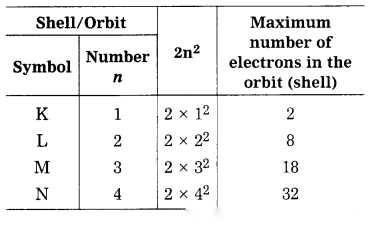
The number of maximum electrons in different orbits of the atom are fixed. The orbit (shell) closest to the nucleus is: given the number 1, the next orbit the ; number 2… etc. The orbits one are designated ; by letters K, L, M, N,… corresponding to the shell numbers n = 1, 2, 3, 4, … etc. The maximum number of electrons in a given orbit is 2n2, when n is the number of orbit (shell), thus the first shell has the capacity of 2 electrons, the second 8, the third 18, the fourth 32 and so on. The electrons in the K shell have minimum energy. The electrons in the subsequent shells possess higher energy.
Question 27
Maharashtra Board Solution
There is a similarity in atomic structure and solar system. The planets revolve around the sun due to the gravitational force. Which force might be acting in the atomic structure? Can you tell?
Solution & Step-by-Step Answer:
The electric force might be acting in the atomic structure. In the atomic structure, electric force is much stronger than gravitational force. [Note: Here the gravitational force is very very small compared to the electric force, therefore, the gravitational force can be ignored.]
Question 28
Maharashtra Board Solution
Positively charged proton are together in the nucleus. What might be, one of the function of the neutrons in the nucleus? Can you tell?
Solution & Step-by-Step Answer:
One of the function of the neutrons in the nucleus is to keep the protons and neutrons together by nuclear force.
Question 29
Maharashtra Board Solution
What do you understand by electronic configuration?
Solution & Step-by-Step Answer:
The shellwise distribution of the electron in an atom of an element is called the electronic configuration.?
Question 30
Maharashtra Board Solution
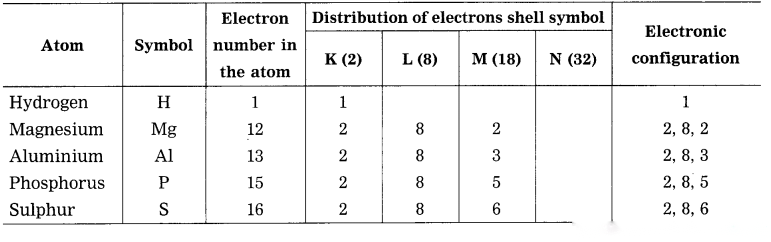
Write the electronic configuration of the following elements: (1) Hydrogen, (2) Magnesium. (3) Aluminium, (4) Phosphorus, (5) Sulphur.
Solution & Step-by-Step Answer:
Question 31
Maharashtra Board Solution
Use the following molecular formulae to determine the valencies of H, Cl, O, S, N, C, Br, I, Na. Molecular formulae – H2, HCl, H2O, H2S, NH3, CH4, HBr, HI, NaH. Can you recall?
Solution & Step-by-Step Answer:
Question 32
Maharashtra Board Solution
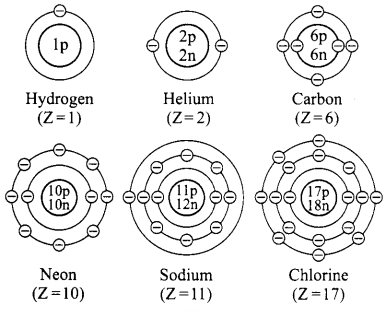
Draw suitable diagrams to show the electronic configuration of the atoms of the following elements: Hydrogen, helium, carbon, neon, sodium, chlorine.
Solution & Step-by-Step Answer:
Question 33
Maharashtra Board Solution
What are the symbols used for the shells which accommodate the electrons in various atoms? Use your brain power!
Solution & Step-by-Step Answer:
The symbols used for the shells which accommodate the electrons are K, L, M, N, … respectively.
Question 34
Maharashtra Board Solution
What is the symbol and ordinal number of the innermost shell? (Use your brain power!
Solution & Step-by-Step Answer:
The symbol of the innermost shell is K and ordinal number of the innermost shell is 1.
Question 35
Maharashtra Board Solution
Write symbol of electron distribution in shell of fluorine atom? Use your brain power!
Solution & Step-by-Step Answer:
Symbol for fluorine atom = F, Electronic configuration of fluorine , .
Question 36
Maharashtra Board Solution
Which is the outermost shell of fluorine atom? Use your brain power!
Solution & Step-by-Step Answer:
The outermost shell of fluorine atom is L.
Question 37
Maharashtra Board Solution
Which is the outermost shell of sodium atom? Use your brain power!
Solution & Step-by-Step Answer:
The outermost shell of sodium atom is M shell.
Question 38
Maharashtra Board Solution
Which is the outermost shell of hydrogen atom? Use your brain power!
Solution & Step-by-Step Answer:
The outermost shell of hydrogen is K shell.
Question 39
Maharashtra Board Solution
What is meant by the atomic number (Z) of an element? (Use your brain power!
Solution & Step-by-Step Answer:
Atomic number (Z): The number of electrons or protons in an atom is called the atomic number. It is denoted by Z.
Question 40
Maharashtra Board Solution
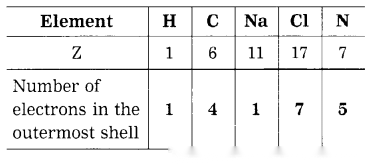
Atomic numbers (Z) of some elements are given here. Write down the number of electron present in the outermost shell of each of them. Use your brain power!
Solution & Step-by-Step Answer:
Question 41
Maharashtra Board Solution
The number of electrons of some elements is given here. By using it write the electronic configuration, number of valence electron and valency of the respective elements. Use your brain power!
Solution & Step-by-Step Answer:
Question 42
Maharashtra Board Solution
Why are the atomic numbers and atomic mass numbers always in whole numbers? Use your brain power!
Solution & Step-by-Step Answer:
The total number of protons and neutrons in the nucleus of the atom is called the atomic mass number (A). The number of electrons or protons in an atom is called the atomic number (Z). Both protons and neutrons are whole numbers, therefore, atomic numbers and atomic mass numbers are always in whole numbers.
Question 43
Maharashtra Board Solution
Sulphur contains 16 protons and 16 neutrons. What would be its atomic number and mass number? Use your brain power.
Solution & Step-by-Step Answer:
The atomic number of sulphur is 16 and the atomic mass number is 32.
Question 44
Maharashtra Board Solution
State the uses of isotopes.
Solution & Step-by-Step Answer:
Isotopes of some elements are radioactive. Isotopes are used in various fields such as industry, agriculture, medicine, research field.
Question 45
Maharashtra Board Solution
Write a note on nuclear reactor.
Solution & Step-by-Step Answer:
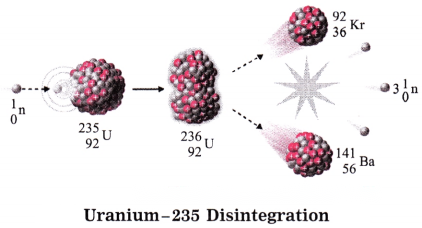
1. A machine that generates electricity on large scale by using atomic energy is called a nuclear reactor. In a nuclear reactor, the nuclear energy in atom is released by bringing about nuclear reactions on the nuclear fuel.
2. When uranium – 235 is bombarded with a slow speed neutron, it undergoes nuclear fission. Various elements are produced. For example: Krypton – 92 and Barium – 141 along with 2 to 3 neutrons are emitted on fission, these neutron have high speed. Their speed is reduced and they are used for bombarding more Uranium – 235 nuclei. The process is repeated many times. In this way a chain reaction of nuclear fission takes place (See the figure). A large amount of nuclear energy is released during a chain reaction of fission. The chain reaction is controlled to prevent the probable explosion.
Give scientific reasons:
Question 1
Maharashtra Board Solution
In Rutherford’s experiment, some alpha particles colliding with the thin gold foil are turned back.
Solution & Step-by-Step Answer:
1. All the positive charges in an atom is concentrated in a very small region at the centre of the atom. This region is called the nucleus. Electrons revolve around the nucleus, but most of the atom is empty. Alpha particles are positively charged.
2. When a thin sheet of gold is bombarded by alpha particles, most of the particles pass through it without deviation as the atom is almost empty. But some alpha particles move directly towards the positive nuclei, collide with them and due to the electric repulsion, turn back. Thus, in Rutherford’s experiment, some alpha particles colliding with the thin gold foil are turned back.
Question 2
Maharashtra Board Solution
Two electrons in helium atom are placed in only one shell while three electrons in lithium atom occupy two shells.
Solution & Step-by-Step Answer:
1. The electronic configuration of helium is (2). It indicates that helium atom has two electrons. Both the electrons are accommodated in the K shell. The maximum capacity of the K shell is two electrons and is maintained in all the elements. Hence, two electrons in helium are placed in only one shell.
2. The electronic configuration of lithium is (2, 1). It indicates that lithium atom has three electrons. The first shell K accommodates two electrons, i.e., the maximum capacity of the K shell. The remaining electron is accommodated in the next shell, i.e., the L shell. Thus, three electrons in lithium occupy two shells (K and L). Complete the following:
Question 1
Maharashtra Board Solution
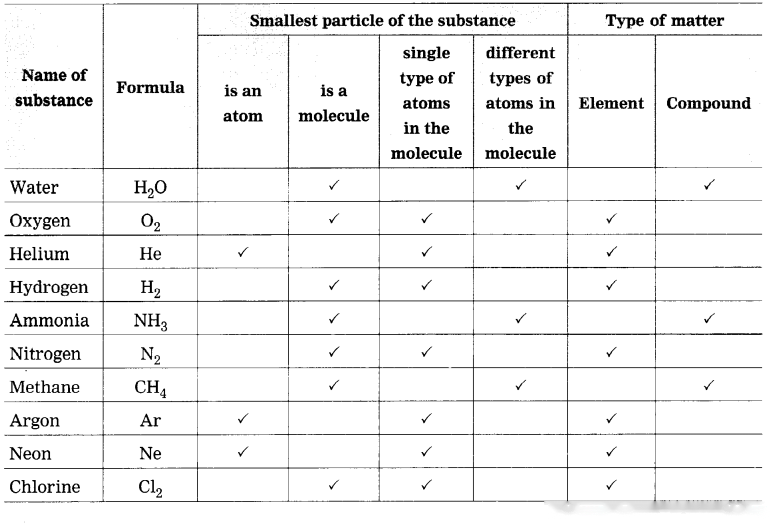
Complete the table by putting tick mark in appropriate box.
Solution & Step-by-Step Answer:
Types of substances:
Question 2
Maharashtra Board Solution
Complete the table:
Solution & Step-by-Step Answer:
Write the maximum number of electron in a shell using the above table. K Shell : 2, L Shell : 8, M Shell : 18, N Shell : 32.
Question 3
Maharashtra Board Solution
Complete the table:
Solution & Step-by-Step Answer:
Electronic configuration of some elements:
Question 4
Maharashtra Board Solution
Complete the following table:
Solution & Step-by-Step Answer:
Relationship between valency and electronic configuration:
Question 5
Maharashtra Board Solution
In table 4 column you have written of that element? How many electrons identified valency from its molecular are used to complete the octet? formulae. When the number of the valency electrons in an element ‘x’ is 4 or less than 4, does ‘x’ match with the valency of that element? Use your brain power!
Solution & Step-by-Step Answer:
When the number of the valence electrons in an element x is 4 or less than 4, then x matches with the valency of that element.
Question 6
Maharashtra Board Solution
When the number of the valence electrons in an element ‘x’ is 4 or more than 4, does’(8 – x)’ match with the valency of that element? How many electrons are used to complete the octet? (Use your brain power!
Solution & Step-by-Step Answer:
When the number of the valence electrons in an element x is 4 or more than 4, then (8-x) matches with the valency of that element. (8-x) electrons are used to complete the octet.
Question 7
Maharashtra Board Solution
Complete the table:
Solution & Step-by-Step Answer:
|