Maharashtra State Board Class 8 Science Solutions Chapter 7 Metals and Nonmetals
Class 8 Science Chapter 7 Metals and Nonmetals Textbook Questions and Answers
1. Complete the table:
Question a.
Answer:
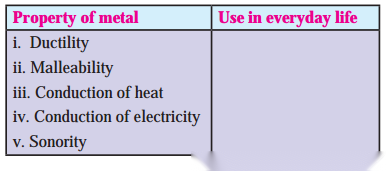
Property of metal | Use in everyday life |
i. Ductility | i. Gold, silver ornaments |
ii. Malleability | ii. Aluminium sheets, galvanised sheets |
iii. Conduction of heat | iii. Stainless steel vessels, copper vessels, boilers |
iv. Conduction of electricity | iv. Copper wires |
v. Sonority | v. Brass articles |
2. Identify the odd term.
Question a.
Gold, Silver, Iron, Diamond.
Answer:
Diamond. (Others are metals.)
Question b.
Ductility, Brittleness, Sonority, Malleability.
Answer:
Brittleness. (Other properties are metallic properties.)
Question c.
Carbon, Bromine, Sulphur, Phosphorus.
Answer:
Bromine. (Others are solids.)
Question d.
Brass, Bronze, Iron, Steel.
Answer:
Iron. (Others are alloys.)
3. Give scientific reasons:
Question a.
The stainless steel vessels in kitchen have copper coating on the bottom.
Answer:
Question b.
Copper and brass vessels are cleaned with lemon.
Answer:
Question c.
Sodium metal is kept in kerosene.
Answer:
4. Answer the following:
Question a.
What is done to prevent corrosion of metals?
Answer:
By applying a layer of paint, oil, grease or varnish on the surface of a metal to prevent corrosion. Also plating with noncorroding metal is done. Iron is coated with thin layer of zinc. Due to these processes the contact of metal surface with air is lost and corrosion is prevented.
Question b.
What are the metals that make the alloys brass and bronze?
Answer:
The alloy brass is formed from copper and zinc and the alloy bronze is formed from copper and tin.
Question c.
What are the adverse effects of i corrosion?
Answer:
Question c.
What are the uses of noble metals?
Answer:
Uses of Noble Metals:
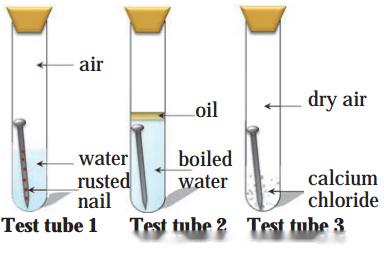
5. Three experiments to study the process of rusting are given below. Observe the three test tubes and answer the following questions.
Question a.
Why the nail in the test tube 2 is not rusted?
Answer:
In the test tube 2, oil cuts the supply of air to nail due to which oxidation of nail is prevented and boiled water is free from gases. Hence, the nail in the test tube 2 is not rusted.
Question b.
Why is the nail in the test tube 1 is rusted highly?
Answer:
The nail in the test tube 1 is highly rusted because nail is in contact with water and air. The oxidation process is fast.
Question c.
Would the nail in the test tube 3 get rusted?
Answer:
No change is observed in the test tube 3. Nail remains as it is because the calcium chloride absorbs moisture, making the air dry, thus preventing rusting of the nail.
Project:
Question a.
How is the Varkha or silver foil used in sweets made? Collect the information about which metals are used to make ‘Varkha’.
Class 8 Science Chapter 7 Metals and Nonmetals Additional Important Questions and Answers
Rewrite the sentences after filling the blanks:
Rewrite the following statements by selecting the correct options:
State whether the following statements are True or False:
Identify the odd term:
Consider the relation between the items in the first pair and write the correlation for second pair:
Match the columns:
Column ‘A’ | Column ‘B’ |
1. Copper | a. Low melting point |
2. Sodium | b. Liquid |
3. Magnesium | c. High melting point |
4. Boron | d. Conduction of heat |
e. 2, 8, 2 |
Column ‘A’ | Column ‘B’ |
1. Copper | d. Conduction of heat |
2. Sodium | a. Low melting point |
3. Magnesium | e. 2, 8, 2 |
4. Boron | c. High melting point
Question 2
Maharashtra Board Solution
|
Column ‘A’ | Column ‘B’ |
1. Silver | a. Copper + tin |
2. Mercury | b. Medicines |
3. Platinum | c. Thermometer |
4. Brass | d. Catalyst |
Column ‘A’ | Column ‘B’ | ||||||||||||||||||||||||||||
1. Silver | b. Medicines | ||||||||||||||||||||||||||||
2. Mercury | c. Thermometer | ||||||||||||||||||||||||||||
3.Platinum | d. Catalyst | ||||||||||||||||||||||||||||
4. Brass | a. Copper + tin Define the following: Answer the following questions in one sentence:
Question 1
Maharashtra Board Solution
Name an alloy of copper and tin.
Solution & Step-by-Step Answer:
An alloy of copper and tin is termed as bronze.
Question 2
Maharashtra Board Solution
Name a metal which is in liquid state at ordinary temperature.
Solution & Step-by-Step Answer:
Mercury is in liquid state at ordinary temperature.
Question 3
Maharashtra Board Solution
Name two metals which are malleable.
Solution & Step-by-Step Answer:
Iron and aluminium are malleable metals.
Question 4
Maharashtra Board Solution
Name two metals which are ductile.
Solution & Step-by-Step Answer:
Gold and silver are ductile metals.
Question 5
Maharashtra Board Solution
Name two metals which are good conductors of heat.
Solution & Step-by-Step Answer:
Silver and copper are good conductors of heat.
Question 6
Maharashtra Board Solution
Name two metals which are good conductors of electricity.
Solution & Step-by-Step Answer:
Copper and aluminium are good conductors of electricity.
Question 7
Maharashtra Board Solution
Name two non-metals which are in solid state at room temperature.
Solution & Step-by-Step Answer:
Carbon and sulphur are solids at room temperature.
Question 8
Maharashtra Board Solution
Name two non-metals which are in gaseous state at room temperature.
Solution & Step-by-Step Answer:
Hydrogen and oxygen are in gaseous state at room temperature.
Question 9
Maharashtra Board Solution
Name the non-metal having electrical conductivity.
Solution & Step-by-Step Answer:
Graphite has electrical conductivity.
Question 10
Maharashtra Board Solution
Name two non-metals which are lustrous.
Solution & Step-by-Step Answer:
Iodine and diamond are lustrous in nature.
Question 11
Maharashtra Board Solution
Name two non-metals having high melting points.
Solution & Step-by-Step Answer:
Carbon and boron melt at high temperature.
Question 12
Maharashtra Board Solution
State two metals which can be cut easily with a knife.
Solution & Step-by-Step Answer:
Sodium and potassium are soft metals and can be cut easily with a knife.
Question 13
Maharashtra Board Solution
Which is the hardest natural substance?
Solution & Step-by-Step Answer:
Diamond, which is a form of carbon is the hardest natural substance.
Question 14
Maharashtra Board Solution
State the property of the metals for which they can be drawn into wires.
Solution & Step-by-Step Answer:
The property of the metals due to which they can be drawn into wires is called ductility.
Question 15
Maharashtra Board Solution
State the property of the metals due to which they can be beaten into thin sheets.
Solution & Step-by-Step Answer:
The property of the metals due to which they can be beaten into thin sheets is called malleability.
Question 16
Maharashtra Board Solution
Which of the following metals react with cold water? Sodium, iron, copper, potassium.
Solution & Step-by-Step Answer:
Sodium and potassium metals react with cold water.
Question 17
Maharashtra Board Solution
Which of the following metals do not react with cold water or hot water?
Solution & Step-by-Step Answer:
Aluminium and iron do not react with cold water or hot water.
Question 18
Maharashtra Board Solution
What are the constituents of stainless steel?
Solution & Step-by-Step Answer:
Iron with carbon, chromium and nickel are the constituents of stainless steel.
Question 19
Maharashtra Board Solution
State the term used to express the purity of gold.
Solution & Step-by-Step Answer:
The purity of gold is expressed in carat.
Question 20
Maharashtra Board Solution
Name two metals having low melting points and boiling points.
Solution & Step-by-Step Answer:
Sodium and potassium having low melting points and boiling points.
Question 21
Maharashtra Board Solution
Name a non-metal which is in liquid state at room temperature.
Solution & Step-by-Step Answer:
Bromine is in liquid state at room temperature.
Question 22
Maharashtra Board Solution
State the atomic number and electronic configuration of sodium.
Solution & Step-by-Step Answer:
Atomic number of sodium: 11. Electronic configuration of sodium (Na): 2, 8, 1.
Question 23
Maharashtra Board Solution
State the atomic number and electronic configuration of aluminium.
Solution & Step-by-Step Answer:
Atomic number of aluminium: 13. Electronic configuration of aluminium (Al): 2, 8, 3.
Question 24
Maharashtra Board Solution
Give two example of metalloids.
Solution & Step-by-Step Answer:
Metalloids: Arsenic (As), germanium (Ge), antimony (Sb).
Question 25
Maharashtra Board Solution
State the atomic number and electronic configuration of nitrogen.
Solution & Step-by-Step Answer:
Atomic number of nitrogen: 7. Electronic configuration of nitrogen (N): 2, 5.
Answer the following questions:
Question 1
Maharashtra Board Solution
A metal can be drawn into a wire. Explain why.
Solution & Step-by-Step Answer:
Question 2
Maharashtra Board Solution
A metal can be hammered into a i thin sheet. Explain why.
Solution & Step-by-Step Answer:
Question 3
Maharashtra Board Solution
State the properties of metals.
Solution & Step-by-Step Answer:
Question 4
Maharashtra Board Solution
State the properties of non-metals.
Solution & Step-by-Step Answer:
Question 5
Maharashtra Board Solution
How are metal ions formed? Give two examples.
Solution & Step-by-Step Answer:
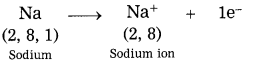
Metals have a tendency to lose their valence electrons to form positively charged ions, called cations. Examples:
Question 6
Maharashtra Board Solution
Classify the following elements into metals and non-metals : Silicon, gold, silver, sulphur, carbon, aluminium, copper and phosphorus.
Solution & Step-by-Step Answer:
Metals: Gold, silver, aluminium and copper. Non-metals: Silicon, sulphur, carbon and phosphorus.
Question 7
Maharashtra Board Solution
How are metal oxides formed? Explain with an example.
Solution & Step-by-Step Answer:
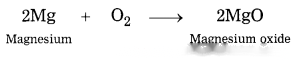
Metals combine with oxygen in the ’ air to form their oxides. Metal + Oxygen → Metal oxide [Note: Reaction/explanation given in the screen are for better understanding of students. The same are not given in the textbook.] When magnesium burns in air, it combines with oxygen to form magnesium oxide. 2Mg + O2 → 2MgO Magnesium Oxygen Magnesium oxide
Question 8
Maharashtra Board Solution
How will you show that metal oxides are basic in nature?
Solution & Step-by-Step Answer:
1. Take magnesium oxide in a test S tube. Add water in the test-tube. Shake the test-tube. Test the solution with red and blue litmus paper. Blue litmus paper remains as it is while red litmus paper turns blue. This shows that metal oxides are basic in nature.
2. Metal oxides react with an acid to form salt and water. Therefore, metal oxides are basic in nature.
Question 9
Maharashtra Board Solution
How do metals react with acid? Explain with an example.
Solution & Step-by-Step Answer:
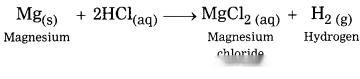
The metals react with dilute acids to form metal salts. Metals liberate hydrogen gas from dilute acids. Metal + Dilute acid → Metal salt + Hydrogen gas. Magnesium reacts with dilute HCl to form magnesium chloride and hydrogen gas.
Question 10
Maharashtra Board Solution
How do metals react with water? Explain with an example.
Solution & Step-by-Step Answer:
Most metals do not react with cold water. But some metals like sodium and potassium react with cold water to form their hydroxides and hydrogen gas. Sodium reacts with water to form sodium hydroxide.
Question 11
Maharashtra Board Solution
How do non-metals react with oxygen? Explain with an example.
Solution & Step-by-Step Answer:
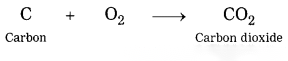
Non-metals combine with oxyen to form their oxides. Non-metal + Oxygen → Non-metal oxide When carbon burns in air, it combines with oxygen to form carbon dioxide.
Question 12
Maharashtra Board Solution
How will you show that non- metal oxides are acidic in nature?
Solution & Step-by-Step Answer:
1. Take non-metal oxide in a test tube. Add water in the test tube. Test the solution with blue and red litmus paper. Red litmus paper remains as it is while blue litmus paper turns red. This shows that non¬metal oxides are acidic in nature.
2. The oxides of non-metals are acidic in nature. They react with bases to form soluble salt and water. Therefore, non-metal oxides are acidic in nature.
Question 13
Maharashtra Board Solution
How are non-metal ions formed? Give two examples.
Solution & Step-by-Step Answer:
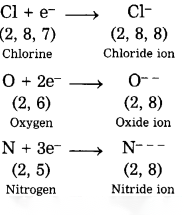
Non-metals have a tendency to accept electrons in their valence shell to form negatively charged ions called anions. Examples:
Question 14
Maharashtra Board Solution
What is meant by noble metals? Give two examples.
Solution & Step-by-Step Answer:
Some metals like gold, silver, platinum, paladium and rhodium are found in nature in the form of elements. They are not affected by air, water, acids and heat etc. Hence, they are called noble metals.
Give scientific reasons:
Question 1
Maharashtra Board Solution
Ornaments are generally not made from 24-carat gold.
Solution & Step-by-Step Answer:
c
Question 2
Maharashtra Board Solution
Ships are painted at frequent intervals.
Solution & Step-by-Step Answer:
1. The metal sheets of ships are made from iron. 2. Due to salty seawater, the metal sheets of ships get rusted and corroded. Paints contain metals like zinc or magnesium. This prevents the metal surface of the ship coming into direct contact with salty seawater. Therefore, ships are painted at frequent intervals.
Question 3
Maharashtra Board Solution
Gold and platinum are called noble elements.
Solution & Step-by-Step Answer:
Explain the following reactions with the help of balanced equations:
Question 1
Maharashtra Board Solution
Magnesium combines with oxygen.
Solution & Step-by-Step Answer:
Magnesium combines with oxygen to form magnesium oxide.
Question 2
Maharashtra Board Solution
Magnesium oxide reacts with dilute HCl.
Solution & Step-by-Step Answer:
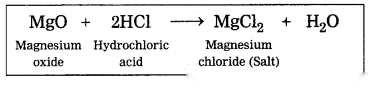
When magnesium oxide reacts with dilute HCl, magnesium chloride (salt) and water are formed.
Question 3
Maharashtra Board Solution
Magnesium reacts with dilute HCl.
Solution & Step-by-Step Answer:
When magnesium reacts with dil. hydrochloric acid, magnesium chloride is formed and hydrogen gas is evolved.
Question 4
Maharashtra Board Solution
Sodium reacts with water.
Solution & Step-by-Step Answer:
When sodium reacts with water, sodium hydroxide and hydrogen gas are formed.
Question 5
Maharashtra Board Solution
Carbon burns in air.
Solution & Step-by-Step Answer:
When carbon burns in air, carbon dioxide is formed.
Question 6
Maharashtra Board Solution
Carbon dioxide reacts with sodium hydroxide.
Solution & Step-by-Step Answer:
When carbon dioxide reacts with sodium hydroxide, soluble salt sodium ; carbonate and water are formed.
Question 7
Maharashtra Board Solution
Carbon dioxide reacts with water.
Solution & Step-by-Step Answer:
When carbon dioxide reacts with water, carbonic acid is formed.
Question 8
Maharashtra Board Solution
Sulphur dioxide reacts with water.
Solution & Step-by-Step Answer:
When sulphur dioxide reacts with water, sulphurous acid is formed.
Question 9
Maharashtra Board Solution
Sulphur trioxide reacts with water.
Solution & Step-by-Step Answer:
When sulphur trioxide reacts with water, sulphuric acid is formed.
Write short notes:
Question 1
Maharashtra Board Solution
The noble metals.
Solution & Step-by-Step Answer:
Some metals like gold, silver, platinum, paladium and rhodium are found in nature in the form of elements. They are not affected by air, water, acids and heat etc. Hence, they are called noble metals.
Uses of Nobel Metals:
Question 2
Maharashtra Board Solution
The purity of gold.
Solution & Step-by-Step Answer:
1. The purity of gold is measured in carats. 2. Twenty-four carat gold is considered as gold of 100% purity. 3. 24-carat pure gold is very soft. 100% pure gold bends easily or breaks due to pressure. Therefore, copper or silver is added to gold in the necessary proportion (while making ornaments). 4. Generally, 22-carat gold is used in making ornaments.
Question 3
Maharashtra Board Solution
Corrosion.
Solution & Step-by-Step Answer:
Corrosion: Gases in the air react with metals in presence of moisture to form metal compounds on its surface, this destroys the metal gradually and is called corrosion.
By applying a layer of paint, oil, grease or varnish on the surface of a metal to prevent corrosion. Also plating with noncorroding metal is done. Iron is coated with thin layer of zinc. Due to these processes, the contact of a metal surface with air is lost and corrosion is prevented.
Question 4
Maharashtra Board Solution
Alloys.
Solution & Step-by-Step Answer:
Distinguish between the following:
Question 1
Maharashtra Board Solution
Metals and Non-metals
Solution & Step-by-Step Answer:
|