Maharashtra State Board Class 9 Geography Solutions Chapter 2 Endogenetic Movements
Class 9 Geography Chapter 2 Endogenetic Movements Textbook Questions and Answers
1. Tick in front of the correct option ✓
(a) On which of the following are slow movements in the earth’s interior dependent?
Landforms [ ]
Velocity [ ]
Direction [ ]
Answer:
Velocity
(b) When waves divert from each other, what do they create
Compression [ ]
Tension [ ]
Mountain [ ]
Answer:
Tension
(c) For the formation of a rift valley, which of the following processes should occur in the earth’s crust?
Compression [ ]
Tension [ ]
Weathering [ ]
Answer:
Tension
(d) Which of these is a fold mountain?
The Satpudas [ ]
The Himalayas [ ]
The Western Ghats [ ]
Answer:
The Himalayas
(e) The formation of extensive plateaus is a result of which type of movements?
Mountain-building [ ]
Continent-building [ ]
Horizontal [ ]
Answer:
Continent-building
2. Give geographical reasons.
(a) Buildings collapsed at the foothills of the Himalayas because of an earthquake. Before collapsing they were moving forward and backward.
Answer:
(b) There is a difference in the formation of the Meghalaya Plateau and the Deccan Plateau.
Answer:
(c) Most of the volcanoes are found on the plate boundaries.
Answer:
(d) The Barren Island is becoming conical in shape.
Answer:
Therefore Barren Island is becoming conical in shape.
(e) Volcanic eruptions can cause earthquakes.
Answer:
3. Identify and name the internal movement.
(a) Tsunamis are generated in coastal areas.
Answer:
Sudden Movement
(b) The Himalayas are an example of fold mountains.
Answer:
Slow movement – Mountain Building Movements.
(c) Molten magma is thrown out of the earth’s mantle.
Answer:
Sudden Movement
(d) Rift valley is formed because of faulting.
Answer:
The slow movement – Upward – Downward Movement.
4. Arrange the following statements in chronological order in which an earthquake occurs.
(a) The earth’s surface vibrates
Answer:
The plates suddenly move.
(b) The plates suddenly move.
Answer:
Due to the movements in the mantle compression goes on increasing.
(c) Due to the movements in the mantle, compression goes on increasing.
Answer:
Along the weak point (faultlines) rocks break apart.
(d) Along the weak points ( faultlines) rocks break apart.
Answer:
Stored energy is released in the form of seismic waves.
(e) Stored energy is released in the form of seismic waves.
Answer:
The earth’s surface vibrates.
5. Distinguish between
(a) Block Mountain and Fold Mountain
Answer:
Block Mountain | Fold Mountain |
(i) When a part of the earth’s crust between two parallel faults is lifted a block mountain is formed. | (i) Because of the energy waves and pressure working towards each other, the layers of the soft rocks form folds leading to the formation of fold mountains. |
(ii) Block mountains are formed due to tension. | (ii) Fold mountains are formed due to compression. |
(iii) e.g. The Black forest mountains of Europe and the Meghalaya Plateau of India. | (iii) e.g. The Himalayas, the Aravalis, the Rockies, the Andes, the Alps |
(b) Primary and Secondary Seismic Waves
Answer:
Primary Seismic Waves | Secondary Seismic waves |
(i) Primary waves are the first one to reach the surface of the earth after the energy is emitted in the Earth’s interior. | (i) The waves which reach the Earth’s surface after the primary waves are called secondary waves. |
(ii) Primary waves can travel through solid, liquid and gaseous medium. | (ii) Secondary waves can travel only through only solid medium. |
(iii) While travelling through liquid medium, primary waves change their direction. | (iii) Secondary waves get absorbed as they enter the liquid medium. |
(iv) The waves move to and fro in the direction of energy transfer. | (iv) These waves move up and down in the direction of energy transfer. |
(c) Earthquakes and volcanoes
Answer:
Earthquakes | Volcanoes |
(i) Earthquake is the movement of the Earth’s crust. | A volcano is an opening in the Earth’s crust from which hot solid, liquid and gaseous materials are thrown out from the mantle of. |
(ii)Nothing is ejected out during an earthquake. | During a volcanic eruption, ash, water vapor, various types of poisonous and inflammable gases, hot molten magma etc. is ejected from the earth’s interior. |
6. Answer in brief
(a) Give reasons why an earthquake occurs.
Answer:
Following are the reasons for the occurrence of an earthquake:
(b) Which type of movements have led to the formation of the major fold mountains in the world?
Answer:
(c) How is the magnitude of the earthquake-related to the collapse of houses
Answer:
(d) What are the effects of earthquakes on the earth’s surface and human life?
Answer:
Following are the effects of earthquakes:
(e) Explain the types of seismic waves.
Answer:
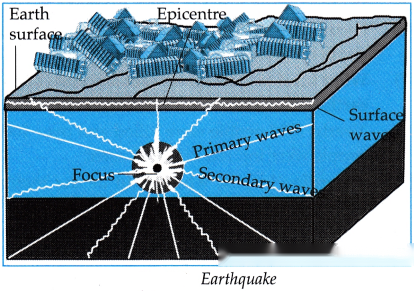
When the intension is released at the focus, the released energy travels in all directions. This energy comes towards the Earth’s surface in the form of waves. The seismic waves can be divided into primary, secondary and surface waves.
(i) Primary or ‘P’ waves:
(ii) Secondary or ‘S’ waves :
(iii) Surface or ‘L’ waves :
(f) Explain the types of volcanoes on the basis of the periodicity of eruption with examples.
Answer:
According to the periodicity of the volcanic eruptions, three types of volcanoes can be identified.
(i) Active Volcanoes –
(ii) Dormant Volcanoes –
(iii) Extinct volcanoes –
7. Show the epicenter, focus and the primary, secondary and surface waves of an earthquake with the help of a neat labeled diagram.
Answer:
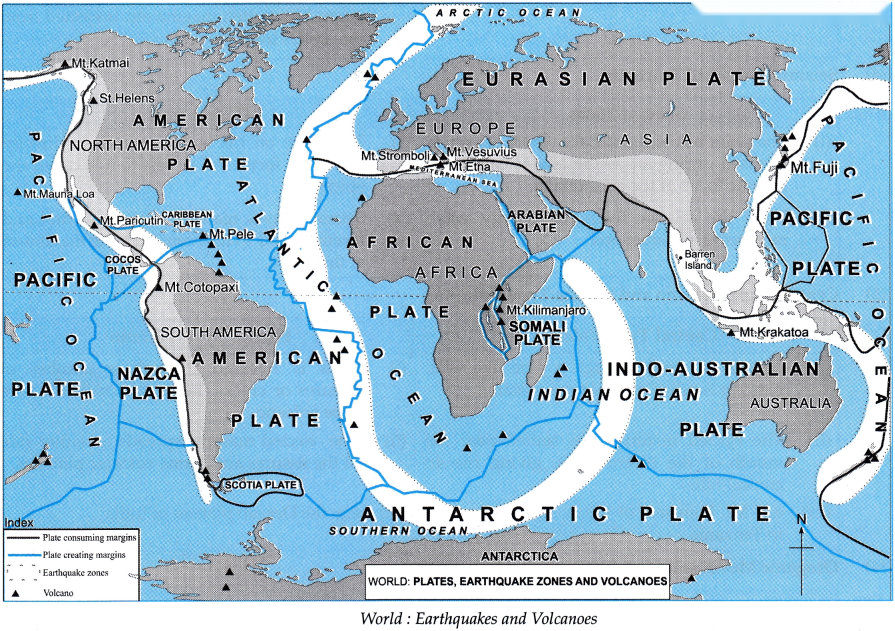
8. Show the following on a given outline map of the world.
(a) Mt. Kilimanjaro
(b) Mid-Atlantic Earthquake zone
(c) Mt. Fuji
(d) Krakatoa
(e) Mt. Vesuvius
Answer:
Class 9 Geography Chapter 2 Endogenetic Movements Intext Questions and Answers
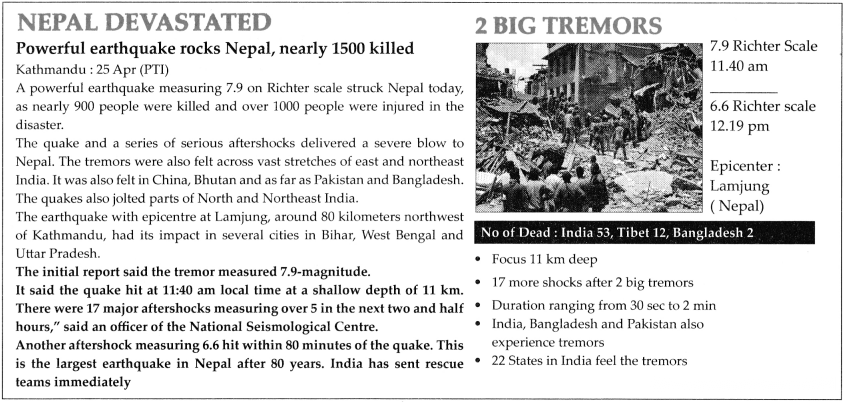
Can you tell?
Read the following news. Observe the photograph and answer the questions.
Class 9 Geography Chapter 2 Endogenetic Movements Additional Important Questions and Answers
Complete the statements choosing the correct option from the bracket:
(Endogenetic Movements Class 9 Geography Chapter 2 )Tick in front of the correct option.
Give one word for each of the following:
(Class 9 Geography Chapter 2 Endogenetic Movements Questions And Answers ) Answer in one sentence each.
Identify and name the internal movements.
Distinguish between:
Seismic Focus | Epicenter |
(i) The point below the surface where energy is released during an earthquake is called the seismic focus of the earthquake. | (i) The place on the surface which is directly above the focus and closest to it is called the epicenter. |
(ii) From the seismic focus, an energy wave radiates in all directions. | (ii) Seismic waves reach the epicenter first and foremost and so its intensity is the maximum at this point. |
Central Type Volcano | Fissure Type Volcano | ||
(i) | Lava is released through a pipe-like vent, hence it is called central type volcano. | (i) | Lava is released through a number of fissures or cracks, hence it is called fissure type volcano. |
(ii) | The ejected material gets settled near the mouth of the central vent, giving rise to conical hills. | (ii) | The ejected material spreads on either side of the fissures and forms volcanic plateaus. |
(iii) | e.g. Mt. Fujiyama of Japan, Mt. Kilimanjaro in Tanzania. | (iii) | e.g. the Deccan plateau of India |
Orogenic Movements | Epeirogemic Movements |
(i) The movements that give rise to mountains are called Orogenic Movements. | (i) The movements that give rise to continents are called Epeirogenic Movements. |
(ii) They lead to the formation of Fold mountains, Block mountains and Rift valleys. | (ii) They lead to the formation of continents and extensive plateaus. |
Slow Internal Movements | Sudden Internal Movements |
(i) The movements in the interior of the earth that are caused by continuous and slow release of energy are called slow internal movements | (i) The movements in the interior of the earth that are caused by the sudden release of energy on a large scale are called sudden internal movements. |
(ii) Slow internal movements give rise to mountains and continents. | (ii) Sudden internal movements lead to earthquakes and volcanic eruptions. |
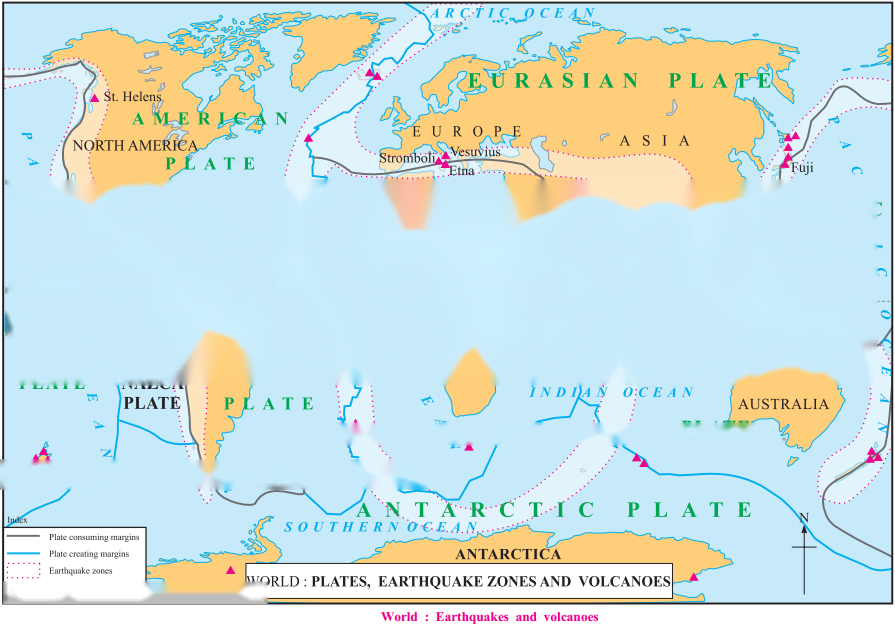
Make friends with Maps!
Answer the following questions:
Give geographical reasons:
Answer in brief:
(ii) Fissure-type volcano: