Maharashtra State Board Class 9 Geography Solutions Chapter 3 Exogenetic Movements Part 1
Class 9 Geography Chapter 3 Exogenetic Movements Part 1 Textbook Questions and Answers
1. Answer in brief.
(a) What is mechanical weathering?
Answer:
(b) What are the main types of chemical weathering?
Answer:
The process of decomposition of rocks due to changes in their chemical composition is called chemical weathering.
Its main types are:
(i) Carbonation
(ii) Solution
(iii) Oxidation
(c) How does biological weathering occur?
Answer:
(d) Distinguish between weathering and mass wasting.
Answer:
Weathering | Mass Wasting |
(i) Breaking or weakening of rocks is called as weathering. | (i) When weathered rock material moves down the slopes due to gravity and accumulate near the foothills or gentle slopes, it is mass wasting. |
(ii) Weathering is of three types – Mechanical, Chemical and Biological. | (ii) Mass wasting is of two types – Rapid and Slow. |
2. Write whether the statements are true or false. Correct the incorrect ones.
(a) Climate affects earthquakes.
Answer:
False – Internal movements affect (leads to) earthquakes.
(b) Mechanical weathering is less effective in humid climates.
Answer:
True
(c) Mechanical weathering happens on a large scale in dry climates.
Answer:
True
(d) The breaking down of rocks into smaller particles is called weathering.
Answer:
True
(e) Lateritic rocks are formed through exfoliation.
Answer:
False – Lateritic rocks are formed due to oxidation.
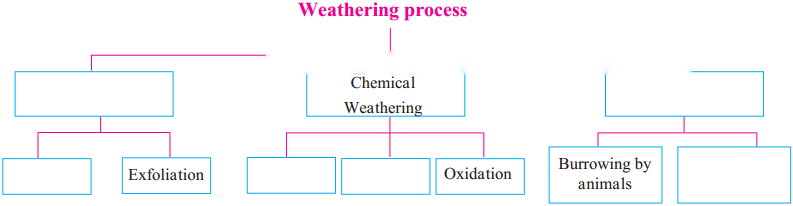
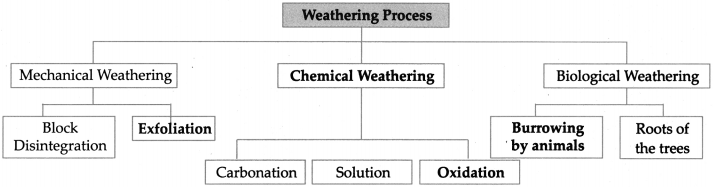
3. Complete the flowchart below.
Answer:
4. Identify the type of weathering from the given description.
(a) Some animals live inside the grounds by making burrows.
(b) The rock rusts.
(c) Water which has accumulated in the crevices of the rocks freezes. Consequently, the rock breaks.
(d) The pipes supplying water in colder regions break.
(e) Sand formation occurs in deserts
Answer:
(a) Biological weathering
(b) Chemical weathering
(c) Mechanical weathering
(d) Mechanical weathering
(e) Mechanical weathering
Class 9 Geography Chapter 3 Exogenetic Movements Part 1 Intext Questions and Answers
Can You Tell?
(1) See the given pictures. Observe the physical appearance of the rocks in each picture. You can see that rocks are broken, fractured and have holes in them. In a picture you can also see that the statue has been deformed. Why are the rocks in such a condition? Think about them and briefly tell the reasons you can think of. Discuss the reasons. Check with the teachers if your reasons are relevant.
Answer:
Lets Recall
Solution & Step-by-Step Answer:
I have seen process of biological weathering3 around me. Many plants and trees have grown in an old dilapidated building which is located near my house. The roots of the trees have broken the walls and slabs of the building at many places.
Class 9 Geography Chapter 3 Exogenetic Movements Part 1 Additional Important Questions and Answers
Complete the statements choosing the correct option from the bracket:
Solution & Step-by-Step Answer:
(a) Limestone
Solution & Step-by-Step Answer:
(b) Oxidation
Solution & Step-by-Step Answer:
(d) slumping
Solution & Step-by-Step Answer:
(b) solifluction
Solution & Step-by-Step Answer:
(d) living organisms
Solution & Step-by-Step Answer:
(a) solution
Solution & Step-by-Step Answer:
(a) carbonation
Solution & Step-by-Step Answer:
(c) exfoliation
Solution & Step-by-Step Answer:
(b) Water
Solution & Step-by-Step Answer:
(c) brittle
Match the Column:
I.
(I) Column ‘A’ | Column ‘B’ |
(1) Mechanical weathering
(2) Chemical weathering
(3) Biological weathering | (a) burrowing
(b) frost
(c) carbonation
(d) erosion |
Answer:
(1-b),
(2- c),
(3 – a)
II.
Column ‘A’ | Column ‘B’ |
(1) Oxidation
(2) Slumping
(3) Solifluction | (a) Mass movement occurring slowly
(b) Carbon dioxide gets mixed with air
(c) Chemical reaction between iron and oxygen
(d) Weathered material which sink in situ |
Answer:
(1 – c),
(2 – d),
(3 – a)
Answer in one sentence each;
Solution & Step-by-Step Answer:
Exogenetic processes are external processes 1 that occur on or above the earth’s surface, E.g. weathering, erosion, transportation, deposition etc.
Solution & Step-by-Step Answer:
Breaking or weakening of rocks is called as weathering.
Solution & Step-by-Step Answer:
The disintegration of rocks without any change in their chemical composition is called mechanical weathering.
Solution & Step-by-Step Answer:
The process of decomposition of rocks due to changes in their chemical composition is called chemical weathering.
Solution & Step-by-Step Answer:
The weathering process caused by human beings, animals and plants is called biological weathering.
Solution & Step-by-Step Answer:
Sometimes the weathered materials do not move downward but sink ‘in situ’ (where they ! are). This is called slumping. ;
Solution & Step-by-Step Answer:
In periglacial regions along the slopes, small layers of soil accumulate because of the movement of soil. This is called solifluction.
Solution & Step-by-Step Answer:
When water penetrates in rocks like sandstones and conglomerates1, the particles get loose and separate from the main rock. This is called granular weathering.
Solution & Step-by-Step Answer:
When water accumulates in wide points and big blocks of rocks separate from each other, this is called block disintegration.
Solution & Step-by-Step Answer:
When the outer layer of the racks fall apart from the main rock due to temperature, the process is called exfoliation.
Solution & Step-by-Step Answer:
The difference between the daily maximum and minimum temperature is diurnal Range.
Solution & Step-by-Step Answer:
The minerals in rocks which dissolve in water leads to the formation of solutions.
Solution & Step-by-Step Answer:
The two types of mass movements are: (a) Rapid Mass Movement and (b) Show Mass movement.
Solution & Step-by-Step Answer:
The types of Mechanical weathering are (a) Temperatures (b) Frost (c) Crystal growth (d) Release of pressure and (c) water
Solution & Step-by-Step Answer:
The types of chemical weathering are: (a) Carbonation (b) Solution and (c) Oxidation
Solution & Step-by-Step Answer:
Mechanical weathering occurs mainly in the arid climates.
Solution & Step-by-Step Answer:
In humid conditions, one can see chemical weathering.
Write whether the statements are TRUE or FALSE. Correct the incorrect statements.
Solution & Step-by-Step Answer:
False – It is a common phenomenon in such areas.
Solution & Step-by-Step Answer:
True.
Solution & Step-by-Step Answer:
True.
Distinguish between:
Solution & Step-by-Step Answer:
Mechanical Weathering | Chemical Weathering |
(i) In this type of weathering, rocks get disintegrated but the chemical composition of the rocks does not change. | (i) It is a process where rocks get disintegrated and the chemical composition of the rocks change. |
(ii) It is caused due to differences in the day and night temperature. | (ii) It is caused due to the reaction of oxygen, carbon dioxide and water with certain rock minerals. |
(iii) It is more common in an extremely cold climates and hot dry desert climates. | (iii) It is more common in hot and humid climates. |
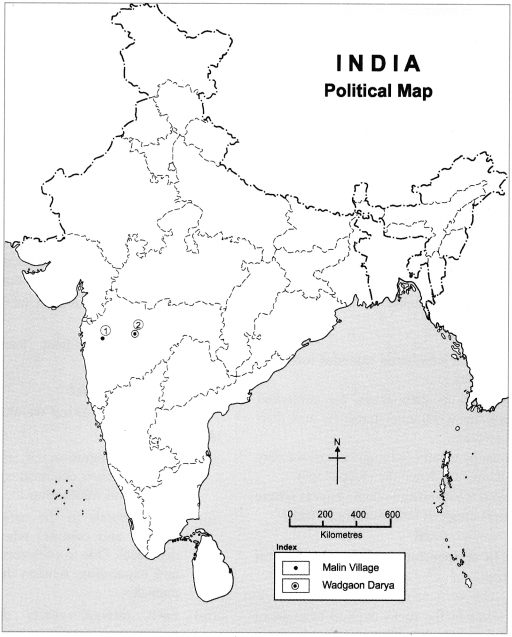
Fill the map with the given information and make a legend.
(1) Area affected by a landslide (mudslide) in Maharashtra.
(2) Wadgaon Darya
Give geographical reasons:
Solution & Step-by-Step Answer:
Solution & Step-by-Step Answer:
Solution & Step-by-Step Answer:
Solution & Step-by-Step Answer:
Solution & Step-by-Step Answer:
Solution & Step-by-Step Answer:
Solution & Step-by-Step Answer:
Answer in brief:
Solution & Step-by-Step Answer:
The weathered rock materials move along the slopes due to gravity and accumulate near the foothills or the gentler slopes. When the weathered particles move down due to gravity alone, the process is called mass movements.
Types of Mass movements:
(i) Rapid mass movements:
(ii) Slower mass movements:
Solution & Step-by-Step Answer:
Solution & Step-by-Step Answer:
Solution & Step-by-Step Answer:
Explain:
Solution & Step-by-Step Answer:
Solution & Step-by-Step Answer:
Solution & Step-by-Step Answer:
Solution & Step-by-Step Answer:
Landslide is a rapid mass movement which is caused majorly due to heavy rains, floods, earthquakes etc. The following are some fatal landsides in India.