Maharashtra State Board Class 9 Geography Solutions Chapter 4 Exogenetic Movements Part 2
Class 9 Geography Chapter 4 Exogenetic Movements Part 2 Textbook Questions and Answers
1. Rewrite the correct statement:
Solution & Step-by-Step Answer:
Correct.
Solution & Step-by-Step Answer:
Incorrect. Work of wind is more prominent in desert regions than other agents of erosion.
Solution & Step-by-Step Answer:
Correct.
2. Correct and rewrite the incorrect statements:
Solution & Step-by-Step Answer:
Incorrect. The ice on the base of the glacier moves faster than the ice on the lateral side.
Solution & Step-by-Step Answer:
Correct.
Solution & Step-by-Step Answer:
Correct.
Solution & Step-by-Step Answer:
Correct.
3. Identify the wrong pair
Solution & Step-by-Step Answer:
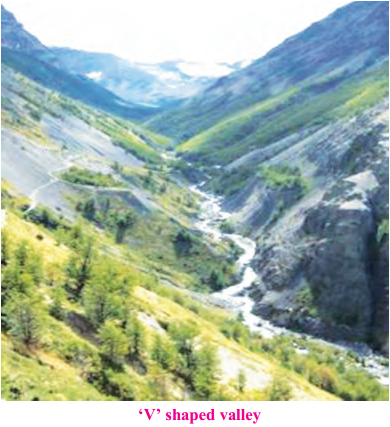
Wrong pair. Correct pair is – Erosion – V-shaped valley
Solution & Step-by-Step Answer:
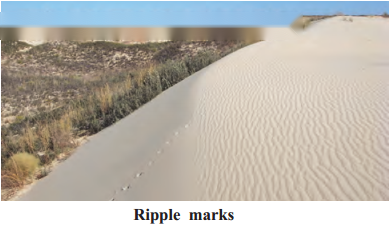
Transport – Ripple Marks
Solution & Step-by-Step Answer:
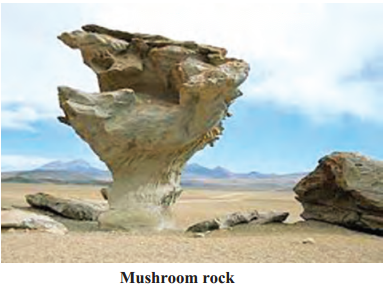
Erosion – Mushroom Rocks
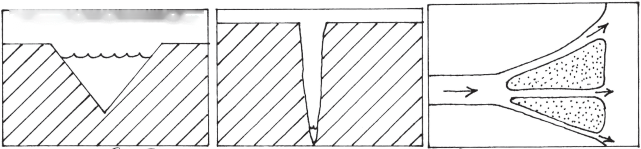
4. Identify and name the landforms in the following diagrams :
Answer:
(i) V-shaped valley
(ii) Gorge (Canyon)
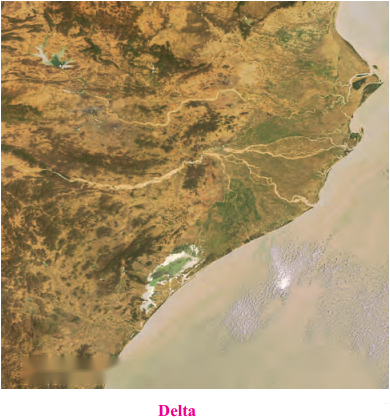
(iii) Delta
5. Complete the following table by classifying the landforms according to their agents of erosion.
(waterfall, delta, cirque, arête, barchans, moraine, pothole, mushroom rock, sinkholes, beach, pillars, lagoons)
Rivers Wind Glacier Sea Waves Groundwater
Answer:
Rivers | Wind | Glacier | Sea waves | Ground Water |
Waterfall | Barchans | Cirque | Beach | Sinkholes |
Delta | Mushroom rock | Aretes | Lagoons | Pillars |
Pothole | | Moraine | | |
6. Answer the following questions in brief.
Solution & Step-by-Step Answer:
Gorges (canyons), V-shaped valleys and waterfalls are the result of the erosional work of the rivers. (i) ‘V’ Shaped Valley:
(ii) Gorge:
(iii) Waterfall:
Solution & Step-by-Step Answer:
Solution & Step-by-Step Answer:
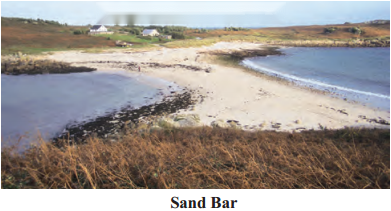
The landforms like beaches, sand bar, lagoons are formed due to depositional work of the sea waves. (i) Beach:
(ii) Lagoon:
(iii) Sand bars:
Solution & Step-by-Step Answer:
The glaciers carry sediments with them. These sediments are called moraines. Depending ond the location of the deposits, moraines can be divided into 4 types: ground moraines, lateral moraines, medial moraines and terminal moraines.
7. Observe the following picture carefully. Identify the landforms formed by different agents of erosion. Number them with a pencil here and write their names in the sequence in your notebook.
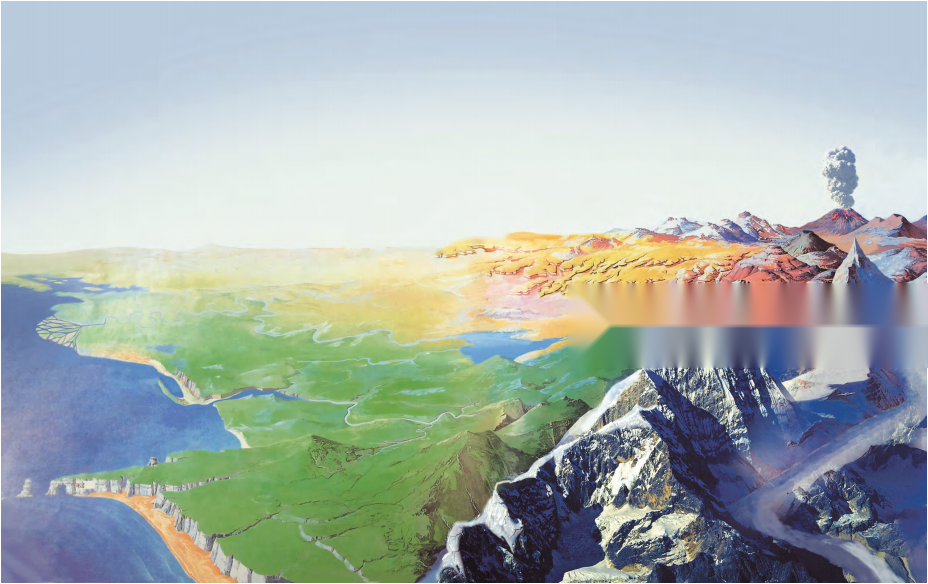
(i)
Answer:
Depositional work of river
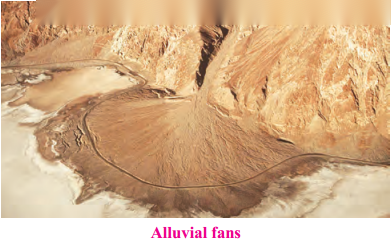
(ii)
Answer:
Depositional work of river
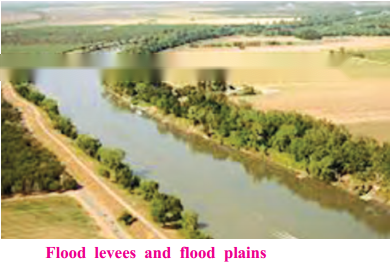
(iii)
Answer:
Erosional work of river
(iv)
Answer:
Depositional work of river
(2) Some pictures of the landforms formed by glaciers3 are given below. Write the function because of which they have been formed.
(i)
Answer:
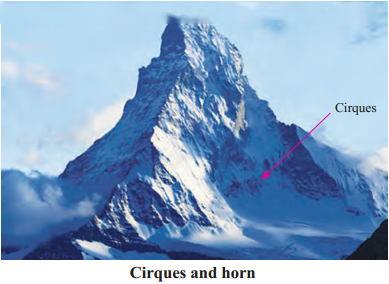
Erosional work of glacier
(ii)
Answer:
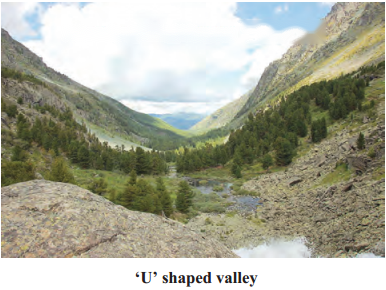
Erosional work of glacier
(iii)
Answer:
Depositional work of glacier
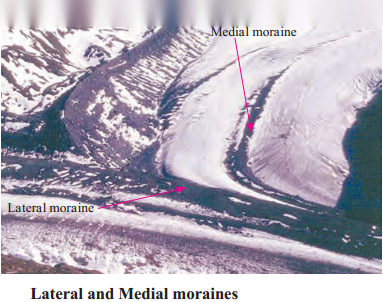
(iv)
Answer:
Depositional work of glacier
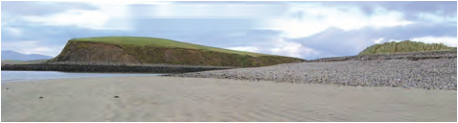
(v)
Answer:
Erosional work of glacier
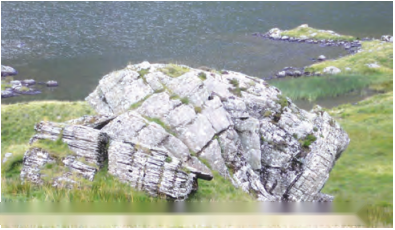
(vi)
Answer:
Erosional work of glacier
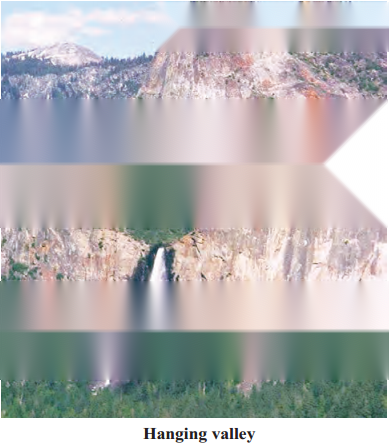
(vii)
Answer:
Depositional work of glacier
(3) Some pictures of the Iandforms produced by the work of the winds are given below. See the pictures and write in the box whether they have been formed by erosion or deposition.
(i)
Answer:
Erosional work of wind
(ii)
Answer:
Depositional work of wind

(iii)
Answer:
Depositional work of wind
(iv)
Answer:
Depositional work of wind
(v)
Answer:
Erosional work of wind
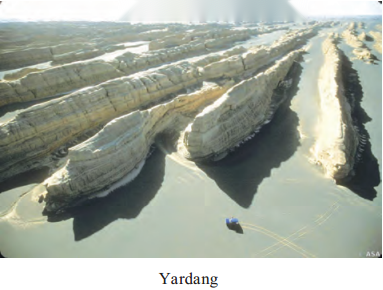
(vi)
Answer:
Erosional work of wind
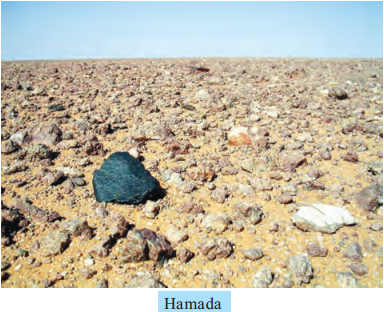
(4) Some pictures of the landforms produced by the work of the sea waves are given below. See the pictures and write in the box whether they have been formed by erosion or deposition.
With the help of internet, obtain information regarding the places along the Konkan coast where you will find the landforms formed by sea waves.
(i)
Answer:
Erosional work of sea waves.
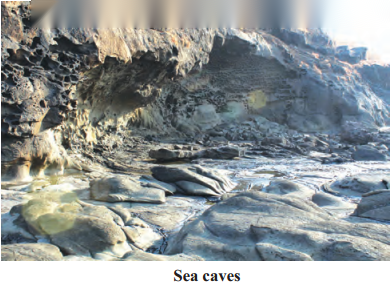
(ii)
Answer:
Depositional work of sea waves
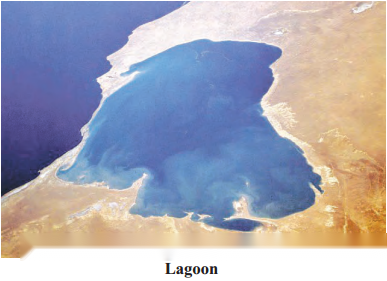
(iii)
Answer:
Erosional work of sea waves.
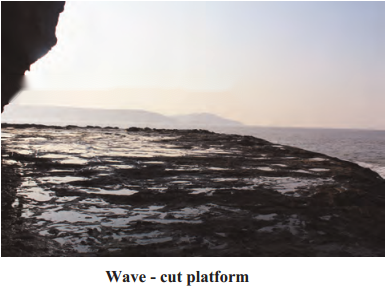
(iv)
Answer:
Erosional work of sea waves.
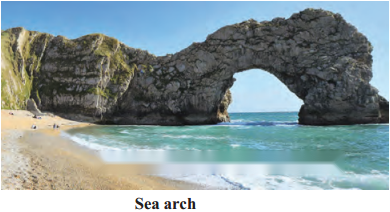
(v)
Answer:
Erosional work of sea waves.
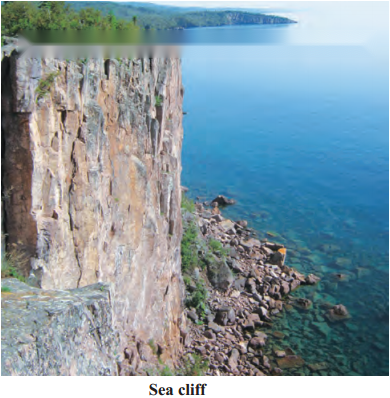
(vi)
Answer:
Depositional work of sea waves.
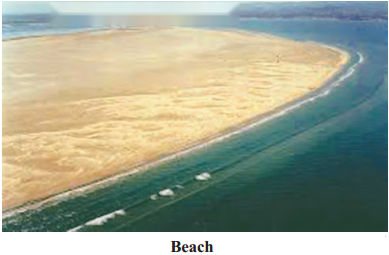
(vii)
Answer:
Depositional work of sea waves.
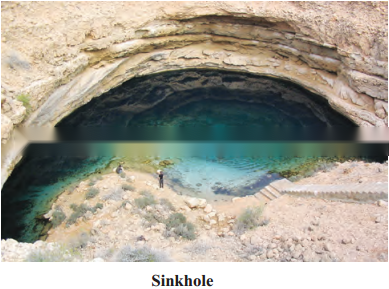
(5) See the pictures of the landforms produced by the work of groundwater. Write in the box below them whether they are formed through the work of erosion or deposition.
(i)
Answer:
Erosional work of ground water
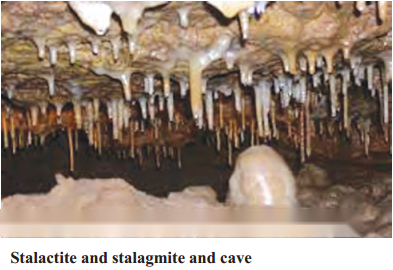
(ii)
Answer:
Depositional work of ground water
Class 9 Geography Chapter 4 Exogenetic Movements Part 2 Intext Questions and Answers
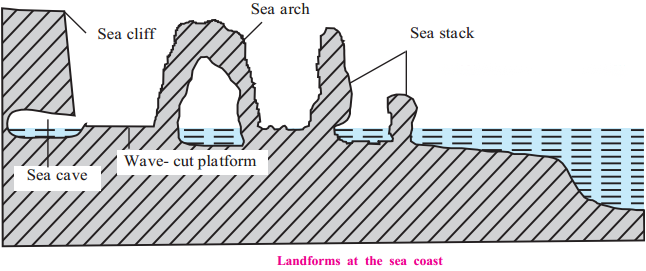
Draw a diagram showing landforms at the sea coast:
Answer:
Can You Tell?
Solution & Step-by-Step Answer:
The smallest natural flow of rain water is a rill. Many rills come together to form a gully. Many gullies come together and form a stream. Many streams come together and form a river. Thus we can see that rills, gullies, streams nad rivers are the various forms of flowing water in increasing order of their size.
Solution & Step-by-Step Answer:
Running water flows naturally in a direction according to gravity along the slope, making its own way. This is called a flow of water when many such flows of water come together a river is formed.
Solution & Step-by-Step Answer:
Glaciers can be seen in the Himalayan region in India.
Solution & Step-by-Step Answer:
We can see the work of glacier at sea level in the Polar regions (Antarctica).
Solution & Step-by-Step Answer:
Along the Konkan coast, landforms formed by sea waves can be found at Harihareshwar, Bhagwatibandar, Shrivardhan, Ratnagiri and Sindhudurg.
Think about it.
Solution & Step-by-Step Answer:
The Konkan coast has an indented (broken) coastline. Hence many creeks are found here. Many small seasonal rivers originate in the steep western side of the Western Ghats. As the rivers flow through the steep slopes their velocity increases. So, there is very little erosion done by them. Due to the narrow width of the Konkan coast, the rivers cover a short distance and drain in the Arabian sea. Thus they do not form estuaries rather than deltas.
Solution & Step-by-Step Answer:
No
Solution & Step-by-Step Answer:
Ramu should dig a well during the summer season. A deep well can be dug during the summer season. This will ensure water supply not only during the monsoon and winter season but also during the next summer season.
Solution & Step-by-Step Answer:
Glacier is the agent of erosion which has the most kinetic energy of all. The glacier is a mixture of heavy soil and rock particles which are flowing. Thus it has both weight and movement.
Find out.
Solution & Step-by-Step Answer:
Solution & Step-by-Step Answer:
Mushroom rocks can be found in the Hyderabad.
Solution & Step-by-Step Answer:
Yes, Ripple marks and sand mounds can be seen on the sand in the coastal regions.
Solution & Step-by-Step Answer:
Limestone caves, stalactites and stalagmites are found in Kanhur caves in the Ahmednagar district of Maharashtra.
Solution & Step-by-Step Answer:
A karst is an area of land formation created by eroding and dissolving portions of limestone or other soluble rock layers above or below the ground. According to the prevalent interpretation, the term is derived from the German name for the Karst region, a limestone plateau above the city of Trieste in the northern Adriatic.
Class 9 Geography Chapter 4 Exogenetic Movements Part 2 Additional Important Questions and Answers
Complete the statements by choosing the correct options.
Solution & Step-by-Step Answer:
(a) alluvial fan
Solution & Step-by-Step Answer:
(c) moraines
Solution & Step-by-Step Answer:
(b) deserts
Solution & Step-by-Step Answer:
(b) river
Solution & Step-by-Step Answer:
(c) ground water
Solution & Step-by-Step Answer:
(a) Delta
Solution & Step-by-Step Answer:
(c) snowfall
Solution & Step-by-Step Answer:
(c) cirques
Solution & Step-by-Step Answer:
(b) Greenland
Solution & Step-by-Step Answer:
(a) limestone caves
Solution & Step-by-Step Answer:
(a) downwards
Solution & Step-by-Step Answer:
(a) summer
Solution & Step-by-Step Answer:
(b) Lagoon
Solution & Step-by-Step Answer:
(c) krast
Match the Columns:
(1) River
Column A’ | Column B’ | | |
(1) | Erosion | (a) | Ox-bow lake |
(2) | Deposition | (b) | Meanders |
| | (c) | Yardangs |
Answer:
(1 – b),
(2-a)
(2) Glacier
Column ‘A’ | Column ‘B’ | | |
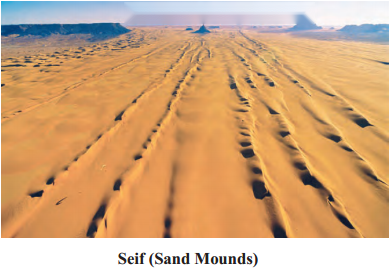
(1) | Erosion | (a) | Seif |
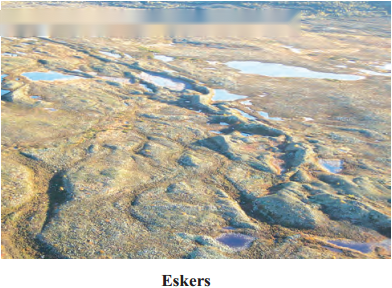
(2) | Deposition | (b) | Eskers |
| | (c) | Cirque |
Answer:
(1 – c),
(2 – b)
(3) Wind
Column ‘A’ | Column B’ | | |
(1) | Erosion | (a) | Sand dunes |
(2) | Deposition | (b) | Mushroom Rock |
| | (c) | Lagoon |
Answer:
(1 – b),
(2 – a)
(4)
Column ‘A’ | Column B’ | | |
(1) | Ground water | (a) | Delta region |
(2) | Sea waves | (b) | Lagoon |
| | (c) | Sink holes |
Answer:
(1 – c),
(2 – b)
(5)
Column ‘A’ | Column B’ | | |
(1) | Stalactites & stalagmites | (a) | wind |
(2) | Sand bar | (b) | ground water |
| | (c) | sea waves |
Answer:
(1 – b),
(2 – c)
Answer in one sentence:
Solution & Step-by-Step Answer:
The agents of erosion are wind, rivers, glaciers, sea waves and ground water.
Solution & Step-by-Step Answer:
The works of river depends on the nature of rock, the slope of land, velocity of the flow and the volume of water.
Solution & Step-by-Step Answer:
The important phases of a river’s work are erosion, transportation and deposition.
Solution & Step-by-Step Answer:
The work of glacier depends on the thickness of the accumulated ice, the temperature, and the slope of the land.
Solution & Step-by-Step Answer:
Landforms like gorges, V-shaped valleys, potholes and waterfalls are created due to the processes of erosion by the river.
Solution & Step-by-Step Answer:
Due to the transportational and depositional work of a river, meanders, ox-bow lakes, flood levees, flood plains and delta regions are formed.
Solution & Step-by-Step Answer:
The landforms such as a cirque, arete and matterhorn, U-shaped valley, hanging valleys, etc. are created as a result of the erosional work of a glacier.
Solution & Step-by-Step Answer:
The landforms formed by the depositional work of glaciers are drumlins, eskers etc.
Solution & Step-by-Step Answer:
Ground moraine, lateral moraine, medial moraine and terminal moraine are the different types of moraine.
Solution & Step-by-Step Answer:
The landforms like mushroom rocks, deflation hollows, yardangs etc. are created as a result of the erosional work of the wind.
Solution & Step-by-Step Answer:
Sand dunes, barchans, seif, ripple marks, and loess plains are created as a result of transportation and depositional work of the wind.
Solution & Step-by-Step Answer:
The landforms like sea cliffs, sea caves, wave-cut platforms, sea arches and sea stacks are produced as a result of the erosional work of sea waves.
Solution & Step-by-Step Answer:
Beaches, sand bars and lagoons are created due to the transportation and depositional work of sea waves.
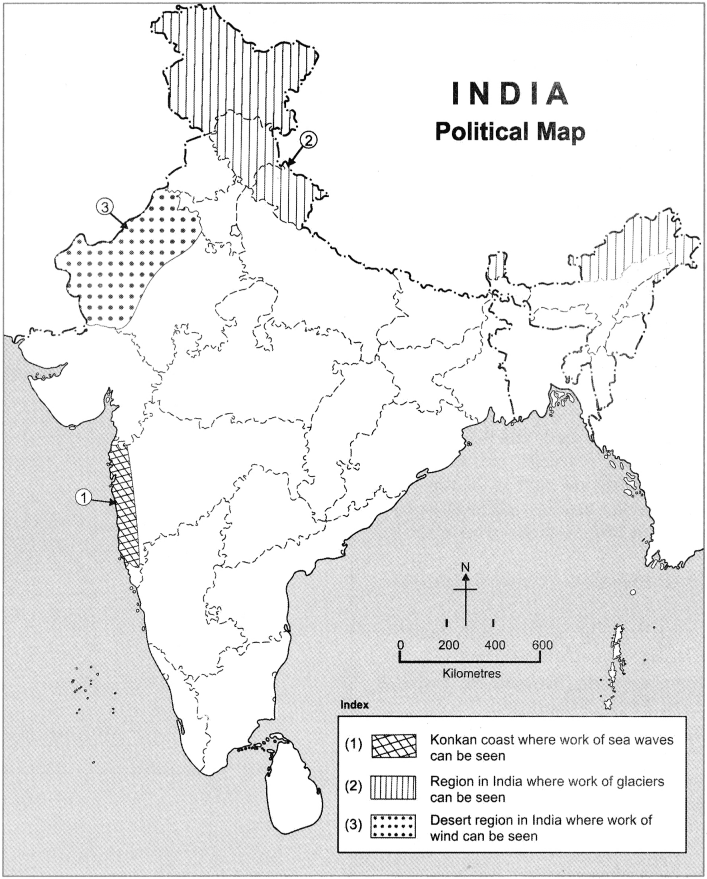
Fill the map with the given information and make a legend.
(1) Konkan Coast where work of sea waves can be seen
(2) Region in India where work of glaciers can be seen
(3) Desert region in India where work of wind can be seen
Answer:
Give geographical reasons:
Solution & Step-by-Step Answer:
Solution & Step-by-Step Answer:
Solution & Step-by-Step Answer:
Solution & Step-by-Step Answer:
Solution & Step-by-Step Answer:
Solution & Step-by-Step Answer:
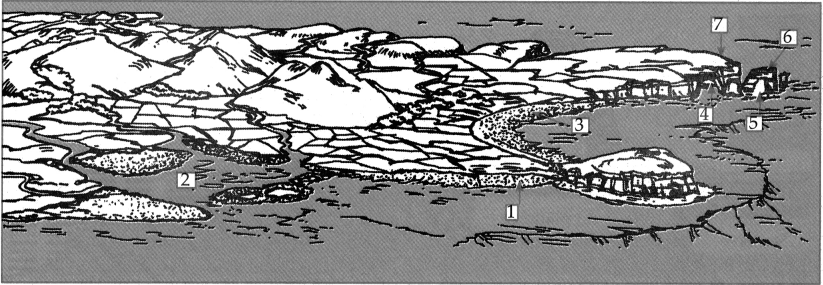
Identify the land forms made by waves and write their names in the given picture.
Answer:
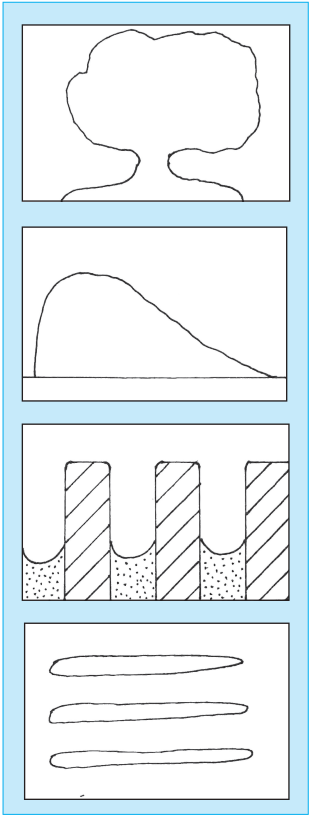
Write the name of the landforms with which the following diagrams are associated. Colour the eroded and the remaining part, if any, in the given diagrams.
Answer:
(a) Mushroom Rock
(b) Sand Dune (Barchan)
(c) Yardangs
(d) Seif (Sand Mounds)
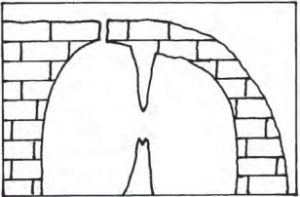
Identify the landforms formed by groundwater in the given diagram.
Answer:
Stalactite and Stalagmite cave.
Answer the following questions in brief:
Solution & Step-by-Step Answer:
The agents – running water (river), glaciers, wind, sea waves and groundwater, – do the work of erosion, transportation and deposition. Because of these agents, the earth’s surface keeps undergoing changes and new landforms are formed. (i) Running water (river):
(ii) Glaciers:
(iii) Wind:
(iv) Sea waves:
(v) Groundwater:
Solution & Step-by-Step Answer:
Landforms like flood levees, flood plains, deltas are formed because of deposition of sediments,
Solution & Step-by-Step Answer:
(i) Erosional work of winds:
(ii) Depositional work of winds:
Solution & Step-by-Step Answer:
(i) Erosional work of sea waves:
(ii) Depositional work of sea waves:
Explain:
Solution & Step-by-Step Answer:
Solution & Step-by-Step Answer:
Solution & Step-by-Step Answer:
Solution & Step-by-Step Answer:
Solution & Step-by-Step Answer:
Solution & Step-by-Step Answer:
Solution & Step-by-Step Answer:
Solution & Step-by-Step Answer:
Solution & Step-by-Step Answer: