Maharashtra State Board Class 9 History Solutions Chapter 2 India: Events After 1960
Class 9 History Chapter 2 India: Events After 1960 Textbook Questions and Answers
1. A. Choose the correct option from the given option and rewrite the statements:
Question 1.
The Prime Minister of India who took an initiative in resolving the question of the Tamil minority in Sri Lanka was
(a) Rajiv Gandhi
(b) Indira Gandhi
(c) H. D. Deve Gowda
(d) P. V. Narasimha Rao
Answer:
(a) Rajiv Gandhi
Solution & Step-by-Step Answer:
(c) Dr. M. S. Swaminathan
B. Identify and write the wrong pair in the following sets:
Solution & Step-by-Step Answer:
Chandrashekhar – Mandal Commission
Solution & Step-by-Step Answer:
2B. Write Short Notes on:
Solution & Step-by-Step Answer:
(i) Globalisation brought about many changes in different fields like economy, politics, science and technology, society and culture. (ii) India has emerged as an important country on the global scene in different spheres. (iii) India is an important member of international organisations like G-20 and ‘BRICS’ (Brazil, Russia, India, China, South Africa). (iv) India has experienced an important revolution in the field of telecommunication technology. (v) Mobile phones, internet and the communication facilities based on satellite have spread all across the country. (vi) It has resulted in a total transformation in the lifestyle of Indians and especially the youth. (vii) These changes are visible from their dietary habits, clothing, language and beliefs.
Solution & Step-by-Step Answer:
(i) White Revolution is a major event of India’s efforts towards self-reliance. (ii) The experiment in co-operative dairy movement by Dr. Verghese Kurien led to the increase of milk production in India. (iii) This is called as ‘White Revolution’.
3A. Give reasons:
Solution & Step-by-Step Answer:
(i) On the backdrop of the emergency, many opposition parties came together and formed a party called the Janata Party. (ii) The Congress party led by Indira Gandhi was roundly defeated by this newly formed ‘Janata Party’. (iii) Morarji Desai became the Prime Minister, but under his leadership the Janata Party government couldn’t last long due to its internal differences. (iv) Hence, the Morarji Desai government lasted for a short while.
Solution & Step-by-Step Answer:
(i) The Sikhs in Punjab demanded an independent state of Khalistan and began a movement which went on to become violent and destructive. (ii) Pakistan had lent its support to this movement. (iii) Some terrorists had allegedly taken shelter inside the Golden Temple at Amritsar, a holy shrine of the Sikhs in 1984. (iv) Hence, the Indian army was sent into the Golden Temple in Amritsar to evict the terrorists who had taken shelter there.
Solution & Step-by-Step Answer:
(i) India wanted to acquire modernity and self-reliance by establishing industries. (ii) India wanted to establish an economy based on social justice through planning. (iii) For this, the National Planning Commission was established. This would coordinate development through the policy of Five Year Plans.
B. Answer the following questions in 25 to 30 words.
Solution & Step-by-Step Answer:
(i) The year 1991 is held to be very important in the history of the world as well as India. (ii) The Soviet Union disintegrated into several different small countries and the Cold War came to an end. (iii) During this period, the Ram Janmabhumi and Babri Mosque issue at Ayodhya came to the forefront. (iv) In India, the Government under the leadership of Prime Minister P. V. Narasimha Rao initiated many changes in the Indian economy. (v) These economic reforms are called as economic liberalisation. The Indian economy flourished as a result of the implementation of this policy. (vi) Skilled Indian professionals helped reform the Indian economy. The field of information technology opened several avenues of employment in the country. (vii) The changes after 1991 are also described as ‘globalisation’.
Solution & Step-by-Step Answer:
(i) Right from independence, the modernisation of economy, economic self-sufficiency and social justice have been the characteristics of Indian economy. (ii) India wanted to acquire modernity and self-reliance by establishing industries. (iii) It wanted to establish an economy based on social justice through planning. (iv) For this, the National Planning Commission was established that would coordinate development through the policy of Five Year Plans.
4. With the help of the information in the chapter, complete the list of the challenges before India and the strengths of India.
Question 1.
The Challenges In Front of India | Strengths |
For Example: India-Pakistan war | Unity in diversity |
………………………….. | …………………….. |
……………………………. | Nuclear preparedness |
Separatism | …………………………….. |
Answer:
The Challenges In Front of India | Strengths |
India-Pakistan war | Unity in diversity |
Cross – Border Terrorism | Membership in G20 and BRICS |
Corruption | Nuclear preparedness |
Separatism | Establishment of National Planning Commission |
Class 9 History Chapter 2 India: Events After 1960 Additional Important Questions and Answers
Choose the correct option from the given option and rewrite the statements:
Solution & Step-by-Step Answer:
(b) 1962
Solution & Step-by-Step Answer:
MacMahon
Solution & Step-by-Step Answer:
(d) 1964
Solution & Step-by-Step Answer:
(c) Lal Bahadur Shastri
Solution & Step-by-Step Answer:
(a) Kashmir
Solution & Step-by-Step Answer:
(a) Soviet Union (a) Soviet Union
Solution & Step-by-Step Answer:
(b) Lai Bahadur Shastri
Solution & Step-by-Step Answer:
(c) Tashkent
Solution & Step-by-Step Answer:
(a) Mukti Bahini
Solution & Step-by-Step Answer:
(a) Bangladesh
Solution & Step-by-Step Answer:
(d) Pokhran
Solution & Step-by-Step Answer:
(a) Allahabad
Solution & Step-by-Step Answer:
(b) Jayprakash Narayan
Solution & Step-by-Step Answer:
(c) 1975 – 77
Solution & Step-by-Step Answer:
(c) Janata Party
Solution & Step-by-Step Answer:
(a) Morarji Desai
Solution & Step-by-Step Answer:
(a) Khalistan
Solution & Step-by-Step Answer:
(b) Pakistan
Solution & Step-by-Step Answer:
(a) United Liberation Front of Assam
Solution & Step-by-Step Answer:
(b) Homi Bhabha
Solution & Step-by-Step Answer:
(a) LTTE
Solution & Step-by-Step Answer:
(b) Industries
Solution & Step-by-Step Answer:
(c) Narasimha Rao
Solution & Step-by-Step Answer:
(d) National Democratic Alliance
Solution & Step-by-Step Answer:
(a) Dr. Verghese Kurien
Solution & Step-by-Step Answer:
(c) Aryabhatta
Solution & Step-by-Step Answer:
(d) Kakasaheb Kalelkar
Write Short Notes on:
Solution & Step-by-Step Answer:
(i) Dr. Homi Bhabha laid the foundation of the Indian atomic power programme. (ii) India insisted on using atomic energy for peaceful purposes like generation of electricity, pharmaceuticals and defence. (iii) India has achieved considerable success in space technology as well. In 1975, the first satellite ‘Aryabhatta’ was launched. (iv) Today, India has a successful space programme and many satellites have been launched under this programme. India has also made considerable advancement in the telecom sector.
Explain the statements with reason:
Solution & Step-by-Step Answer:
(i) India has emerged as an important country on the global scene in different spheres. (ii) India is an important member of international organisations like G-20 and ‘BRICS’ (Brazil, Russia, India, China, and South Africa). (iii) India has experienced an important revolution in the field of telecommunication technology. (iv) Mobile phones, internet and the communication facilities based on satellite have spread all across the country. (v) In the political field, India has demonstrated to the world how a stable democracy can function successfully. (vi) All this has resulted in a total transformation in the lifestyle of Indians, especially the youth. These changes are visible from their dietary habits, clothing, language and beliefs.
Solution & Step-by-Step Answer:
(i) To promote the all-round development of women and children many constructive steps were taken. (ii) A separate ‘Department of Women and. Child Development’ was created in 1985 under the Ministry of Human Resource Development. (iii) Some laws were made to ensure social justice to women and to help the implementation of various schemes in this direction. (iv) They include the Prohibition of Dowry Act, Equal Remuneration Act. As per the 73rd and 74th Constitution Amendments, seats are reserved for women in the local self¬government bodies.
Read the passage and answer the questions.
As a part of India’s policy to use atomic energy for peaceful purposes, India successfully carried out an underground test of an atomic device at Pokharan in Rajasthan in 1974. In 1975, the people of Sikkim voted for joining the Indian republic and Sikkim became a full-fledged State in the Indian federation. During this decade, the political situation in India grew unstable. The Allahabad High Court gave the verdict in 1974 that Indira Gandhi; the then Prime Minister had misused the government machinery during her election campaign. It led to nationwide strikes and protest. During this period, the situation became more complicated due to the movement led by Jayprakash Narayan. The situation of law and order in the country worsened and the government declared a state of National Emergency on the basis of the constitutional provisions relating to Emergency. During this turbulent period, the fundamental rights of Indian citizens were suspended. Due to the emergency, the Indian administration became disciplined, but the human rights were restricted. The period of national emergency lasted from 1975 to 1977 and after that general elections were conducted. On the backdrop of the emergency, many opposition parties came together and formed a party called the Janata Party. The Congress party led by Indira Gandhi was roundly defeated by this newly formed ‘Janata Party’. Morarji Desai became the Prime Minister, but under his leadership the Janata Party government couldn’t last long due to internal differences. Charan Singh succeeded him, but even his government was a short-lived one. Elections were conducted once again in 1980 and the Congress party under the leadership of Indira Gandhi came to power again.
Solution & Step-by-Step Answer:
Following incidents paved the way of Indira Gandhi back to power:
Solution & Step-by-Step Answer:
Sikkim voted to join the Indian Republic and it became a full – fledged state of Indian Republic in 1975.
Solution & Step-by-Step Answer:
India conducted Nuclear tests for two reasons: (i) to keep Pakistan’s aggression under check post 1971 war. (ii) To initiate peaceful and constructive use of atomic energy.
Answer the following questions in detail:
Solution & Step-by-Step Answer:
(i) Lai Bahadur Shastri succeeded Pandit Jawaharlal Nehru and became the next Prime Minister of India. (ii) During his tenure, India and Pakistan went to war over the Kashmir issue in 1965. (iii) The Soviet Union tried to mediate between the two countries. (iv) Lai Bahadur Shastri gave the slogan ‘Jai Jawan Jai Kisan’ with which he highlighted the importance of Indian soldiers and Indian farmers. (v) Lai Bahadur Shastri breathed his last at Tashkent in 1966.
Solution & Step-by-Step Answer:
(i) Right after Indira Gandhi’s assassination in 1984, Rajiv Gandhi became the Prime Minister of India. (ii) He tried to make several reforms in the field of Indian economy and that of science and technology. (iii) He took the lead in solving the issues of the Tamil minority in Sri Lanka. He promoted the idea of a united Sri Lanka with internal autonomy to the Tamil community, but his efforts in this regard proved to be in vain. (iv) He faced a lot of criticism in the context of corruption that took place during a defence equipment deal, especially the purchase of long-range canons from a foreign company called Bofors. (v) Political corruption became a crucial issue in the general elections that followed and the Congress party was defeated. (vi) In 1991, during the election campaign, the terrorist organisation in Sri Lanka, Liberation Tigers of Tamil Eelam (LTTE), assassinated Rajiv Gandhi.
Solution & Step-by-Step Answer:
(i) In 1999 the ‘National Democratic Alliance’ came to power under the flag of Bharatiya Janata Party and Atal Bihari Vajpayee became India’s Prime Minister (1998-2004). (ii) Atal Bihari Vajpayee tried to establish a dialogue with Pakistan but was not successful. (iii) India conducted a number of nuclear tests in 1998 and declared herself as an atomic power. (iv) In 1999, there was another war between India and Pakistan in Kargil region over the Kashmir issue (v) India defeated Pakistan in this war as well.
Solution & Step-by-Step Answer:
(i) The Narasimha Rao Government started economic reforms from 1991. These economic reforms are known as economic liberalisation. (ii) The Indian economy flourished as a result of the implementation of this policy. (iii) The foreign investment in India increased. Skilled Indian professionals helped reform the Indian economy. (iv) The field of information technology opened several avenues of employment in the country. (v) The changes after 1991 are also described as ‘globalisation’.
Solution & Step-by-Step Answer:
(i) Dr. M. S. Swaminathan is known as the father of the Green Revolution in 1965. He implemented new scientific agricultural techniques and increased the production of foodgrains. (ii) The experiment in co-operative dairy movement by Dr. Verghese Kurien led to increase of milk production in India. This is called as ‘White Revolution’.
Solution & Step-by-Step Answer:
(i) India had also made a lot of progress in the fields of atomic energy and space research. (ii) Dr. Homi Bhabha laid the foundation of the Indian atomic power programme. (iii) India insisted on using atomic energy for peaceful purposes like generation of electricity, pharmaceuticals and defence. (iv) India has achieved considerable success in space technology as well. In 1975, the first satellite ‘Aryabhatta’ was launched. (v) Today, India has a successful space programme and many satellites have been launched under this programme. (vi) India has also made considerable advancement in the telecom sector.
Solution & Step-by-Step Answer:
(i) Globalisation brought about many changes in different fields like economy, politics, science and technology and society and culture. (ii) India has emerged as an important country on the global scene in different spheres. India is an important member of international organisations like G-20 and ‘BRICS’ (Brazil, Russia, India, China, and South Africa). (iii) India has experienced an important revolution in the field of telecommunication technology. Mobile phones, internet and the communication facilities based on satellite have spread all across the country. (iv) In the political field, India has demonstrated to the world how a stable democracy can function successfully. (v) All this has resulted in a total transformation in the lifestyle of Indians and especially the youth. These changes are visible from their dietary habits, clothing, language and beliefs.
Solution & Step-by-Step Answer:
(i) Indira Gandhi became the Prime Minister of India in 1966. (ii) During her tenure, Pakistan’s oppressive I policies in East Pakistan resulted in a big movement there. This movement was led by Sheikh Mujibur Rahman and his organisation, ‘Mukti Bahini.’ (iii) This crisis in East Pakistan affected India as well, because millions of refugees came to India. (iv) The 1971 war between India and Pakistan led to the creation of an independent country called Bangladesh.
Solution & Step-by-Step Answer:
(i) The ‘Kakasaheb Kalelkar Commission’ was set up in 1953 to make recommendations so as to improve their condition. (ii) In 1978, a Commission was constituted under the chairmanship of B. P. Mandal to study the issue of the backward classes. (iii) The policy of reservation was adopted in order to strengthen the representation of backward sections in various services and institutions. (iv) The Government passed the Prevention of Atrocities Act in 1989 to enable those belonging to the Scheduled Castes and Tribes to live with dignity and respect, free from fear, violence and oppression of the upper classes.
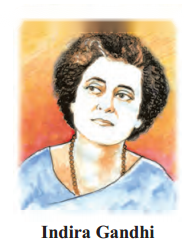
Question 10. Identify the picture and give relevant information. Indira Gandhi became the Prime Minister of India in the year 1966. Indira Gandhi’s strong leadership was prominent in the war between India and Pakistan in 1971. The first atomic test at Pokharan was carried out under her leadership. The Allahabad High Court gave the verdict in 1974, that Indira Gandhi had misused the government machinery during her election campaign. She declared a’state of National Emergency in 1975. |