Maharashtra State Board Class 9 Political Science Solutions Chapter 1 Post World War Political Developments
Class 9 Political Science Chapter 1 Post World War Political Developments Textbook Questions and Answers
1A. Choose the right option and rewrite the sentence:
2. Explain with reasons whether the following statements are true or false:
3. Explain the following concepts:
(ii) The cooperation between them gave way to rivalry. This rivalry occupied a period of 40-45 years of international politics
(iii) There was no open war between these two countries; but there was such tension in their relations, that it seemed that a war would erupt any time.
(iv) The concept of Cold War is used to describe the condition where there is no actual war, but there are such tensions in the circumstances, that they may be responsible to cause war.
(v) In this period, America was already a super power, but the Soviet Union also tried to become a super power by making nuclear weapons and by increasing its military might.
(vi) The struggle for power, arms race, differences in ideologies, attitude of checkmating each other by strategies and counter-strategies gave rise to the Cold War.
(ii) The Asian and African countries, which became independent after the Second World War supported the idea of non-alignment.
(iii) This movement started from 1961 under the leadership of India’s Prime Minister Pandit Jawaharlal Nehru, President of Yugoslavia Marshall Tito, President of Egypt Gamal Abdal Nasser, President of Indonesia Dr. Sukarno and Prime Minister of Ghana Dr. Kwame Nkrumah.
(iv) The non-aligned Movement has opposed colonialism, imperialism and racism. It has encouraged the resolution of international disputes by peaceful means.
(v) India led this movement under the guidance of Pandit Jawaharlal Nehru. India continued to actively support the movement afterwards as well.
(vi) Even after the end of the Cold War, the importance of the movement has not reduced. The non-aligned movement is based on eternal principles of humanism, global peace and equality.
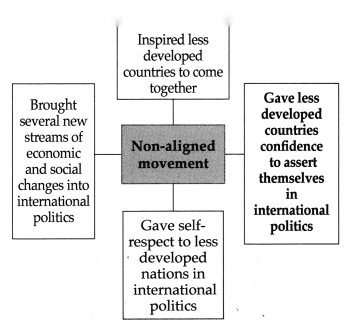
(vii) It has inspired the less developed countries to come together. It has encouraged the resolution of international disputes by peaceful means.
(viii) While taking a firm stand on disarmament, fostering human rights, the non-aligned movement put forth the problems of poor, undeveloped countries firmly. This movement made a demand of a New International Economic Order (NIEO).
(ii) Even big nations have to depend upon other big and small nations. Thus, interdependence is an important feature of the international system, i.e. today’s global system.
(ii) The give and take of ideas among people all over the world grew.
(iii) Due to the revolution in information technology, different events and developments began to be known everywhere.
(iv) The boundaries between nations did not remain as sacrosanct as they were before. All these processes are together called globalisation.
(v) Just as globalisation has brought us benefits, it has also caused losses. For example, as the economies of different countries got linked with each other, trade increased, economic unification grew, plenty of products became available in the markets; but (at the same time) the gap between the poor and rich nations did not reduce.
4. Give your opinion on the following topics:
(ii) League should have reconsidered implementation of harsh term of treaties imposed on the losers to avoid the revengeful policies of dictators like Adolf Hitler.
(ii) Since these countries did not officially show allegiance to any super power, they freed themselves from the dominance of USA and USSR and could independently frame their foreign policies.
(iii) This further promoted peace and co-operation.
(ii) Moreover the Arms Race diverted the resources and harnessed science for destruction rather than human welfare.
5. Write brief answers:
Points | First World War | Second World War |
(1) Period | ||
(2) Involved nations | ||
(3) Impacts (Political and Economic) | ||
(4) International Organisations established after the War |
Points | First World War | Second World War |
(1) Period | 1914-1918 | 1939 -1945 |
(2) Involved nations | Allied Powers – Britain, France, Russia, Italy, America Central Powers – Germany, Austria, Hungary, Ottoman Empire, Bulgaria | Allied Powers – Britain, France, Australia, Canada, New Zealand, India, Soviet Union, China, America Axis powers – Germany, Japan, Italy |
(3) Impacts (Political and Economic) | (i) Earlier empires in Europe collapsed and new nations came into being. | (i) Beginning of Cold War |
(ii) Independence movements in European colonies changed hegemony of European Nations. | (ii) Destruction of public property on larger scale due to use of nuclear weapons | |
(iii) League of nations was established. | ||
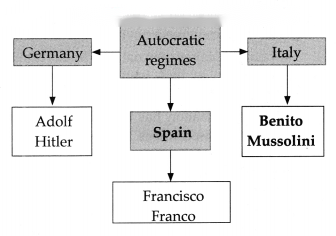
(iv) Autocratic regime came up in Germany, Spain, Italy and other countries. | ||
(v) Destruction of public property. | ||
(4) International Organisations established after the War | League of Nations | United Nations Organisation
Question 2
Maharashtra Board Solution
What were the factors responsible for the end of Cold War?
Solution & Step-by-Step Answer:
The factors responsible for the end of Cold War are:
(i) The Soviet Union adopted the policy of opening up the economy. The State loosened up its control of the economy. (ii) The then President of the Soviet Union Mikhail Gorbachev implemented the policies of Perestroika (Restructuring) and Glasnost (Openness). Due to these policies, the control over the media reduced. (iii) As the East European countries under the influence of the Soviet Union adopted the capitalist and democratic paths, the Soviet Union disintegrated and several new nations were created out of it.
Question 3
Maharashtra Board Solution
What major changes occurred in global politics after the end of the Cold War?
Solution & Step-by-Step Answer:
(i) Major changes took place in world politics after the end of the Cold War. For example, America remained the only super power in world politics.
(ii) A conducive atmosphere prevailed for the growth in trade and economic relations between and among nations. (iii) As all nations of the world decided to give priority to trade relations, the idea of giving ‘aid’ to other nations fell behind. (iv) The United Nations now had to take more concrete steps to maintain global peace and security. (v) Environmental protection, fostering of human rights, gender equality and management of natural calamities now acquired a global dimension. Class 9 Political Science Chapter 1 Post World War Political Developments Additional Important Questions and Answers Choose the correct option from the given options and rewrite the sentence:
Question 1
Maharashtra Board Solution
President of Soviet Union who implemented ‘Perestroika’ and ‘Glasnost’ ______. (a) Nikita Khrushchev (b) Mikhail Gorbachev (c) General Molotov (d) Vladimir Lenin
Solution & Step-by-Step Answer:
(b) Mikhail Gorbachev
Question 2
Maharashtra Board Solution
Military organisation formed under dominance of USA ______. (a) North Atlantic Treaty Organisation (b) Warsaw Pact (c) New International Economic Order (d) Non-Aligned Movement
Solution & Step-by-Step Answer:
(a) North Atlantic Treaty Organisation
Question 3
Maharashtra Board Solution
Division of world into two power blocs is called ______. (a) Globalisation (b) Nuclear Escalation (c) Bipolarisation (d) Internationalism
Solution & Step-by-Step Answer:
(c) Bipolarisation
Question 4
Maharashtra Board Solution
Among the following ________ is not an Axis Power. (a) Germany (b) Italy (c) Belgium (d) Japan
Solution & Step-by-Step Answer:
(c) Belgium
Question 5
Maharashtra Board Solution
______ is an important event of the Cold War. (a) Fashoda Incident (b) Cuban Missile Crisis (c) Wall Street Crash (d) Red Menace
Solution & Step-by-Step Answer:
(b) Cuban Missile Crisis
Question 6
Maharashtra Board Solution
Non-aligned movement is opposed to ____. (a) Racism (b) Capitalism (c) McCarthyism (d) Nepotism
Solution & Step-by-Step Answer:
(a) Racism
Question 7
Maharashtra Board Solution
Non-aligned movement demanded establishment of _______. (a) Association of South East Asian Nations (b) League of Nations (c) New International Economic Order (NIEO) (d) European Union (EU)
Solution & Step-by-Step Answer:
(c) New International Economic Order (NIEO)
Question 8
Maharashtra Board Solution
The policy of Perestroika means restructuring and Glasnost means ______. (a) strictness (b) oneness (c) massiveness (d) openness
Solution & Step-by-Step Answer:
(d) openness
State whether the following statements are True or False, with reasons:
Question 1
Maharashtra Board Solution
A system of Independent States is called International System.
Solution & Step-by-Step Answer:
True.
Question 2
Maharashtra Board Solution
Interdependence is not an important feature of the International System.
Solution & Step-by-Step Answer:
False.
Question 3
Maharashtra Board Solution
The Second World War proved to be far more destructive than the First World War.
Solution & Step-by-Step Answer:
True.
Question 4
Maharashtra Board Solution
Efforts towards arms control and disarmament happened during the Cold War.
Solution & Step-by-Step Answer:
True.
Question 5
Maharashtra Board Solution
Non-alignment was an important movement during the Cold War.
Solution & Step-by-Step Answer:
True.
Explain the concept:
Question 1
Maharashtra Board Solution
Military Organisation
Solution & Step-by-Step Answer:
(i) During the Cold War, power struggle between USSR and USA created need for nations who will support their ideologies.
(ii) Thus, organisations were created for helping nations militarily and thus dragging them into either of the super power blocs for their hegemony. (iii) The respective super powers took up the responsibility of the security of the countries joining the military organisations led by them. (iv) NATO (North Atlantic Treaty Organisation) was a military organisation under the dominance of America, while the Warsaw Pact was a military organisation, under the command of the Soviet Union. Do as directed/instructed: Complete the charts.
Question 1
Maharashtra Board Solution
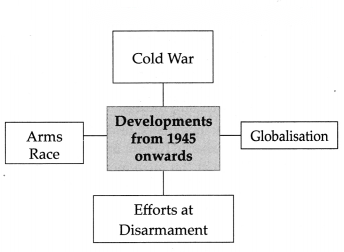
Solution & Step-by-Step Answer:
Question 2
Maharashtra Board Solution
Solution & Step-by-Step Answer:
Question 3
Maharashtra Board Solution
Solution & Step-by-Step Answer:
Answer in brief:
Question 1
Maharashtra Board Solution
What were the effects of World War I?
Solution & Step-by-Step Answer:
(i) The First World War was fought between 1914 and 1918. The war caused a tremendous loss of life and property. The countries which joined the war suffered tremendous economic losses.
(ii) Even the countries which did not join the war were impacted by the war. The economies of the victorious as well as the losing countries collapsed. (iii) Earlier empires in Europe collapsed and new nations came into being. (iv) Independence movements in European colonies changed hegemony of European Nations. (v) League of Nations was established. (vi) Autocratic regime came up in Germany Spain, Italy and other countries.
Question 2
Maharashtra Board Solution
Describe America’s role in the Second World War.
Solution & Step-by-Step Answer:
(i) America played a major role in the Second World War. It had manufactured nuclear weapons.
(ii) In order to end the war, it dropped two nuclear weapons on two cities of Japan – Hiroshima and Nagasaki on 6th and 9th August 1945 respectively.
Question 3
Maharashtra Board Solution
What gave rise to the Cold War?
Solution & Step-by-Step Answer:
(i) America was already a super power, but the Soviet Union also tried to become one, by making nuclear weapons and by increasing its military might.
(ii) The struggle for power, arms race, differences in ideologies, attitude of checkmating each other by strategies and counter-strategies gave rise to the Cold War.
Question 4
Maharashtra Board Solution
Describe extreme differences among USA and USSR.
Solution & Step-by-Step Answer:
(i) The U.S.A was a democratic State, advocating capitalism, while the Soviet Union advocated socialism and a one party authoritarian system. (ii) Both the super powers wanted to expand their own dominance in the world. (iii) America wanted to spread capitalism, while the Soviet Union wanted to spread socialism.
Question 5
Maharashtra Board Solution
What is meant by Non-Aligned Movement and who were its founding fathers?
Solution & Step-by-Step Answer:
(i) The Asian and African countries, which became independent after the Second World War supported the idea of non-alignment.
(ii) This movement started from 1961 under the leadership of India’s Prime Minister Pandit Jawaharlal Nehru, President of Yugoslavia Marshall Tito, President of Egypt Gamal Abdal Nasser, President of Indonesia Dr. Sukarno and Prime Minister of Ghana Dr. Kwame Nkrumah.
Question 6
Maharashtra Board Solution
Evaluate the Non-Aligned Movement.
Solution & Step-by-Step Answer:
(i) The Non-Aligned Movement has opposed colonialism, imperialism and racism. (ii) It has encouraged the resolution of international disputes by peaceful means. (iii) The Non-Aligned movement is based on eternal principles of humanism, global peace and equality. (iv) It has inspired the less developed countries to come together. (v) While taking a firm stand on disarmament, fostering human rights, the Non-Aligned movement put forth the problems of poor, undeveloped countries firmly. (vi) This movement made a demand of a New International Economic Order (NIEO).
|