Maharashtra State Board Class 9 Political Science Solutions Chapter 2 India’s Foreign Policy
Class 9 Political Science Chapter 2 India’s Foreign Policy Textbook Questions and Answers
1. Choose the right option and rewrite the sentence:
Solution & Step-by-Step Answer:
(a) Enhance military capacity
Solution & Step-by-Step Answer:
(b) economic development
Solution & Step-by-Step Answer:
(c) non-alignment
Solution & Step-by-Step Answer:
(c) Pokharan
2. Explain with reasons whether the following statements are true or false:
Solution & Step-by-Step Answer:
True. Self-opinion based
Solution & Step-by-Step Answer:
True. Evaluative, self-opinion based
3. Explain the following concepts:
Solution & Step-by-Step Answer:
(i) India got independence in 1947 and from then onwards India started shaping its Foreign Policy independently. (ii) Article 51 among the Directive Principles of State Policy lay down the broad framework for Foreign Policy. (iii) According to it, India should give priority to safeguard international peace and security, and resolve our international problems and disputes by peaceful means. (iv) The objectives of our Foreign Policy should be to maintain friendly relations with other nations and respect international law.
Solution & Step-by-Step Answer:
(i) National interest implies the means through which the independence and sovereignty of our country can be safeguarded.
(ii) National interest also includes efforts to achieve our economic development and to take steps towards increasing our national power.
(iii) When decisions are taken after giving careful thought to what is beneficial and good for our country, we say that we are nurturing our national interest.
Solution & Step-by-Step Answer:
(i) World peace is an ideal state of freedom, peace, and happiness among and within all nations and people. (ii) This idea of world non-violence provides a basis for peoples and nations to willingly co-operate. (iii) Either voluntarily or by virtue of a system of governance, that prevents warfare. (iv) India has been consistently supporting efforts for disarmament because it is India’s policy that there should be peace and security.
4. What is your opinion about the fact that world peace is threatened due to nuclear preparedness?
Answer:
Nuclear preparedness leads to an Arm’s Race. It increases the possibilities of wars.
(i) If a nuclear bomb exploded in a major city, the blast center would be hotter than the surface of the sun.
(ii) Survivors would have no electricity, no transportation, no phones, and hospitals would be overwhelmed if they were still standing
(iii) India is now a country that has nuclear weapons. We have accepted the role of a responsible nuclear power. India has been consistently supporting efforts for disarmament because it is India’s position that there should be peace and security in the world.
5. Answer the following questions in brief:
Solution & Step-by-Step Answer:
(i) India got independence in 1947 and from then onwards we started shaping our foreign policy independently.
(ii) The Directive Principles of State Policy have laid down guidelines about how to shape Foreign Policy. Article 51 among the Directive Principles of State Policy lay down the broad framework for foreign policy.
(iii) According to it, India should give priority to safeguard international peace and security, and resolve our international problems and disputes by peaceful means.
(iv) The objectives of our foreign policy should be to maintain friendly relations with other nations and respect international law. India’s Foreign Policy till now has been developed in this framework.
Solution & Step-by-Step Answer:
(i) Prime Minister Atal Bihari Vajpayee contributed a great deal to improving Sino-Indian relations. (ii) The President, the Prime Minister, the Foreign Minister, the Defence Minister, the Finance Minister, and the Home Minister have a role in deciding foreign policy. (iii) The persons holding these positions try to maintain the continuity in Foreign Policy and to improve upon it.
Question.3
Write the objectives of India’s Foreign Policy.
Answer:
Objectives of India’s Foreign Policy are as follows:
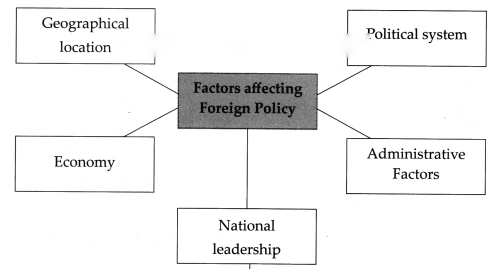
6. Prepare the following concept map:
Solution & Step-by-Step Answer:
Class 9 Political Science Chapter 2 India’s Foreign Policy Additional Important Questions and Answers
Choose the correct option from the given options and rewrite the sentence:
Solution & Step-by-Step Answer:
(a) Pandit Jawaharlal Nehru
Solution & Step-by-Step Answer:
(b) Commercial
Solution & Step-by-Step Answer:
(b) 1990
Solution & Step-by-Step Answer:
(b) freedom
Solution & Step-by-Step Answer:
(c) Dr. Homi Bhabha.
Solution & Step-by-Step Answer:
(b) 1991
Solution & Step-by-Step Answer:
(d) Singapore
State whether the following statements are true or false with reasons:
Solution & Step-by-Step Answer:
True.
Solution & Step-by-Step Answer:
True.
Explain the concept:
Solution & Step-by-Step Answer:
(i) While maintaining friendly relations with neighboring countries, ensure that the defense and security of India are not affected. (ii) Protecting the unity and integrity of the country. (iii) Protecting the interests of India’s citizens living in other countries. This responsibility is fulfilled by the Indian embassies there. (iv) To establish economic and commercial relations with other countries for achieving economic development.
Solution & Step-by-Step Answer:
(i) Foreign policy is shaped by the need to establish economic relations with other countries, import-export, participation in world trade, all aimed at strengthening the economy of the country. (ii) In today’s world, the issues of economic security are as important as national security. (iii) A country is recognized to be powerful in proportion to the economic security it enjoys. (iv) Countries having a strong economy are less dependent on others, and they can have an independent foreign policy as well.
Solution & Step-by-Step Answer:
(i) The President, the Prime Minister, the Foreign Minister, the Defence Minister, the Finance Minister and the Home Minister have a role in deciding foreign policy. (ii) The persons holding these positions try to maintain continuity in foreign policy and to improve upon it. (iii) For example, Pandit Jawaharlal Nehru contributed the policy of non-alignment to India’s foreign policy. (iv) Prime Minister Atal Bihari Vajpayee contributed a great deal to improving Sino-Indian relations.
Solution & Step-by-Step Answer:
(i) India got independence in 1947, and from then onwards we started shaping our foreign policy independently. (ii) The Directive Principles of State Policy have laid down guidelines about how to shape foreign policy. (iii) Article 51 among the Directive Principles of State Policy lay down the broad framework for foreign policy. According to it, India should give priority to safeguard international peace and security, and resolve our international problems and disputes by peaceful means. (iv) The objectives of our foreign policy should be to maintain friendly relations with other nations and respect international law.
Do as directed:
Complete the list:
Solution & Step-by-Step Answer:
(i) Indira Gandhi: Pokhran Nuclear Test. (ii) Rajiv Gandhi: Science and Technology (iii) Atal Bihari Vajpayee: Sino-Indian Relations
Solution & Step-by-Step Answer:
(i) Pandit Jawaharlal Nehru: Look East (ii) P. V. Narasimha Rao: Efforts to increase Foreign Direct Investment
Answer the following questions in brief:
Solution & Step-by-Step Answer:
(i) Three things that influenced India’s foreign policy in this period. (ii) We made an effort to understand all international events and developments independently, without any pressure from any power. Peace has always been a central feature of India’s foreign policy. (iii) The threats from China and Pakistan were also taken into account. (iv) One more feature of India’s foreign policy at this time was the insistence on self-reliance.
Solution & Step-by-Step Answer:
(i) In the beginning, India decided to improve relations with countries in Asia.
(ii) Efforts were taken to cooperate with Asian countries in order to achieve development and to keep our independence intact.
(iii) This concept of regional development later expanded to include Africa, as well.
(iv) But some Asian-African countries participated in the military pacts led either by America or the Soviet Union.
(v) This stopped the process of regional development. After this, countries of Asia and Africa, which did not participate in these military pacts supported the concept of non-alignment.
(vi) Peace and freedom became the fundamental principles of non-aligned policy.
Solution & Step-by-Step Answer:
(i) In the decade of the 1970s, there came about some stability in India’s Foreign Policy.
(ii) India had risen as a powerful regional power in South Asia.
(iii) By conducting nuclear tests in 1974, India had also proved its nuclear capability.
(iv) From 1980, however, some changes began to take place. In order to increase cooperation among South Asian countries, South Asian Association for Regional Cooperation (SAARC) was established.
(v) India initiated a dialogue to improve relations with China. India also started interaction with America for cooperation in the field of security.
Solution & Step-by-Step Answer:
Three factors that influenced India’s foreign policy in the early period are:
Solution & Step-by-Step Answer:
Prime Minister Pandit Nehru shaped India’s foreign policy in the early period. He opposed colonialism through India’s foreign policy. He took an internationalist position and gave priority to global peace and security.
Solution & Step-by-Step Answer:
In the early period, India had to face conflict with neighbouring countries. Wars happened between India and Pakistan over the Kashmir question in 1947-48 and 1965. In the third war, which happened in 1971, Pakistan broke apart and independent Bangladesh was created.
Solution & Step-by-Step Answer:
From 1980, some important changes began to take place. In order to increase cooperation among South Asian countries, the South Asian Association for Regional Cooperation (SAARC) was established. India initiated a dialogue to improve relations with China. India also started interaction with America for cooperation in the field of security.
Solution & Step-by-Step Answer:
(i) In the beginning, India decided to improve relations with countries in Asia.
(ii) Efforts were taken to cooperate with Asian countries in order to achieve development and to keep our independence intact.
(iii) This concept of regional development later expanded to include Africa as well.
(iv) But some Asian-African countries participated in the military pacts led either by America or the Soviet Union. This stopped the process of regional development.
(v) After this, countries of Asia and Africa, which did not participate in these military pacts supported the concept of Non-alignment.
Solution & Step-by-Step Answer:
(i) In a democratic political system, the nation’s Parliament plays a major role in evolving Foreign Policy.
(ii) When different aspects come up for discussion in Parliament, the opposition parties try to regulate the Foreign Policy by raising questions about the same.
(iii) Federal political systems have to take into account the inclinations of the constituent states while shaping Foreign Policy because the affairs in neighbouring nations affect constituent states.
(iv) For example, events in Sri Lanka may affect Tamil Nadu, and those in Bangladesh may affect West Bengal and the North-East Indian States.
Solution & Step-by-Step Answer:
(i) Ministry of External Affairs, Foreign Secretary, embassies in different countries, Diplomatic officers, etc. are the administrative factors involved in creating Foreign Policy.
(ii) Even though the final decisions about Foreign Policy are taken by the Prime Minister and the Minister for External Affairs, the administrative machinery helps to arrive at that decision.
(iii) The administrative officers collect information needed to shape the foreign policy, analyze it and give appropriate advice based on it.
(iv) The National Security Advisor also completes this task.
Solution & Step-by-Step Answer:
(i) India adopted the policy of non-alignment in the context of the cold war. As a result, priority was given to maintaining friendly relations with all nations and to taking the help required for development from different countries. Due to the policy of non-alignment, India could get aid from both the superpowers.
(ii) There was a lot of stress on improving/ strengthening India’s defence. The technology required for this was imported. Soviet Union, France, and Germany helped India in this matter.
(iii) In this period, India had to face some challenges. These included the conflict with Pakistan, the creation of Bangladesh, and the conflict with China.
(iv) India proved its nuclear capability by conducting nuclear tests in 1974.
Solution & Step-by-Step Answer:
(i) In the globe or map of the world. We see the geographical location of any nation of the world.
(ii) Some countries are far away from other countries, while there are several neighbouring countries around some countries. Some nations have a long coastline, while some have plenty of mineral wealth.
(iii) In sum, the size, population, topography, coastline, availability of natural resources, all these factors need to be considered while deciding the foreign policy of any country.
Solution & Step-by-Step Answer:
The following factors are included in the national interest of any country.
Solution & Step-by-Step Answer:
(i) India’s Foreign Policy became more comprehensive and dynamic in the second stage.
(ii) In the post-cold war period, the priority no longer remained on political and military relations.
(iii) Several other dimensions like the economy, trade, education, and technology got included in foreign policy.
(iv) After 1991, India reduced the government controls over the economy and adopted the free-market policy.
(v) In the decade after 1990, our relations with South Asian countries like Singapore, Thailand, Vietnam, etc. became stronger.
(vi) Our trade exchange with Israel, Japan, China, and European Union increased.
(vii) India began to participate in organizations at the international and regional levels more than before.
(viii) For example, G-20 and BRICS (Brazil, Russia, India, China, South Africa).
(ix) Our relations with America strengthened.
(x) India’s nuclear policy is an important part of India’s foreign policy. India undertook the nuclear energy program immediately after independence. India built nuclear weapons and conducted nuclear tests in 1998. India is now a country that has nuclear weapons.
Solution & Step-by-Step Answer:
(i) Interdependence being a key feature in the international system each country has to decide the nations with which it should be friendly, in which bloc it should participate or what position it should take in international relations.
(ii) Such decisions should be made thoughtfully.
(iii) The theoretical framework in which such decisions are taken is called Foreign Policy.
(iv) Every sovereign and independent country decides its own Foreign Policy.
(v) Hence in the discipline of international politics, which studies international relations between nations, Foreign Policy has an important place.