Maharashtra State Board Class 9 Science Solutions Chapter 3 Current Electricity
Class 9 Science Chapter 3 Current Electricity Textbook Questions and Answers
1. The accompanying figure shows some electrical appliances connected in a circuit in a house. Answer the following questions.
A. By which method are the appliances connected?
Answer:
Appliances are connected in parallel.
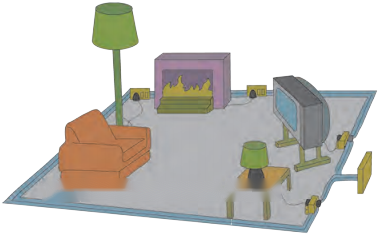
B. What must be the potential difference across individual appliances?
Answer:
The potential difference across all appliances is same in parallel connection.
C. Will the current passing through each appliance be the same? Justify your answer.
Answer:
No, as every appliance has a different load (resistance), the current flowing through each appliance will be different.
D. Why are the domestic appliances connected in this way?
Answer:
The domestic appliances are connected in parallel as the potential difference remains same.
E. If the T.V. stops working, will the other appliances also stop working? Explain your answer.
Answer:
No, the other devices will not stop working as the current flowing through them is along different paths.
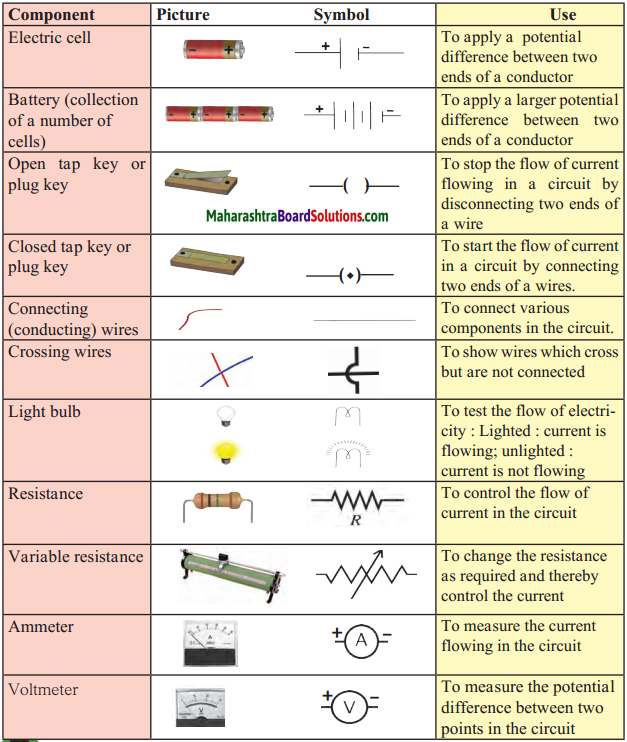
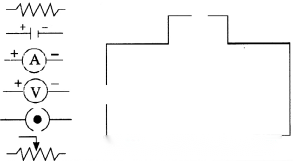
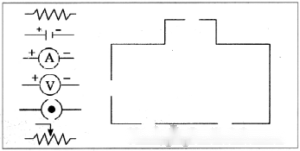
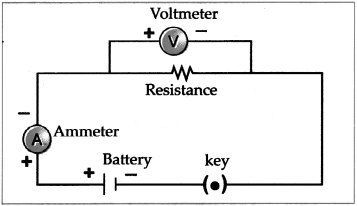
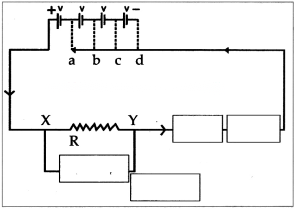
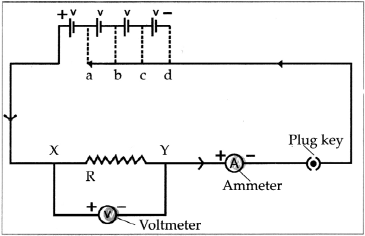
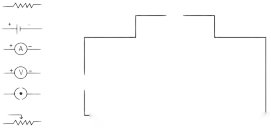
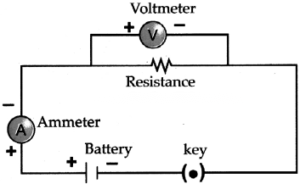
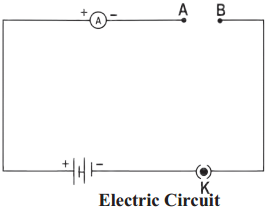
2. The following figure shows the symbols for components used in the accompanying electrical circuit.
Which law can you prove with the help of the above circuit?
Answer:
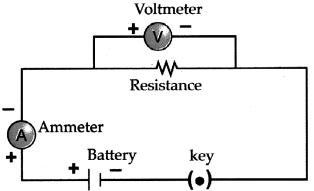
(b) This circuit can be used to prove Ohm’s law.
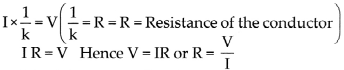
(c) V = 1R is the expression of Ohm’s law
3. Umesh has two bulbs having resistances of 15 W and 30 W. He wants to connect them in a circuit, but if he connects them one at a time the filament gets burnt. Answer the following.
A. Which method should he use to connect the bulbs?
B. What are the characteristics of this way of connecting the bulbs depending on the answer of A above?
C. What will be the effective resistance in the above circuit?
4. The following table shows current in Amperes and potential difference in Volts.
a. Find the average resistance.
b. What will be the nature of the graph between the current and potential difference? (Do not draw a graph.)
c. Which law will the graph prove? Explain the law.
5. Match the pairs
‘A’ Group – ‘B’ Group
1. Free electrons – a. V/ R
2. Current – b. Increases the resistance in the circuit
3. Resistivity – c. Weakly attached
4. Resistances in series – d. VA/LI
6. The resistance of a conductor of length x is r. If its area of crosssection is a, what is its resistivity? What is its unit?
7. Resistances R1, R2, R3and R4are connected as shown in the figure. S1and S2are two keys. Discuss the current flowing in the circuit in the following cases.
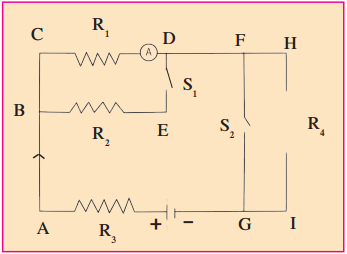
a. Both S1and S2are closed.
b. Both S1and S2are open.
c. S1is closed but S2is open.
Answer:
(a) When both S1and S2are dosed, the effective resistance of the circuit decreases and hence, current will increase.
(b) When both S1and S2are open, the effective resistance of the rircuit increases and hence, current will decrease.
(c) When S2is closed and S2is open, the effective resistance of the tircuit decreases and hence current will increase. [Current will be more than case (b) but less than in case (a)]
8. Three resistances x1, x2and x3are connected in a circuit in different ways. x is the effective resistance. The properties observed for these different ways of connecting x1, x2and x3are given below. Write the way in which they are connected in each case. (I-current, V-potential difference, x-effective resistance)
a. Current I flows through x1, x2and x3
b. x is larger than x1, x2and x3
c. x is smaller than x1, x2and x3
d. The potential difference across x1, x2and x3is the same
e. x = x1+ x2+ x3
9. Solve the following problems.
A. The resistance of a 1m long nichrome wire is 6Ω. If we reduce the length of the wire to 70 cm. what will its resistance be? (Answer : 4.2Ω)
Answer:
The resistance of 70cm wire will be 4.2 Ω
B. When two resistors are connected in series, their effective resistance is 80Ω. When they are connected in parallel, their effective resistance is 20Ω. What are the values of the two resistances? (Answer : 40Ω, 40Ω)
Answer:
The values of the two resistances R1and R2are 40Ω and 40Ω.
C. If a charge of 420 C flows through a conducting wire in 5 minutes what is the value of the current? (Answer : 1.4 A)
Answer:
Given: Electric charge (Q) = 420 C
Time (t) = 5 min = 5 x 60
= 300 sec.
To find: Electric current (1) = ?
Formula:
Solution:
The current in the circuit is 1.4 A.
Class 9 Science Chapter 3 Current Electricity Intext Questions and Answers
Can you recall?
Copper displays lowest resistance while the resistance increases with aluminium, zinc and iron respectively.
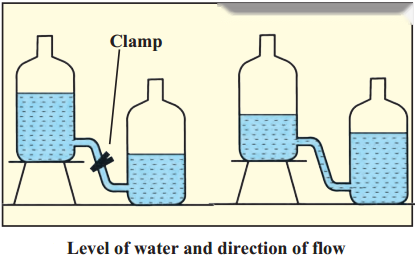
(a) What happens when the clamp is removed?
When the clamp is removed, water flows from higher level to lower level.
(b) Does the water stop flowing? Why?
Answer:
Yes, the water stops flowing. This happens when the level of water becomes equal in both the bottles, i.e., there is no difference in the water levels.
(c) What will you do to keep the water flowing for a longer duration?
Answer:
The difference in the water level has to be maintained till that time. The difference must never be zero.
Question 4
Maharashtra Board Solution
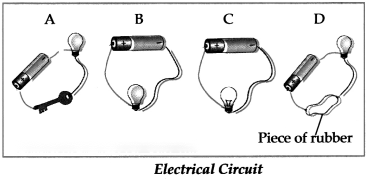
Point out the mistakes in the figure below:
Solution & Step-by-Step Answer:
A: Wire is broken at the negative terminal. Bulb will not glow as the circuit is incomplete. B: Wire is disconnected at the negative terminal. Bulb will not glow as the circuit is incomplete. C: The circuit is complete. Therefore, bulb will glow. D: Rubber is a bad conductor of electricity. Hence, it will not allow current to flow and the bulb will not glow.
Question 5
Maharashtra Board Solution
Why are the bulbs in Figures B, C and D not lighting up?
Solution & Step-by-Step Answer:
Class 9 Science Chapter 3 Current Electricity Additional Important Questions and Answers Choose and write the correct option:
Question 1
Maharashtra Board Solution
1mA = …………… A. (a) 103 (b) 10-3 (c) 106 (d) 10-6
Solution & Step-by-Step Answer:
(a) 103
Question 2
Maharashtra Board Solution
To increase the effective resistance in a circuit the resistors are connected in …………... (a) Series (b) Parallel (c) Both ways (d) None of these
Solution & Step-by-Step Answer:
(a) series
Question 3
Maharashtra Board Solution
1 kilowatt hr = …………… joules. (a) 4.6 x 10⁶ (b) 3.6 x 10⁶ (c) 30.6 x 10⁶ (d) 3.6 x 1O5
Solution & Step-by-Step Answer:
(b) 3.6 x 10⁶
Question 4
Maharashtra Board Solution
The voltage difference in India between the live and neutral wires is about …………... (a) 110 V (b) 220 V (c) 440 V (d) 60 V
Solution & Step-by-Step Answer:
(b) 220 V
Question 5
Maharashtra Board Solution
Resistivity is the specific property of a …………... (a) Area of cross-section (b) Temperature (c) Length (d) Material
Solution & Step-by-Step Answer:
(d) material
Question 6
Maharashtra Board Solution
If a P.D. of 12 V is applied across a 3Ω resistor then the current passing through it is …………... (a) 36 A (b) 4 A (c) 0.25 A (d) 15 A
Solution & Step-by-Step Answer:
(b) 4 A.
Question 7
Maharashtra Board Solution
In order to measure the electric current flowing through a circuit, we connect …………… with the circuit. (a) a voltmeter in parallel (b) a voltmeter in series (c) an ammeter in parallel (d) an ammeter in series
Solution & Step-by-Step Answer:
(d) an ammeter in series
Question 8
Maharashtra Board Solution
P and Q are two wires of same length and different cross-sectional areas and made of same material. Name the property which is same for both the wires. (a) Resistivity (b) Resistance (c) Current (d) Both (a) and (b)
Solution & Step-by-Step Answer:
(a) Resistivity
Question 9
Maharashtra Board Solution
The following is true for identical bulbs connected in parallel. (a) All bulbs glow with unequal brightness. (b) If one bulb is non-functional, all will stop working. (c) All bulbs glow with equal brightness. (d) Bulbs function for longer time.
Solution & Step-by-Step Answer:
(c) All bulbs glow with equal brightness
Question 10
Maharashtra Board Solution
The …………… wire is either yellow or green in colour. (a) Live (b) Neutral (c) Earth (d) Fuse
Solution & Step-by-Step Answer:
(c) earth
Question 11
Maharashtra Board Solution
A current flows through a circuit due to the difference in …………… between two points in the conductor. (a) Gravity (b) Potential (c) Resistance (d) Fuse
Solution & Step-by-Step Answer:
(b) potential
Question 12
Maharashtra Board Solution
…………… is the amount of charge flowing through a particular cross sectional area in unit time. (a) Electric current (b) Ampere (c) Volt (d) Force
Solution & Step-by-Step Answer:
(a) Electric current
Question 13
Maharashtra Board Solution
The flow of …………… constitutes the electric current in a wire. (a) Protons (b) Neutrons (c) Electrons (d) Gravitons
Solution & Step-by-Step Answer:
(c) electrons
Question 14
Maharashtra Board Solution
The conventional direction of flow of current is from …………… terminal to …………… terminal. (a) Negative to positive (b) Neutral to positive (c) Positive to negative (d) Positive to neutral
Solution & Step-by-Step Answer:
(c) positive, negative
Question 15
Maharashtra Board Solution
Current stops flowing when potential difference between two ends of a wire becomes …………... (a) Zero (b) Positive (c) Negative (d) Higher
Solution & Step-by-Step Answer:
(a) zero
Question 16
Maharashtra Board Solution
Resistances are connected in …………… so as to pass the same current through them. (a) Series (b) Parallel (c) Reversed (d) Disconnect
Solution & Step-by-Step Answer:
(a) series
Question 17
Maharashtra Board Solution
To decrease the effective resistance in a circuit, the resistances are connected in …………... (a) Series (b) Parallel (c) Reversed (d) Disconnect
Solution & Step-by-Step Answer:
(b) parallel
Question 18
Maharashtra Board Solution
1μV = …………… V (a) 102 (b) 10-6 (c) 106 (d) 103
Solution & Step-by-Step Answer:
(b) 10-6
Question 19
Maharashtra Board Solution
Good conductors contain a large number of …………... (a) Protons (b) Neutrons (c) Electrons (d) Gravitons
Solution & Step-by-Step Answer:
(c) free electrons
Question 20
Maharashtra Board Solution
Electrons flow from …………… terminal to …………… terminal in a conductor when a potential difference is applied. (a) Negative to positive (b) Neutral to positive (c) Positive to negative (d) Positive to neutral
Solution & Step-by-Step Answer:
(a) negative, positive
Find the odd one out:
Question 1
Maharashtra Board Solution
Voltmeter, Ammeter, Galvanometer, Thermometer
Solution & Step-by-Step Answer:
Thermometer
Question 2
Maharashtra Board Solution
Rubber, Silver, Copper, Gold
Solution & Step-by-Step Answer:
Rubber
Question 3
Maharashtra Board Solution
Wood, Glass, Steel, Rubber
Solution & Step-by-Step Answer:
Steel
Question 4
Maharashtra Board Solution
Graphite, Diamond, Fullerenes, Coal
Solution & Step-by-Step Answer:
Fullerenes
Distinguish between:
Question 1
Maharashtra Board Solution
Voltmeter and Ammeter
Solution & Step-by-Step Answer:
Question 2
Maharashtra Board Solution
Ohmic conductors and Non-Ohmic conductors
Solution & Step-by-Step Answer:
Question 3
Maharashtra Board Solution
Conductors and Insulators
Solution & Step-by-Step Answer:
Question 4
Maharashtra Board Solution
Resistance in Series and Resistance in Parallel
Solution & Step-by-Step Answer:
Question 5
Maharashtra Board Solution
Solution & Step-by-Step Answer:
Make pair:
Question 1
Maharashtra Board Solution
Copper : Conductor :: Rubber : ……………….
Solution & Step-by-Step Answer:
Insulator
Question 2
Maharashtra Board Solution
Aluminium : ………………. :: Indium oxide : Super Insulator
Solution & Step-by-Step Answer:
Super conductor
Question 3
Maharashtra Board Solution
Parallel Connection : :: Series Connection : ……………….
Solution & Step-by-Step Answer:
Rs = R1 + R2
(4) Electric Current : ………………. :: Electric charge : Coulomb (5) Electric resistance : Ohm :: Potential difference : ………………. State whether the following statements are true or false. Correct the false statements: (1) The SI unit of charge is volt. Answer the following in one sentence:
Question 1
Maharashtra Board Solution
Which is the unit used to measure large voltages?
Solution & Step-by-Step Answer:
Kilovolts and Megavolts are the units used to measure large voltages.
Question 2
Maharashtra Board Solution
What is the SI unit of potential difference?
Solution & Step-by-Step Answer:
The SI unit of potential difference is volt (V).
Question 3
Maharashtra Board Solution
What is lightning?
Solution & Step-by-Step Answer:
Lightning is the electric discharge travelling from clouds at high potential to earth’s surface which is at zero potential.
Question 4
Maharashtra Board Solution
What is the unit of resistivity.
Solution & Step-by-Step Answer:
The unit of resistivity is ohm metre (Qm).
Question 5
Maharashtra Board Solution
Which substances are called conductors of electricity?
Solution & Step-by-Step Answer:
Those substances which have very low electrical resistance are called conductors of electricity.
Question 6
Maharashtra Board Solution
What is Earth wire?
Solution & Step-by-Step Answer:
Earth wire is generally yellow or green colour, it is connected to a metal plate buried deep underground near the house and is for safety purpose.
Write formula: Give scientific reasons:
Question 1
Maharashtra Board Solution
Free electrons are required for conduction of electricity.
Solution & Step-by-Step Answer:
Question 2
Maharashtra Board Solution
Wood and glass are good insulators.
Solution & Step-by-Step Answer:
Question 3
Maharashtra Board Solution
Connecting wires in a circuit are made of copper and aluminium.
Solution & Step-by-Step Answer:
Question 4
Maharashtra Board Solution
A thick wire has a low resistance.
Solution & Step-by-Step Answer:
Question 5
Maharashtra Board Solution
A series combination of resistances is used to increase the resistance of a circuit.
Solution & Step-by-Step Answer:
Question 6
Maharashtra Board Solution
A parallel combination of resistances decreases the effective resistance of the circuit.
Solution & Step-by-Step Answer:
Question 7
Maharashtra Board Solution
Lightning occurs from sky to earth.
Solution & Step-by-Step Answer:
Question 8
Maharashtra Board Solution
In streetlights, bulbs are connected in parallel.
Solution & Step-by-Step Answer:
Numerical:
Question 1
Maharashtra Board Solution
A current of 0.4 A flows through a conductor for 5 minutes. How much charge would have passed through the conductor?
Solution & Step-by-Step Answer:
Given: Current (I) = 0.4 A Time (t) = 5 min = 5 x 60 = 300 s To find: Charge (Q) =? Formula: Q = 1 x Solution: Q = 0.4 x 300 Q= 120 C. Charge passing through the conductor is 120
Question 2
Maharashtra Board Solution
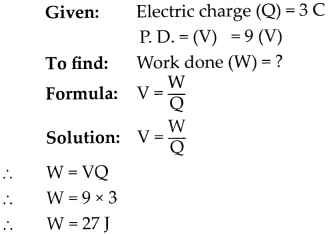
Find the amount of work done if 3 C of charge is moved through a potential difference of 9 V.
Solution & Step-by-Step Answer:
The work done is 27 joule.
Question 3
Maharashtra Board Solution
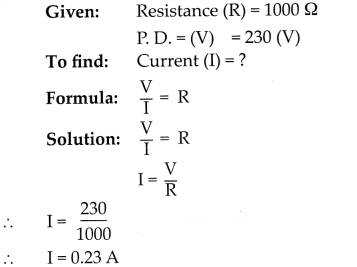
The resistance of the filament of a bulb is 1000Ω. It is drawing a current from a source of 230 V. How much current is flowing through it?
Solution & Step-by-Step Answer:
The current flowing through the filament of bulb is 0.23 A.
Question 4
Maharashtra Board Solution
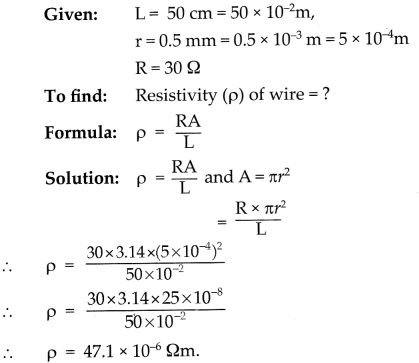
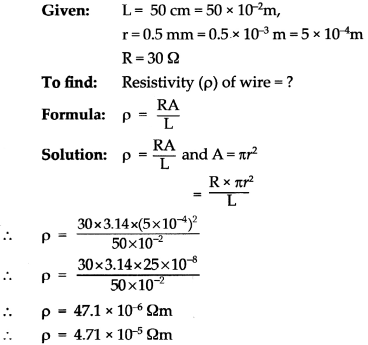
The length of a conducting wire is 50 cm and its radius is 0.5 mm. If its resistance is 30Ω, what is the resistivity of its material?
Solution & Step-by-Step Answer:
The resistivity of the wire is 4.71 x 10⁻⁵ Qm.
Question 5
Maharashtra Board Solution
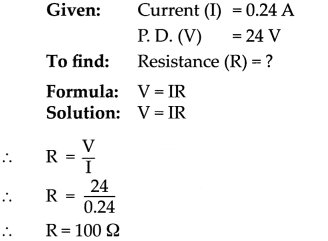
A current of 0.24 A flows through a conductor when a potential difference of 24 V is applied between its two ends. What is its resistance?
Solution & Step-by-Step Answer:
The resistance of a conductor is 100Ω.
Question 6
Maharashtra Board Solution
If three resistors 15Ω, 3Ω and 4Ω each are connected in series, what is the effective resistance in the circuit?
Solution & Step-by-Step Answer:
Given: R1 =15Ω R2 = 3Ω R3 = 4Ω Effective resistance in series (Rs) = ? Rs = R1 + R2 + R3 Rs = 15 + 3 + 4 Rs = 22Ω The effective resistance in the circuit is 22Ω.
Question 7
Maharashtra Board Solution
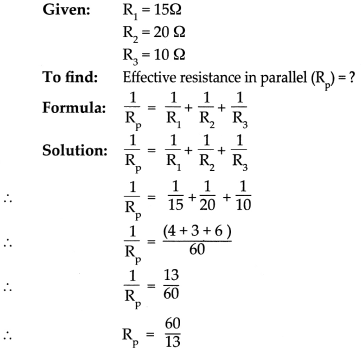
Three resistances 15Ω, 20Ω and 10Ω are connected in parallel. Find the effective resistance of the circuit.
Solution & Step-by-Step Answer:
The effective resistance of the circuit is 4.615 Ω. It is less than the least of the three i.e., 10Ω.
Write a note on the following:
Question 1
Maharashtra Board Solution
Electric current
Solution & Step-by-Step Answer:
An electric current is the flow of electrons through a conductor. Quantitatively, current (I) is defined as the charge passing through a conductor in unit time.
Question 2
Maharashtra Board Solution
1 ampere
Solution & Step-by-Step Answer:
One ampere current is said to flow in a conductor if one coulomb charge flows through it every second.
Question 3
Maharashtra Board Solution
1 volt
Solution & Step-by-Step Answer:
The potential difference between two points is said to be 1 volt if 1 joule of work is done in moving 1 coulomb of electric charge from one point to another.
Question 4
Maharashtra Board Solution
Potential Difference
Solution & Step-by-Step Answer:
The amount of work done to carry a unit positive charge from point A to point B is called the electric potential difference between the two points.
Question 5
Maharashtra Board Solution
Conductor
Solution & Step-by-Step Answer:
Those substances which have very low resistance are called conductors. Current can flow easily through such materials.
Question 6
Maharashtra Board Solution
Insulators
Solution & Step-by-Step Answer:
Those substances which have extremely high resistance and through which current cannot flow are called insulators.
Question 7
Maharashtra Board Solution
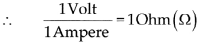
1 ohm
Solution & Step-by-Step Answer:
If one Ampere current flows through a conductor when one Volt potential difference is applied between its ends, then the resistance of the conductor is one Ohm.
Question 8
Maharashtra Board Solution
Potential
Solution & Step-by-Step Answer:
The level of electric charge present is known as potential.
Question 9
Maharashtra Board Solution
Ohm’s Law
Solution & Step-by-Step Answer:
If the physical state of a conductor remains constant, the current (I) flowing through it is directly proportional to the potential difference (V) between its two ends. V = IR
Question 10
Maharashtra Board Solution
Superconductors
Solution & Step-by-Step Answer:
The resistance of some conductors becomes nearly zero if their temperature is decreased up to a certain value close to 0 K. Such conductors are called superconductors.
Question 11
Maharashtra Board Solution
Non-ohmic conductors
Solution & Step-by-Step Answer:
Conductors which do not obey Ohm’s law are called non-ohmic conductors.
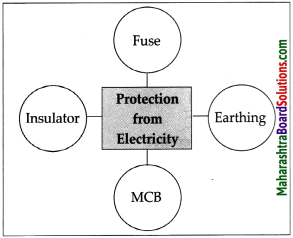
Complete the flow charts: (1) Protection from Electricity
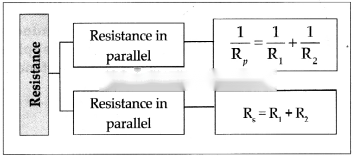
(2) Resistance
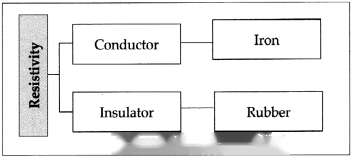
(3) Resistivity
Write properties/characteristics/advantages of the following: Superconductors Give explanations of the given statements:
Question 1
Maharashtra Board Solution
Safety precautions are to be taken while using electricity.
Solution & Step-by-Step Answer:
Question 2
Maharashtra Board Solution
In a domestic circuit colour code is followed while setting up electrical wiring.
Solution & Step-by-Step Answer:
Question 3
Maharashtra Board Solution
Fuse used in electrical circuit can save electrical objects from damage.
Solution & Step-by-Step Answer:
Question 4
Maharashtra Board Solution
Bulbs arranged in parallel glow brighter than bulbs arranged in series.
Solution & Step-by-Step Answer:
Complete the following table:
Solve the numerical:
Question 1
Maharashtra Board Solution
The length of a conducting wire is 50 cm and its radius is 0.5 mm. If its resistance is 30Ω, what is the resistivity of its material?
Solution & Step-by-Step Answer:
The resistivity of the wire is 4.71 x 10⁻⁵ Ωm.
Question 2
Maharashtra Board Solution
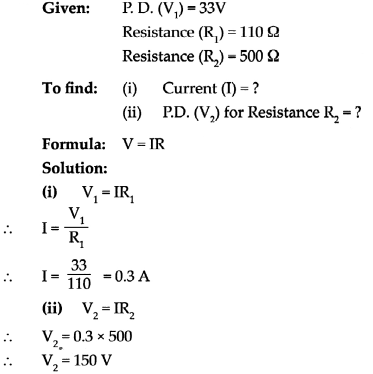
Determine the current that will flow when a potential difference of 33 V is applied between two ends of an appliance having a resistance of 110 Ω. If the same current is to flow through an appliance having a resistance of 500 Ω, how much potential difference should be applied across its two ends?
Solution & Step-by-Step Answer:
The current is 0.3 A and potential difference to be applied is 150 V.
Question 3
Maharashtra Board Solution
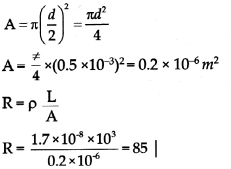
Determine the resistance of a copper wire having a length of 1 km and diameter of 0.5 mm.
Solution & Step-by-Step Answer:
Given: Resistivity of copper (p) = 1.7 x 10⁻⁸ Ω m Converting all measures into metres. Length of wire (L) = 1 km = 1000 m = 103 m Diameter of wire (d) = 0.5 mm = 0.5 x 10⁻³m To find: Resistance of wire (R) = ? Formula: Solution: If d is the diameter of the wire then, its area of cross-section The resistance of a copper wire is 85Ω and area of cross section is 0.2 x 10⁻⁶ m2
Question 5
Maharashtra Board Solution
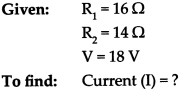
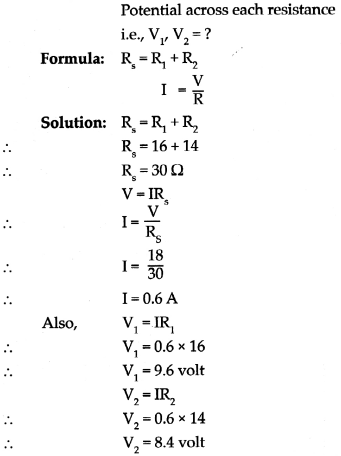
Two resistors having resistance of 16 and 14 are connected in series. If a potential difference of 18 V Is applied across them, calculate the current flowing through the circuit and the potential difference across each individual resistor.
Solution & Step-by-Step Answer:
The current in the circuit is 0.6 A and potential across 16 Ω retor is 9.6 volt and 14 Ω resistor is 8.4 voIt.
Question 6
Maharashtra Board Solution
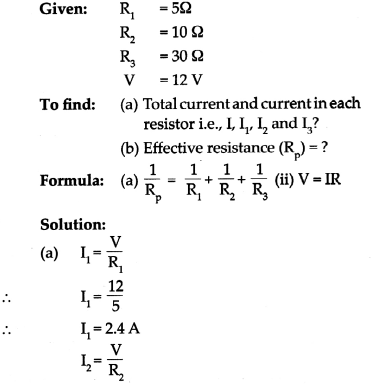
If the resistors 5 Ω, 10 Ω and 30 Ω are connected in parallel to battery of 12 V, find the effective resistance in the circuit. Calculate the total current and current in each resistor.
Solution & Step-by-Step Answer:
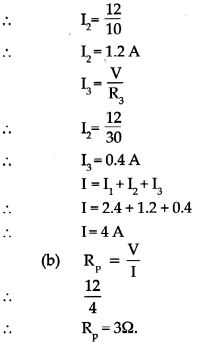
(a) The total current is 4 A and current in each resistor is 2.4 A, 1.2 A and 0.4 A respectively. (b) The effective resistance in the circuit is 3Ω.
Complete the diagram and answer the questions:
Question 1
Maharashtra Board Solution
The following figure shows the symbols for components used in the accompanying electrical circuit. (a) Place them at proper places and complete the circuit. (b) Which law can you prove with the help of the above circuit? (c) State expression for Ohm’s law
Solution & Step-by-Step Answer:
(b) This circuit can be used to prove Ohm’s law. (c) V = IR is the expression of Ohm’s law
Question 3
Maharashtra Board Solution
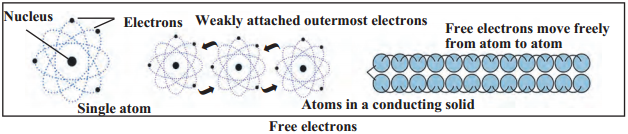
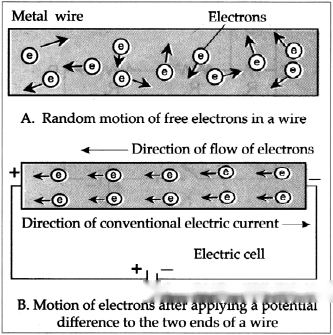
Explain with the help of a diagram, what are free electrons and how they move through the conductor?
Solution & Step-by-Step Answer:
Complete the paragraph:
Question 1
Maharashtra Board Solution
If resistors are connected in series,
Solution & Step-by-Step Answer:
The same current flows through each resistor. The effective resistance of the resistors is equal to the sum of their individual resistances. The potential difference between the two extremes of the arrangement is equal to the sum of the potential differences across individual resistors. The effective resistance is larger than each of the individual resistances. This arrangement is used to increase the resistance in a circuit. This type of connection is used in electrical heating equipment like geysers, iron, and hair dryers.
Question 2
Maharashtra Board Solution
If a number of resistors are connected in parallel,
Solution & Step-by-Step Answer:
The inverse of the effective resistance is equal to the sum of the inverses of individual resistances. The current flowing through an individual resistor is proportional to the r inverse of its resistance and the total current flowing through the circuit is the sum of the currents flowing through individual resistors. The potential difference across all r resistors is the same. The effective resistance of resistors connected in parallel is less than r the least resistance of individual resistors.
This arrangement is used to reduce the resistance in a circuit. Even if any one of the several bulbs connected in parallel becomes non-functional because of some damage to its filament, the circuit does not break as the current flows, through the other paths, and the rest of the bulbs light up. When several bulbs are connected in parallel, they emit the same amount of light as when they are connected individually in the circuit, while bulbs connected in series emit less light than when connected individually. Read the paragraph and answer the questions. Electric switches and sockets should be fitted at a height at which small children cannot reach and put pins or nails inside. Plug wires should not be pulled while removing a plug from its socket. Before cleaning an electrical appliance it should be switched off and its plug removed from the socket. One’s hands should be dry while handling an electrical appliance, and, as far as possible, one should use footwear with rubber soles. As rubber is an insulator, it prevents | the current from flowing through our body, thereby protecting it. If a person gets an electric shock, you should not touch that person. You should switch off the main switch and if the switch is too far or you do not know where it is located, then you should remove the plug from the socket if possible. If not, then you should use a wooden pole to push the person away from the electric wire. (i) Why should the electrical sockets be fitted at a certain height? (ii) Why plug wires should not be pulled out while removing any electrical device? (iii) Why should a person wear footwear with rubber soles while handling electrical appliances.. (iv) Saee is touching an electrical button socket with wet hands what will you advise her and why? (v) Sneha is getting an electrical shock what will you do the save her life? (vi) Give a title to the above passage. Answer the questions in details:
Question 1
Maharashtra Board Solution
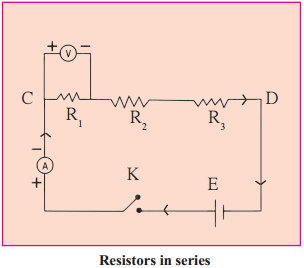
Find the expression (i.e., derive the expression) for the resistors connected in series.
Solution & Step-by-Step Answer:
Expression for the resistance connected in series: (i) Let R1, R2 and R3 be three resistances connected in series between C and D. (ii) Let Rs be the effective resistance in circuit and V1, V2 and V3 be the potential difference across R1, R2 and R3 respectively. (iii) Let the potential difference across CD be V. (iv) In series combination. v = v1 + v2 + v3 ……………………(i) By using Ohm’s law V = IRs ∴ V1= IR1, V2 = IR2 and V3 = 1R3 Substituting these values in equation (j) we get IRs = IR1 + IR2 + IR3 ∴ Rs = R1 + R2 + R3 For ‘n’ number of resistors conneded in series we get Rs = R1 + R2 + R3 + …………………. + Rn
Question 2
Maharashtra Board Solution
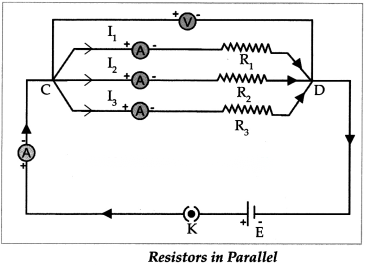
Find the expression (i.e., derive the expression) for the resistors connected in parallel.
Solution & Step-by-Step Answer:
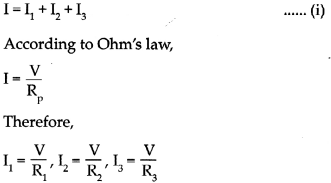
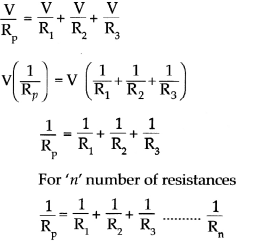
Expression for the resistance connected in parallel. (i) Let R1, R2 and R3 be the three resistances connected in parallel combination between points C and D and let R be their effective resistance. (ii) Let I1, I2 and I3 be the currents flowing through resistances R1, R2 and R3 respectively. Let I be the current flowing through the circuit and V be the potential difference of the cell. (iii) For parallel combination of resistances, (iv) Substituting the values of (I, I1, I2 and I3) in equation (i) we get
Question 3
Maharashtra Board Solution
Find the expression for resistivity of a material.
Solution & Step-by-Step Answer:
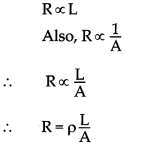
(i) At a given temperature, the resistance (R) of a conductor depends on its length (L), area of cross-section (A) and the material it is made of. If the resistance of a conductor is R, then (ii) p is the constant of proportionality and is called the resistivity of the material. (iii) The unit of resistivity in SI units is Ohm metre (Ω m). (iv) Resistivity is a specific property of a material and different materials have different resistivity. ’
Make the concept diagram and explain:
Question 1
Maharashtra Board Solution
Make the concept diagram of an electrical circuit and explain the working of a fuse.
Solution & Step-by-Step Answer:
(2) Show motion of electrons in an circuit and explain precautions while using an electrical device.
Q.4.4.
Maharashtra Board Solution
Complete the incomplete figure and give an explanation:
Solution & Step-by-Step Answer:
If the physical state of a conductor remains constant, the current (I) flowing through it is directly proportional to the potential difference (V) between its two ends.
I α V
This is known as Ohm’s law.
|