Maharashtra State Board Class 9 Science Solutions Chapter 4 Measurement of Matter
Class 9 Science Chapter 4 Measurement of Matter Textbook Questions and Answers
1. Give examples.
a. Positive radicals
Answer:
Na+– Sodium ion, K+– Potassium ion
b. Basic radicals
Answer:
Na+– Sodium ion, K+– Potassium ion, Ag+– Silver ion
c. Composite radicals
Answer:
d. Metals with variable valency
Answer:
(a) Iron (Ferrum)
(i) Fe2+– Ferrous [Iron – II]
(ii) Fe3+– Ferric [Iron – III]
(b) Copper (Cuprum)
(i) Cu+– Cuprous [Copper -1]
(ii) Cu2+– Cupric [Copper – II]
(c) Mercury (Hydragyrum)
(i) Hg+– Mercurous [Mercury -1]
(ii) Hg2+– Mercuric [Mercury – II]
e. Bivalent acidic radicals
Answer:
O2-– Oxide, S2-– Sulphide, – Carbonate
f. Trivalent basic radicals
Answer:
Al3+– Aluminium, Cr3+– Chromium, Fe3+– Ferric.
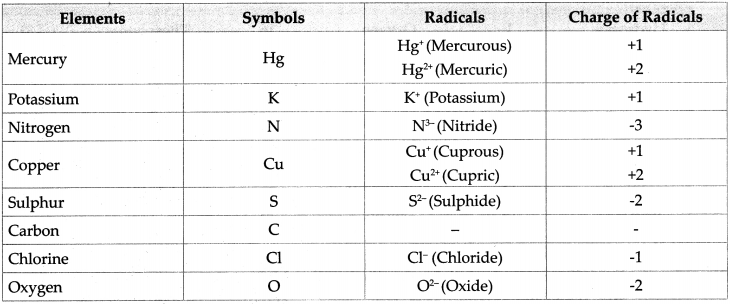
2. Write symbols of the following elements and the radicals obtained from them, and indicate the charge on the radicals.
Mercury, potassium, nitrogen, copper, sulphur, carbon, chlorine, oxygen
Answer:
3. Write the steps in deducing the chemical formulae of the following compounds.
Sodium sulphate, potassium nitrate, ferric phosphate, calcium oxide, aluminium hydroxide
Answer:
In order to write the chemical formulae of compounds, it is necessary to know the symbols and valency of various radicals.
1. Sodium Sulphate:
Step – 1 : To write the symbols of the radicals (Basic radicals on the left and acidic radicals on the right)
Step – 2 : To write the valency below the respective radical.
Step – 3: To cross-multiply as shown by arrows the number of radicals.
Step – 4 : To write down the chemical formula of the compound.
Na2SO4
(Sodium sulphate)


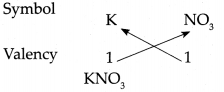
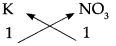
2. Potassium Nitrate:
Step -1 : To write the symbols of the radicals (Basic radicals on the left and acidic radicals on the right)
K NO3
Step – 2 : To write the valency below the respective radical.
{array}{cc}
K & NO_{3} \\
1 & 1
{array}
Step – 3: To cross-multiply as shown by arrows the number of radicals.
Step – 4 : To write down the chemical formula of the compound.
KNO3
(Potassium nitrate)
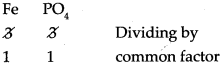
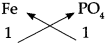
3. Ferric phosphate:
Step -1 : To write the symbols of the radicals (Basic radicals on the left and acidic radicals on the right)
Fe PO4
Step – 2 : To write the valency below the respective radical.
Step – 3: To cross-multiply as shown by arrows the number of radicals.
Step – 4 : To write down the chemical formula of the compound.
FePO4
(Ferric phosphate)
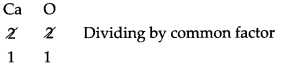
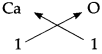
4. Calcium oxide:
Step – 1 : To write the symbols of the radicals (Basic radical on the left and acidic radicals on the right)
Ca O
Step – 2 : To write the valency below the respective radical.
Step – 3: To cross-multiply as shown by arrows the number of radicals.
Step – 4 : To write down the chemical formula of the compound.
CaO
(Calcium oxide)
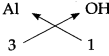
5. Aluminium hydroxide:
Step – 1 : To write the symbols of the radical (Basic radical on the left and acidic radical on the right)
Al OH
Step – 2 : To write the valency below the respective radical.
Step – 3: To cross-multiply as shown by arrows the number of radicals.
Step – 4 : To write down the chemical formula of the compound.
Al(OH)3
(Aluminium hydroxide)

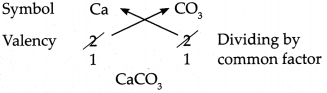
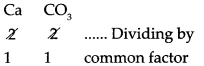
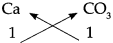
6. Calcium carbonate:
Step – 1 : To write the symbols of the radical (Basic radical on the left and acidic radicals on the right)
Ca CO3
Step – 2 : To write the valency below the respective radical.
Step – 3: To cross-multiply as shown by arrows the number of radicals.
Step – 4 : To write down the chemical formula of the compound.
CaCO3
(Calcium Carbonate)
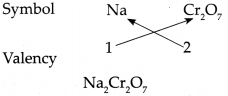
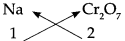
7. Sodium dichromate:
Step – 1 : To write the symbols of the radicals (Basic radical on the left and acidic radical on the right)
Na Cr2O7
Step – 2 : To write the valency below the respective radical.
{array}{cc}
Na & Cr_{2} O_{7} \\
1 & 2
{array}
Step – 3: To cross-multiply as shown by arrows the number of radicals.
Step – 4 : To write down the chemical formula of the compound.
Na2Cr2O7
(Sodium dichromate)
4. Write answers to the following questions and explain your answers.
a. Explain how the element sodium is monovalent.
Answer:
b. M is a bivalent metal. Write down the steps to find the chemical formulae of its compounds formed with the radicals, sulphate and phosphate.
Answer:
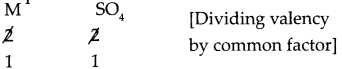
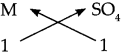
M is a bivalent metal. Following are the steps to find the chemical formulae of its compounds formed with the radicals, sulphate and phosphate:
(i) Compound of metal ‘M’ with radical sulphate
Step – 1: To write the symbols of the radicals (Basic radicals on the left and acidic radicals on the right)
M SO4
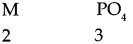
Step – 2: To write the valency below the respective radical.
Step – 3: To cross multiply as shown by arrows the number of radicals.
Step – 4: To write down the chemical formula of the compound.
M SO4
(ii) Compound of metal ‘M’ with radical phosphate.
Step – 1: To write the symbols of the radicals (Basic radicals on the left and acidic radicals on the right)
M PO4
Step – 2: To write the valency below the respective radical.
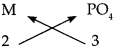
Step – 3: To cross multiply as shown by arrows the number of radicals.
Step – 4: To write down the chemical formula of the compound.
M3(PO4)2
c. Explain the need for a reference atom for atomic mass. Give some information about two reference atoms.
Answer:
(a) Hydrogen (H) atom: The hydrogen atom is the lightest. The relative mass of a hydrogen atom is 1 which has only 1 proton in its nucleus. On this scale, the relative atomic mass of many elements comes out to be fractional. Therefore, carbon was selected as a reference atom.
(b) Carbon (C) atom: The carbon atom is selected as reference atom. In this scale, the relative mass of a carbon atom is accepted as 12.
d. What is meant by Unified Atomic Mass.
Answer:
e. Explain with examples what is meant by a ‘mole’ of a substance.
Answer:
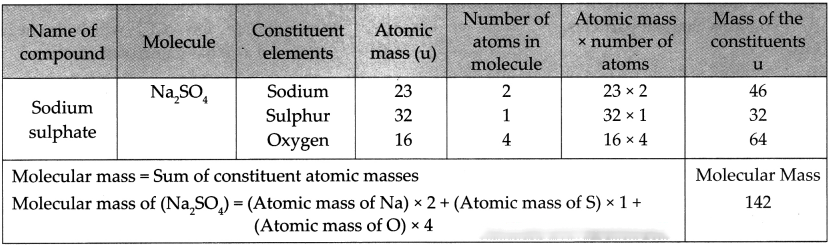
5. Write the names of the following compounds and deduce their molecular masses.
Na2SO4, K2CO3, CO2, MgCl2, NaOH, AlPO4, NaHCO3
Answer:
6. Two samples ‘m’ and ‘n’ of slaked lime were obtained from two different reactions. The details about their composition are as follows:
‘sample m’ mass : 7g
Mass of constituent oxygen : 2g
Mass of constituent calcium : 5g
‘sample n’ mass : 1.4g
Mass of constituent oxygen : 0.4g
Mass of constituent calcium : 1.0g
Which law of chemical combination does this prove? Explain.
Answer:
(i) The expected proportion by weight of the constituent elements of quick lime that is calcium oxide would be from its known molecular formula CaO. The atomic mass of Ca and O are 40 and 16 respectively. This means, the proportion by weight of the constituent elements Ca and O in the compound CaO is 40 :16 which is 5 : 2.
(ii) Now, for the given sample’m’ of CaO = 5 g
mass of given sample = 7 g
mass of constituent Ca in sample’m’ = 5 g
mass of constituent O in sample’m’ = 2 g
(iii) This means that 7 g of calcium oxide contairis 5 g of calcium (Ca) and 2 g of oxygen (O); apd the proportion by weight of calcium and oxygen in it is 5 : 2.
(iv) Now, for the given sample ‘n’ of CaO mass of given sample CaO = 1.4 g
Mass of constituent Ca in sample ‘n’ = 1.0 g
Mass of constituent O in sample ‘n’ = 0.4 g
This means that 1.4g of calcium oxide contains 1.0 g of calcium (Ca) and 0.4 g of oxygen (O); and the proportion by weight of calcium and oxygen in it is 5 : 2.
(v) Above samples’m’ and ‘n’ of calcium oxide (CaO) shows that the proportion by weight of the constituent elements in different samples of a compound is always constant that is the proportion by weight of calcium (Ca) and oxygen (O) in different samples of calcium oxide (CaO) is constant.
(vi) The experimental value of proportion by weight of the constituent elements matched with the expected proportion calculated by molecular mass. This proves and verifies the law of constant proportion.
The law states that ‘The proportion by weight of the constituent elements in the various samples of a compound is fixed’.
7. Deduce the number of molecules of the following compounds in the given quantities.
32g oxygen, 90g water, 8.8g carbon dioxide, 7.1g chlorine.
Class 9 Science Chapter 4 Measurement Of Matter Notes Question 1.
32g oxygen
Answer:
Given : Mass of oxygen (O2) m = 32g
To find : Number of molecules in 32g of oxygen.
Solution : Atomic mass of oxygen (O) = 16
∴ Molecular mass of oxygen (O2) M = 16 x 2 = 32
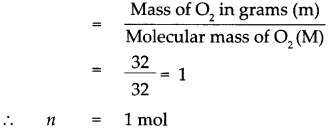
According to the formula, Number of moles in the given O2(n)
1 mol of O2contains 6.022 x 10²³molecules that is 32 g of 02 contains 6.022 * 1023molecules of O2.
32g of oxygen contains 6.022 x 10²³molecules of oxygen.
Class 9 Science Chapter 4 Measurement Of Matter Answers Question 2.
90g water
Answer:
Given : Mass of water (H2O) m = 90g.
To find : Number of molecules in 90g of water.
Solution : Molecular mass of (H2O) M = (Atomic mass of H) x 2 + (Atomic mass of O) x 1
∴ Molecular mass of (H2O) M = 1 x 2 +16
∴ Molecular mass of (H2O) M = 18
According to the formula,
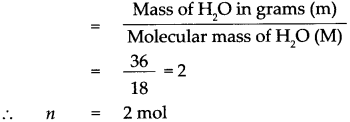
Number of moles in the given H2O (n)
1 mol of H2O contains 6.022 x 10²³molecules.
5 mol of H2O contains 5 x 6.022 x 1023molecules. = 30.11 x 10²³molecules, that is 90g of H2O contains 30.11 x 10²³molecules of H20.
90g of water contains 30.11 x 10²³molecules of water.

4 Measurement Of Matter Exercise Question 3.
8.8g carbon dioxide
Answer:
Given : Mass of Carbon dioxide (CO2)m = 8.8g.
To find : Number of molecules in 8.8g of carbon dioxide.
Solution : Molecular mass of (CO2)M = (Atomic mass of C) x 1 + (Atomic mass of O) x 2
∴ Molecular mass of (CO2)M = 12 x 1 + 16 x 2 = 12 + 32
Molecular mass of (CO2)M = 44
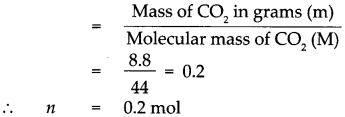
According to the formula, Number of moles in the given CO2(n)
∴ 1 mol of CO2contains 6.022 x 10²³molecules.
∴ 0.2 mol of CO2contains 0.2 x 6.022 x 1023molecules.
= 1.2044 x 10²³molecules,
that is 8.8g of CO2contains 1.2044 x 10²³molecules of CO2.
8.8g of CO2contains 1.2044 x 10²³molecules of CO2.
Class 9 Science Solutions Maharashtra Board Question 4.
7.1g chlorine
Answer:
Given : Mass of Chlorine (Cl2)m = 7.1g.
To find : Number of molecules in 7.1g of chlorine.
Solution : Atomic mass of (Cl) = 35.5
∴ Molecular mass of chlorine (Cl2)M = 35.5 x 2 = 71
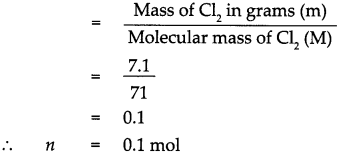
According to the formula, Number of moles in the given Cl2(n)
∴ 1 mol of Cl2contains 6.022 x 10²³molecules.
∴ 0.1 mol of Cl2contains 0.1 x 6.022 x 1023molecules.
= 0.6022 x 10²³molecules,
that is 7.1g of Cl2contains 0.6022 x 10²³molecules of Cl2.
7.1g of Cl2contains 0.6022 x 10²³molecules of chlorine.
8. If 0.2 mol of the following substances are required how many grams of those substances should be taken? Sodium chloride, magnesium oxide, calcium carbonate
Answer:
Given : Number of moles of sodium chloride (NaCl) n = 0.2 mol
To find : Mass in grams of 0.2 mol of NaCl
Solution:
Molecular mass of (NaCl)M = (Atomic mass of Na) x 1 + (Atomic mass of Cl) x 1
= 23 x 1 + 35.5 x 1
= 23 + 35.5
Molecular mass of (NaCl)M = 58.5
According to the formula,
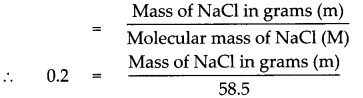
Number of moles in the given NaCl (n)
Mass of NaCl in grams (m) = 0.2 x 58.5
Mass of NaCl in grams (m) = 11.7 g
Mass of 0.2 mole of NaCl is 11.7g
Class 9 Science Chapter 3 Current Electricity Intext Questions and Answers
Maharashtra State Board Class 9 Science Solutions Question 1.
What is the type of chemical bond in NaCl and MgCl2?
Answer:
9th Class Science Chapter 4 Measurement Of Matter Question 2.
Determine the valencies of H, Cl, O and Na from the molecular formulae H2, HC1, H2O and NaCl.
Answer:
(i) In the molecular formula HCl
∴ The valency of H is 1 and Cl is 1.
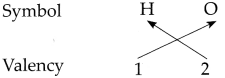
(ii) In the molecular formula H2O
∴ The valency of H is 1 and O is 2.
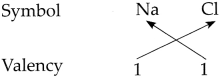
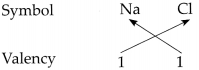
(iii) In the molecular formula NaCl
∴ The valency of Na is 1 and Cl is 1.
∴ From all the above, the valencies of the given elements are as follows : H = 1, Cl = 1, O = 2 and Na = l.
Measurement Of Matter Class 9 Exercise Answers Question 3.
How is an element indicated in Chemistry?
Answer:
In chemistry an element is indicated by its symbol.
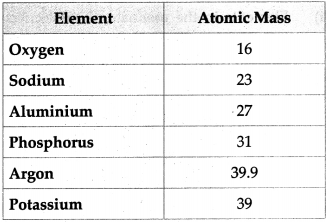
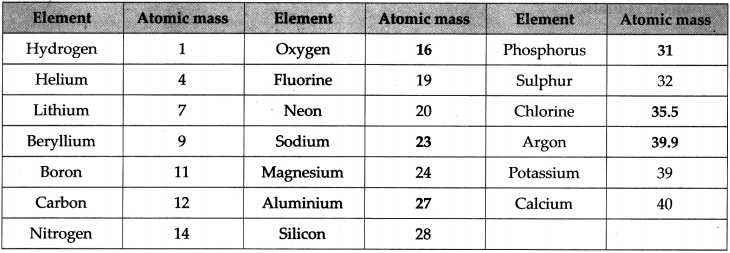
Following are atomic masses of a few elements in Daltons and the molecular formulae of some compounds. Deduce the molecular masses of those compounds:
Atomic masses – H(l), 0(16), N(14), C(12), K(39), S(32) Ca(40), Na(23), Cl(35.5), Mg(24), Al(27)
Simple radicals | Composite radicals |
Ag+ | |
Mg2+ | |
Cl | |
Fe2+ | |
Br– | |
Na+ | |
Cu+ |
Basic Radical | Acidic Radical |
(i)Ag+ | (i) Cl– |
(ii) Cu2+ | (ii) I– |
(iii) Fe3+ | |
(iv) Ca2+ | |
Wnh; | |
(vi) K+ | |
(vii) Na+ |
Give examples:
Problem-based questions
Answer the following questions:
Answer the following:
Open-ended questions
Question 1
Maharashtra Board Solution
How will the compounds, MgCl2 and CaO be formed from their elements?
Solution & Step-by-Step Answer:
block bg-white dark:bg-slate-900/80 border-l-4 border-emerald-500 rounded-r-xl p-5 my-3 shadow-xs border border-slate-200/60 dark:border-slate-800">
Solution & Step-by-Step Answer:
(1) Magnesium Chloride (MgCl2) Magnesium atom (Mg): Electronic configuration Magnesium ion Mg2+ (2,8). Chlorine atom (Cl). Electronic configuration Chloride ion Ch (2,8,8). ∴ Mg2+ + 2CT → MgCl2 (Magnesium Chloride)
(2) Calcium Oxide (CaO)
Question 2
Maharashtra Board Solution
|
(i) When 18 g of water is added to 56 g of calcium oxide, calcium oxide combines with water to form calcium hydroxide Ca(OH)2
(ii) The mass of calcium hydroxide formed is 74 g.?
(iii) In this activity the total mass of reactants, Calcium oxide + Water = 56 g +18 g = 74 g.
It is equal to the mass of the product formed. Ca(OH)2= 74g.
This activity verifies the Law of Conservation of Matter, i.e., in a chemical reaction, the total weight of the reactants is same as the total weight of the products formed due to the chemical reactions.
Question 3
Maharashtra Board Solution
Solution & Step-by-Step Answer:
Question 4
Maharashtra Board Solution
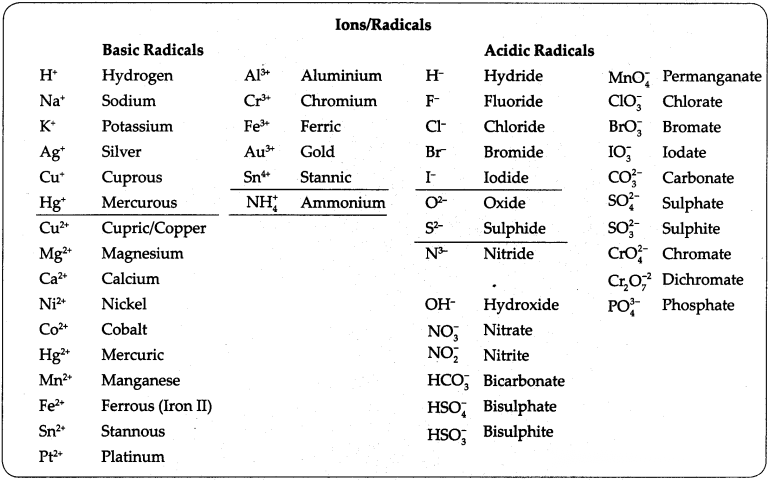
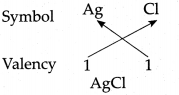
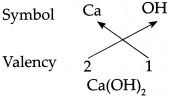
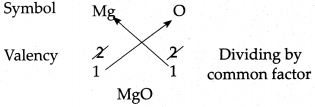
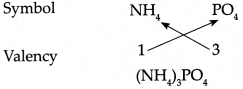
Using the chart of ions/radicals and the cross-multiplication method, write the chemical formulae of the following compounds : Calcium carbonate, Sodium bicarbonate, Silver chloride, Calcium hydroxide, Magnesium oxide, Ammonium phosphate, Cuprous bromide, Copper sulphate, Potassium nitrate, Sodium dichromate.
Solution & Step-by-Step Answer:
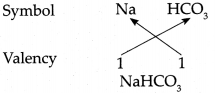
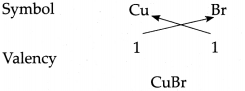
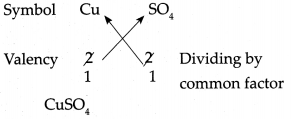
Calcium carbonate – CaCO3 Sodium bicarbonate – NaHCO3 Silver chloride – AgCl, Calcium hydroxide – Ca(OH)2, Magnesium oxide – MgO, Ammonium phosphate – (NH4)3PO4, Cuprous bromide – CuBr, Copper sulphate – CuSO4, Potassium nitrate – KNO3, Sodium dichromate – Na2Cr2O7.
Class 9 Science Chapter 3 Current Electricity Additional Important Questions and Answers (A) Select the correct option:
Question 1
Maharashtra Board Solution
The proportion by weight of hydrogen and oxygen in water is ………………………... (a) 8 : 1 (b) 2 : 1 (c) 1 : 2 (d) 1 : 8
Solution & Step-by-Step Answer:
(d) 1: 8
Question 2
Maharashtra Board Solution
The proportion by weight of carbon and oxygen in carbon dioxide is ………………………... (a) 8 : 3 (b) 3 : 8 (c) 3 : 2 (d) 2 : 3
Solution & Step-by-Step Answer:
(b) 3 : 8
Question 3
Maharashtra Board Solution
A nucleus of an atom is made up of positively charged ………………………… and electrically neutral ………………………... (a) protons; neutrons (b) electrons; neutrons (c) neutrons; protons (d) neutrons; electrons
Solution & Step-by-Step Answer:
(a) protons; neutrons
Question 4
Maharashtra Board Solution
The size of an atom is determined by its ………………………...
Solution & Step-by-Step Answer:
radius
Question 5
Maharashtra Board Solution
Atomic radius is expressed in ………………………... (a) milimetres (b) centimetres (c) nanometres (d) picometres
Solution & Step-by-Step Answer:
(c) nanomet res
Question 6
Maharashtra Board Solution
The atomic size depends on the number of ………………………… in the atom. (a) protons (b) nucleus (c) neutrons (d) electron orbits
Solution & Step-by-Step Answer:
(d) electron orbits
Question 7
Maharashtra Board Solution
The mass of an atom is concentrated in its ………………………... (a) protons (b) nucleus (c) neutrons (d) electrons
Solution & Step-by-Step Answer:
(b) nucleus
Question 8
Maharashtra Board Solution
The total number of protons and neutrons in the atomic nucleus is called the ………………………... (a) atomic number (b) electronic configuration (c) atomic mass number (d) valency
Solution & Step-by-Step Answer:
(c) atomic mass number
Question 9
Maharashtra Board Solution
A ………………………… is that quantity of a substance whose mass in grams is equal in magnitude to the molecular mass of that substance in Daltons. (a) mole (b) dalton (c) dozen (d) gross
Solution & Step-by-Step Answer:
(a) Mole
Question 10
Maharashtra Board Solution
Avogadro’s number is denoted by the symbol ………………………... (a) NG (b) Nv (c) NA (d) ND
Solution & Step-by-Step Answer:
(c) NA
Question 11
Maharashtra Board Solution
A mole of any substance stands for ………………………… molecules. (a) 60.22 x 10²³ (b) 6.022 x 10²² (c) 6.022 x 10²³ (d) 60.22 x 10²²
Solution & Step-by-Step Answer:
(a) 60.22 x 10²³
Question 12
Maharashtra Board Solution
The capacity of an element to combine is called its ………………………... (a) valency (b) electronic configuration (c) atomic number (d) volence electrons
Solution & Step-by-Step Answer:
(a) valency
Question 13
Maharashtra Board Solution
Electronic configuration of sodium atom is ………………………... (a) (2, 8, 3) (b) (2, 8, 7) (c) (2, 8, 2) (d) (2, 8,1)
Solution & Step-by-Step Answer:
(d) (2,8,1)
Question 14
Maharashtra Board Solution
Electronic configuration of chlorine atom is ………………………... (a) (2, 8, 3) (b) (2, 8, 7) (c) (2, 8, 2) (d) (2, 8, 1)
Solution & Step-by-Step Answer:
(b) (2, 8, 7)
Question 15
Maharashtra Board Solution
Positively charged ions are called as ………………………... (a) cations (b) anions (c) nucleous (d) protons
Solution & Step-by-Step Answer:
(a) cations
Question 16
Maharashtra Board Solution
Negatively charged ions are called as ………………………... (a) cations (b) anions (c) nucleus (d) electrons
Solution & Step-by-Step Answer:
(b) anions
Question 17
Maharashtra Board Solution
Iron (Fe) exhibits the variable valencies ………………………... (a) 1 and 2 (b) 2 and 3 (c) 3 and 4 (d) 2 and 4
Solution & Step-by-Step Answer:
(b) 2 and 3
Question 18
Maharashtra Board Solution
Cationic radicals are called as ………………………… radicals. (a) basic (b) acidic (c) neutral (d) mixed
Solution & Step-by-Step Answer:
(a) basic
Question 19
Maharashtra Board Solution
Anionic radicals are called as ………………………… radicals. (a) basic (b) acidic (c) neutral (d) mixed
Solution & Step-by-Step Answer:
(b) acidic
Question 20
Maharashtra Board Solution
The unit Dalton is used to express ………………………… (a) atomic mass (b) atomic radius (c) atomic number (d) mass number
Solution & Step-by-Step Answer:
(a) atomic mass
Question 21
Maharashtra Board Solution
The valency of element with electronic configuration ………………………… is 2. (a) (2,5) (b) (2, 4) (c) (2, 6) (d) (2, 7)
Solution & Step-by-Step Answer:
(c) (2, 6)
Question 22
Maharashtra Board Solution
The symbol of Avogadro’s number is ………………………... (a) ND (b) N0 (c) NB (d) NA
Solution & Step-by-Step Answer:
(d) NA
Question 23
Maharashtra Board Solution
………………………. is bicarbonate radical.
Solution & Step-by-Step Answer:
Question 24
Maharashtra Board Solution
Molecular formula of sodium sulphate is ………………………... (a) Na(SO4)2 (b) Na2SO4 (c)Na2(SO4)2 (d)NaSO4
Solution & Step-by-Step Answer:
(b) Na2SO4
Question 25
Maharashtra Board Solution
………………………… is a composite radical. (a) Fe3+ (b) Ca2+ (c) NH4+ (d) S2-
Solution & Step-by-Step Answer:
(c) NH
Question 26
Maharashtra Board Solution
A mole of any substance stands for ………………………… molecules. (a) 6.022 x 10²³ (b) 6.022 x 10²² (c) 60.22 x 10²³ (d) 60.22 x 10²²
Solution & Step-by-Step Answer:
(a) 6.022 x 10²³
Question 27
Maharashtra Board Solution
The mass of an atom is concentrated in its …………………………. (a) nucleus (b) electrons (c) extranuclear part (d) protons
Solution & Step-by-Step Answer:
(a) nucleus
Question 28
Maharashtra Board Solution
………………………… g of water make 1 mole of water. (a) 32 (b) 33 (c) 16 (d) 18
Solution & Step-by-Step Answer:
(d) 18
Complete the analogy: (1) Electron : extra nuclear part:: Neutron …………………………. Match the columns:
Answer:
Answer:
Answer:
Answer: Answer the following in one sentence:
Question 1
Maharashtra Board Solution
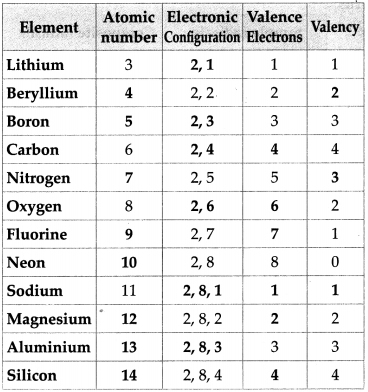
What are valence electrons?
Solution & Step-by-Step Answer:
The electrons present in the outermost orbit of an atom are called valence electrons.
Question 2
Maharashtra Board Solution
Give the formula to determine the number of moles of a substance.
Solution & Step-by-Step Answer:
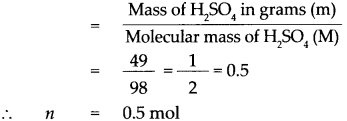
The formula to determine the number of moles of a substance is as given below.
Question 3
Maharashtra Board Solution
What are basic radicals? Give examples.
Solution & Step-by-Step Answer:
The radicals which are formed by removal of electrons from the atoms of metals are called as basic radicals, e.g., Na+, Cu2+
Question 4
Maharashtra Board Solution
What are acidic radicals? Give examples.
Solution & Step-by-Step Answer:
The radicals which are formed by adding electrons to the atoms of non-metals are called as acidic radicals, e.g., CT, S2-
State whether the following statement is ‘True’ or ‘False’. Correct the false statement. (1) Molecular state of oxygen is monoatomic. Name the following:
Question 1
Maharashtra Board Solution
Scientist who gave Law of Conservation of Matter.
Solution & Step-by-Step Answer:
Antoine Lavoisier
Question 2
Maharashtra Board Solution
Scientist who gave Law of Constant Proportion.
Solution & Step-by-Step Answer:
J. L. Proust
Question 3
Maharashtra Board Solution
What are protons and neutrons present in nucleus together called as?
Solution & Step-by-Step Answer:
Nucleons
Question 4
Maharashtra Board Solution
Unit used to express atomic radius.
Solution & Step-by-Step Answer:
Nanometre
Question 5
Maharashtra Board Solution
The number (p + n) in the atomic nucleus is called as?
Solution & Step-by-Step Answer:
Atomic mass number
Question 6
Maharashtra Board Solution
Name the unit of atomic mass.
Solution & Step-by-Step Answer:
Dalton (u)
Question 7
Maharashtra Board Solution
Write molecular formula of two ionic compounds containing chlorine.
Solution & Step-by-Step Answer:
NaCl, MgCl2
Question 8
Maharashtra Board Solution
Give two monoatomic radicals.
Solution & Step-by-Step Answer:
Na+, Cl–
Question 9
Maharashtra Board Solution
Give two examples of simple radicals.
Solution & Step-by-Step Answer:
Ag+, O2-
Give scientific reasons:
Question 1
Maharashtra Board Solution
An atom is electrically neutral though it contains charged particles.
Solution & Step-by-Step Answer:
Question 2
Maharashtra Board Solution
Neon is chemically inert element.
Solution & Step-by-Step Answer:
Question 3
Maharashtra Board Solution
The valency of sodium (Na) is one.
Solution & Step-by-Step Answer:
Question 4
Maharashtra Board Solution
The valency of chlorine (Cl) is one.
Solution & Step-by-Step Answer:
Question 5
Maharashtra Board Solution
The valency of Magnesium (Mg) is two.
Solution & Step-by-Step Answer:
Question 6
Maharashtra Board Solution
Valency is always a whole number.
Solution & Step-by-Step Answer:
Question 7
Maharashtra Board Solution
Atomic size of potassium is bigger than atomic size of sodium.
Solution & Step-by-Step Answer:
Question 8
Maharashtra Board Solution
The atomic size of sodium is bigger than atomic size of Magnesium.
Solution & Step-by-Step Answer:
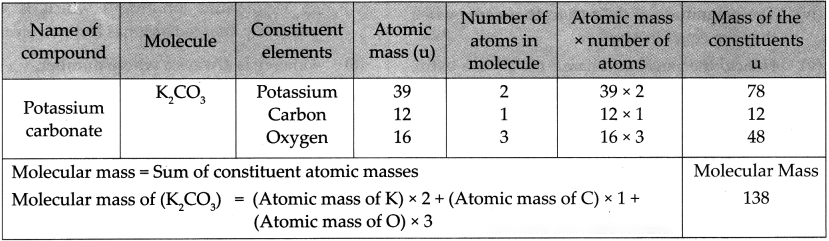
Write the names of the following compounds and deduce their molecular masses: Atomic masses : H(1), 0(16), N(14), C(12), K(39), S(32), Ca(40), Na(23), C1(35.5), Mg(24), A1(27), P(31)
Question 1
Maharashtra Board Solution
Molecular mass of K2CO3
Solution & Step-by-Step Answer:
Question 2
Maharashtra Board Solution
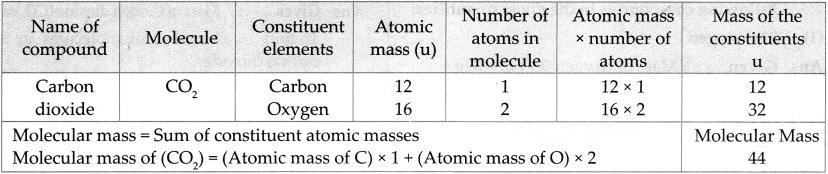
Molecular mass of CO2
Solution & Step-by-Step Answer:
Question 3
Maharashtra Board Solution
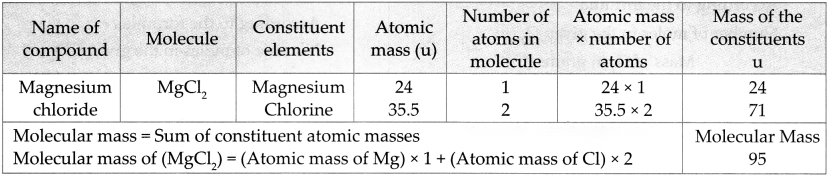
Molecular mass of MgCl2
Solution & Step-by-Step Answer:
Question 4
Maharashtra Board Solution
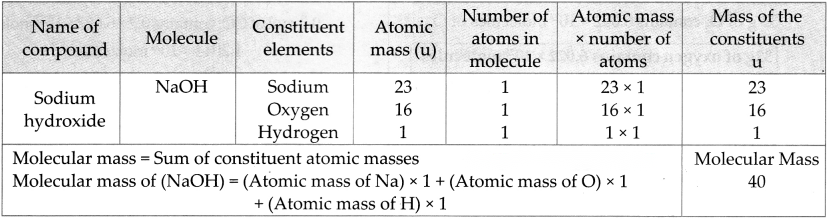
Molecular mass of NaOH
Solution & Step-by-Step Answer:
Question 5
Maharashtra Board Solution
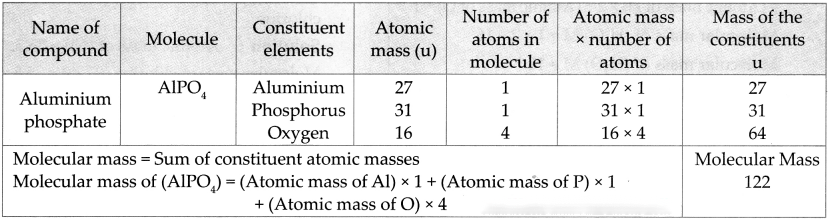
Molecular mass of AIPO4
Solution & Step-by-Step Answer:
Question 6
Maharashtra Board Solution
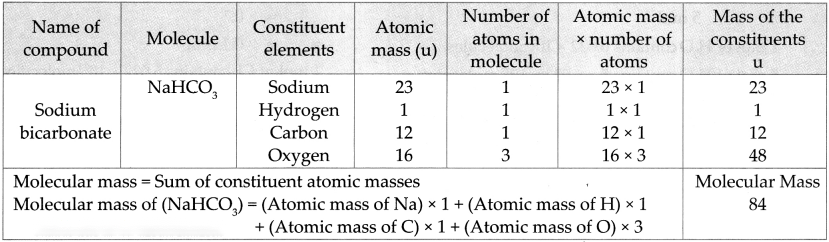
Molecular mass of NaHCO3
Solution & Step-by-Step Answer:
Numerical.
Question 1
Maharashtra Board Solution
Magnesium Oxide:
Solution & Step-by-Step Answer:
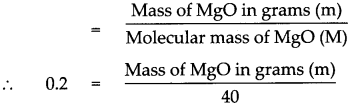
Given : Number of moles of Magnesium oxide (MgO)n = 0.2 mol To find : Mass in grams of 0.2 mol of MgO Solution: Molecular mass of (MgO)M = (Atomic mass of Mg) x 1 + (Atomic mass of O) x 1 = 24 x 1 + 16 x 1 = 24 + 16 Molecular mass of (MgO)M = 40 According to the formula Number of moles in the given MgO (n) Mass of MgO in grams (m) = 0.2 x 40 Mass of MgO in grams (m) = 8 g. Mass of 0.2 mole of MgO is 8 g
Question 2
Maharashtra Board Solution
Calcium Carbonate:
Solution & Step-by-Step Answer:
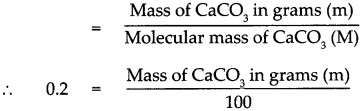
Given : Number of moles of Calcium carbonate (CaCO3) n = 0.2 mol To find : Mass in grams of 0.2 mol of CaCO3 Solution: Molecular mass of (CaCO3) M = (Atomic mass of Ca) x 1 + (Atomic mass of C) x 1 + (Atomic mass of O) x 3 = (40 x l) + (12 x 1) +(16 x 3) = 40+ 12+ 48 Molecular mass of (CaCO3) M = 100 According to the formula Number of moles in the given CaCO3 (n) ∴ Mass of CaCO3 in grams (m) = 0.2 x 100 ∴ Mass of CaCO3 in grams (m) = 20 g Mass of 0.2 mole of CaCO3 is 20 g
State laws/Define the following:
Question 1
Maharashtra Board Solution
Law of Conservation of Matter.
Solution & Step-by-Step Answer:
In a chemical reaction, the total weight of the reactants is same as the total weight of the products formed due to chemical reaction.
Question 2
Maharashtra Board Solution
Law of Constant Proportion.
Solution & Step-by-Step Answer:
The proportion by weight of the constituent elements in the various samples of a compound is fixed.
Question 3
Maharashtra Board Solution
Molecular Mass:
Solution & Step-by-Step Answer:
The molecular mass of a substance is the sum of the atomic masses of all the atoms in a single molecule of that substance.
Question 4
Maharashtra Board Solution
Mole
Solution & Step-by-Step Answer:
A mole is that quantity of a substance whose mass in grams is equal in magnitude to the molecular mass of that substance in Daltons.
Question 5
Maharashtra Board Solution
Valency
Solution & Step-by-Step Answer:
The capacity of an element to combine is called its valency.
Question 6
Maharashtra Board Solution
Electronic definition of Valency
Solution & Step-by-Step Answer:
The number of electrons that an atom of an element gives away or takes up while forming an ionic bond is called valency of that element.
Question 7
Maharashtra Board Solution
Radicals
Solution & Step-by-Step Answer:
The positively or negatively charged ions that take part independently in chemical reactions are called radicals.
Question 8
Maharashtra Board Solution
Atomic size determination
Solution & Step-by-Step Answer:
The size of an atom is determined by its radius. The atomic radius of an isolated atom is the distance between the nucleus of an atom and its outermost orbit.
Question 9
Maharashtra Board Solution
Atomic mass number
Solution & Step-by-Step Answer:
The number of protons and neutrons in the atomic nucleus is called the atomic mass number.
Question 10
Maharashtra Board Solution
Unified mass
Solution & Step-by-Step Answer:
Unified mass is the standard unit of atomic mass that quantifies mass on an atomic or molecular scale. Its symbol is ‘u’. 1 u = 1.66053904 x 10⁻²⁷ kg.
Question 11
Maharashtra Board Solution
Molecular mass of a substance
Solution & Step-by-Step Answer:
The molecular mass of a substance is the sum of the atomic masses of all the atoms in a single molecule of that substance. Like atomic mass, molecular mass is also expressed in the unit Dalton (u).
Answer the following questions:
Question 1
Maharashtra Board Solution
What is variable valency?
Solution & Step-by-Step Answer:
Complete the following table:
Question 1
Maharashtra Board Solution
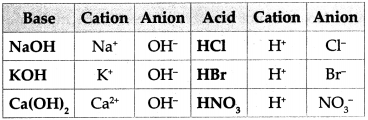
Write down the cations and anions obtained from the compounds in the following chart.
Solution & Step-by-Step Answer:
Answer the following questions:
(a) Calcium carbonate
Solution & Step-by-Step Answer:
∴ Chemical formula of Calcium carbonate is CaCO3
(b) Sodium bicarbonate
(c) Silver chloride
(d) Calcium hydroxide Answer: Symbol Ca OH
(e) Magnesium oxide
(f) Ammonium phosphate
(g) Cuprous bromide
(h) Copper sulphate
(i) Potassium nitrate
(j) Sodium dichromate
|