Maharashtra State Board Class 9 Science Solutions Chapter 8 Useful and Harmful Microbes
Class 9 Science Chapter 8 Useful and Harmful Microbes Textbook Questions and Answers
1. Complete the statements using the proper option from those given below. Explain the statements. (mycotoxins, budding, rhizobium)
a. Yeast reproduces asexually by the …………………….. method.
Answer:
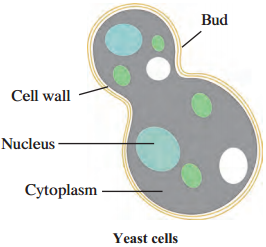
The yeast cells develop small round bodies on the parent cell. These are called buds. New daughter cells develop from these buds.
b. Toxins of fungal origin are called ……………………...
Answer:
Mycotoxins are poisonous chemicals released into the food by fungi. This makes the food poisonous.
c. Leguminous plants can produce more proteins due to ……………………...
Answer:
2. Write the names of microbes found in the following food materials.
yogurt, bread, root nodules of leguminous plants, idli, dosa, spoiled potato curry.
Answer:
Food materials | Microbes |
Yogurt | Lactobacilli |
Bread | Yeast |
Root nodules of leguminous plants | Rhizobium |
Idli | Yeast, bacteria |
Dosa | Yeast, bacteria |
Spoiled potato curry | Clostridium |
3. Identify the odd word out and say why it is the odd one?
a. Pneumonia, diphtheria, chicken pox, cholera.
Answer:
Chickenpox. It is caused by a virus, whereas others are caused by bacteria.
b. Lactobacilli, rhizobia, yeast, clostridia.
Answer:
Yeast. It is a fungus, whereas the rest are bacteria.
c. Root rot, rust (tambura), rubella, mozaic.
Answer:
Rubella. It is a disease of humans, whereas the rest are diseases of plants.
4. Give scientific reasons.
a. Foam accumulates on a the surface of ‘dal’ kept for a long time in summer.
Answer:
b. Why are naphthalene balls kept with clothes to be put away.
Answer:
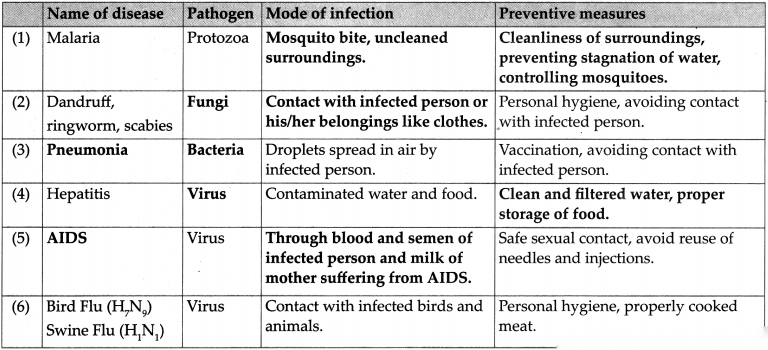
5. Write down the modes of infection and the preventive measures against fungal diseases.
Answer:
6. Match the pairs.
‘A’ group ‘B’ group
1. Rhizobium a. Food poisoning
2. Clostridium b. Nitrogen fixation
3. Penicillium c. Bakery products
4. Yeast d. Production of antibiotics
Answer:
(1 – b),
(2 – a),
(3 – d),
(4 – c)
7. Answer the following questions.
a. Which vaccines are given to infants? Why?
Answer:
b. How is a vaccine produced?
Answer:
c. How do antibiotics cure disease?
Answer:
Antibiotics cure diseases by destroying or preventing the growth of harmful micro-organisms.
d. Are the antibiotics given to humans and animals the same? Why?
Answer:
e. Why is it necessary to safely store the pathogens of a disease against which vaccines are to be produced?
Answer:
8. Answer the following questions in brief.
a. What are ‘broad-spectrum antibiotics’?
b. What is fermentation?
Answer:
c. Define ‘Antibiotic’.
Answer:
Class 9 Science Chapter 8 Useful and Harmful Microbes Intext Questions and Answers
Can you recall?
Characteristics of Microbes.
Answer the following.
Open-ended questions
Answer the following questions:
Class 9 Science Chapter 8 Useful And Harmful Microbes Exercise Question 1.
How is yoghurt made from milk? What exactly happens in this process?
Answer:
Useful And Harmful Microbes Class 9 Exercise Question 2.
Sometimes, you may notice a black powder or white discs floating on the pickle or murabba, when a jar is opened after a long time. What exactly is this? Why are such food items not good to eat?
Answer:
8 Useful And Harmful Microbes Class 9 Question 3.
How many different industries depend upon the Lactobacilli bacteria?
Answer:
Industries like milk products, cider, cocoa, pickles, pharmaceuticals depend on Lactobacilli bacteria.
Useful And Harmful Microbes Class 9 Question 4.
Which types of cottage industries and factories can be started in areas with abundant milk production?
Answer:
Cottage industries like the manufacture of milk products like ghee, cheese, paneer, curd, shrikhand, etc. and chocolate making can be started in areas with abundant milk production.
9th Class Science Chapter 8 Useful And Harmful Microbes Exercise Question 5.
Which changes do you notice in leather articles and gunny (jute) bags during the rainy season?
Answer:
In rainy season we can notice whitish-green cotton-like growth or black powder or white discs on leather articles and gunny (jute) bags during the rainy season as these articles are infected by fungus.
Class 9th Science Chapter 8 Useful And Harmful Microbes Exercise Question 6.
For how long afterwards can you use those articles?
Answer:
Those articles cannot be used for long as they wear out and do not last long.
Preventive Measures:
Animal diseases:
Preventive Measures:
Answer the following questions:
What changes do you observe after 10 minutes? Mix limewater with the gas accumulated in the balloon. Collect that limewater in a beaker and observe it. What do you notice?
Class 9 Science Chapter 8 Useful and Harmful Microbes Additional Important Questions and Answers
Select the correct option:
Question 1
Maharashtra Board Solution
The rod-shaped bacteria found in milk or buttermilk are called …………………….. (a) Rhizobium (b) Clostridium (c) Lactobacilli (d) Saccharomyces
Solution & Step-by-Step Answer:
(c) Lactobacilli
Question 2
Maharashtra Board Solution
Yoghurt has a specific sour taste due to …………………….. (a) lactic acid (b) citric acid (c) acetic acid (d) alcohol
Solution & Step-by-Step Answer:
(a) lactic acid
Question 3
Maharashtra Board Solution
Bacteria found in the root nodules of leguminous plants are …………………….. (a) clostridium (b) streptococcus (c) Lactobacilli (d) Rhizobium
Solution & Step-by-Step Answer:
(d) Rhizobium
Question 4
Maharashtra Board Solution
A mutually beneficial relationship is called …………………….. (a) symbiosis (b) parasitism (c) autotropism (d) none of these
Solution & Step-by-Step Answer:
(a) symbiosis
Question 5
Maharashtra Board Solution
Carbon compounds obtained from bacteria and fungi for destroying or preventing the growth of harmful micro-organisms are called …………………….. (a) probiotics (b) antibiotics (c) antibodies (d) antigens
Solution & Step-by-Step Answer:
(b) antibiotics
Question 6
Maharashtra Board Solution
Fungi release ……………………. into the food, making the food poisonous. (a) cyanotoxins (b) dinotoxins (c) mycotoxins (d) cytotoxins
Solution & Step-by-Step Answer:
(c) mycotoxins
Question 7
Maharashtra Board Solution
……………………. produce bottle-shaped endospores in adverse conditions. (a) Lactobacilli (b) Clostridium (c) Yeast (d) Rhizobium
Solution & Step-by-Step Answer:
(b) Clostridium
Question 8
Maharashtra Board Solution
……………………. conducted important research on the toxin responsible for gas gangrene and the antitoxin responsible for treating it. (a) Ida Bengston (b) Van Ermengem (c) Louis Pasteur (d) Alexander Fleming
Solution & Step-by-Step Answer:
(a) Ida Bengston
Question 9
Maharashtra Board Solution
……………………. is a smokeless and high quality fuel. (a) Methanol (b) Ethanol (c) Petrol (d) Diesel
Solution & Step-by-Step Answer:
(b) Ethanol
Question 10
Maharashtra Board Solution
Antibiotics mainly act against …………………….. (a) bacteria (b) viruses (c) algae (d) fungi
Solution & Step-by-Step Answer:
(a) Bacteria
Question 11
Maharashtra Board Solution
……………………. is a broad-spectrum antibiotic. (a) Gentamycin (b) Penicillin (c) Amoxicillin (d) Erythromycin
Solution & Step-by-Step Answer:
(c) Amoxicillin
Question 12
Maharashtra Board Solution
……………………. is a narrow-spectrum antibiotic. (a) Ampicillin (b) Amoxicillin (c) Tetracyclin (d) Penicillin
Solution & Step-by-Step Answer:
(d) Penicillin
Question 13
Maharashtra Board Solution
Antibiotic penicillin was discovered by …………………….. (a) Louis Pasteur (b) Alexander Fleming (c) Ida Bengston (d) Van Ermengem
Solution & Step-by-Step Answer:
(b) Alexander Fleming
Question 14
Maharashtra Board Solution
……………………. proved that the anaerobic bacterium Clostridium botulinum is responsible for food poisoning. (a) Louis Pasteur (b) Ida Bengston (c) Alexander Fleming (d) Van Ermengem
Solution & Step-by-Step Answer:
(d) Van Ermengem
Question 15
Maharashtra Board Solution
AIDS is caused by …………………….. (a) virus (b) bacteria (c) protozoa (d) fungi
Solution & Step-by-Step Answer:
(a) Virus
Question 16
Maharashtra Board Solution
Dengue is caused by …………………….. (a) droplets spread in air (b) contact with infected person (c) mosquito bite (d) contaminated water and food
Solution & Step-by-Step Answer:
(c)mosquitobite
Question 17
Maharashtra Board Solution
Pneumonia is caused by …………………….. (a) virus (b) bacteria (c) fungi (d) protozoa
Solution & Step-by-Step Answer:
(b) bacteria
Question 18
Maharashtra Board Solution
……………………. can be prevented by vaccination. (a) Malaria (b) AIDS (c) Leprosy (d) Chicken pox
Solution & Step-by-Step Answer:
(d) Chicken pox
Question 19
Maharashtra Board Solution
Malaria is caused by …………………….. (a) protozoa (b) bacteria (c) fungi (d) virus
Solution & Step-by-Step Answer:
(a) protozoa
Question 20
Maharashtra Board Solution
Bird flu (H7N9) and swine flu (H1N1) are caused by …………………….. (a) bacteria (b) protozoa (c) fungi (d) virus
Solution & Step-by-Step Answer:
(d) virus
Question 21
Maharashtra Board Solution
The Lactobacilli convert lactose, the sugar in the milk, into …………………….. (a) lactic acid (b) acetic acid (c) alcohol (d) citric acid
Solution & Step-by-Step Answer:
(a) lactic acid
Question 22
Maharashtra Board Solution
The ……………………. destroys harmful microbes present in the milk. (a) high pH (b) neutral pH (c) low pH (d) none of these
Solution & Step-by-Step Answer:
(c) low pH
Question 23
Maharashtra Board Solution
Lactobacilli kill the harmful bacteria like ……………………. present in the alimentary canal. (a) Rhizobium (b) Saccharomyces (c) Clostridium (d) Alcanivorax
Solution & Step-by-Step Answer:
(c) Clostridium
Question 24
Maharashtra Board Solution
During fermentation, yeast cells convert carbohydrates into …………………….. (a) glucose and fructose (b) alcohol and carbon dioxide (c) proteins and fats (d) fatty acids and amino acids
Solution & Step-by-Step Answer:
(b) alcohol and carbon dioxide
Question 25
Maharashtra Board Solution
Molasses is fermented with the help of yeast called …………………….. (a) Yarrowia lipolytica (b) Alcanivorax (c) Rhizobia (d) Saccharomyces
Solution & Step-by-Step Answer:
(d) Saccharomyces
Question 26
Maharashtra Board Solution
A yeast ……………………. is used to absorb the toxins released during the production of palm oil. (a) Yarrowia lipolytica (b) Alcanivorax (c) Saccharomyces cerevisiae (d) Penicillium
Solution & Step-by-Step Answer:
(a) Yarrowia lipolytica
Question 27
Maharashtra Board Solution
The bacteria which spoil cooked food are …………………….. (a) Saccharomyces (b) Lactobacilli (c) Clostridium (d) Rhizobium
Solution & Step-by-Step Answer:
(c) Clostridium
Question 28
Maharashtra Board Solution
……………………. can grow and reproduce only in living cells. (a) Bacteria (b) Viruses (c) Fungi (d) Protozoa
Solution & Step-by-Step Answer:
(b) Viruses
Find the odd man out:
Question 1
Maharashtra Board Solution
AIDS, Hepatitis, Leprosy, Dengue.
Solution & Step-by-Step Answer:
Leprosy. It is caused by bacteria, whereas the rest are caused by viruses.
Question 2
Maharashtra Board Solution
Cholera, Leprosy, Pneumonia, Influenza.
Solution & Step-by-Step Answer:
Influenza. It is caused by a virus, whereas the rest are caused by bacteria.
Question 3
Maharashtra Board Solution
Ampicillin, Amoxycillin, Penicillin, Tetracycline.
Solution & Step-by-Step Answer:
Penicillin. It is a narrow-spectrum antibiotic, whereas others are broad-spectrum antibiotics.
Question 4
Maharashtra Board Solution
Tetracycline, Penicillin, Gentamycin, Erythromycin.
Solution & Step-by-Step Answer:
Tetracycline. It is a broad-spectrum antibiotic, whereas others are narrow-spectrum antibiotics.
Complete the analogy:
Question 1
Maharashtra Board Solution
(1) Dengue : Virus :: Malaria : ………………………….. (2) Hepatitis : Virus :: Pneumonia : ………………………….. (3) Cholera : Bacteria :: Swine flu : ………………………….. (4) Swine flu : HJNJ : : Bird Flu : ………………………….. (5) Measles : Virus :: Ringworm : ………………………….. (6) Yoghurt: Lactobacilli : : Bread : ………………………….. (7) Oil spills: Alcanivorax :: Absorption of arsenic : ………………………….. (8) Rhizobium : Nitrogen fixation : : Clostridium : …………………………..
Solution & Step-by-Step Answer:
(1) Protozoa (2) Bacteria (3) Virus (4) HyN9 (5) Fungi (6) Yeast (7) Saccharomyces cerevisiae (8) Food poisoning.
Match the columns:
Question 1
Maharashtra Board Solution
|
Column ‘A’ | Column ‘B’ |
(1) Leprosy | (a) Virus |
(2) Ringworm | (b) Fungi |
(3) Influenza | (c) Protozoa |
(4) Malaria | (d) Bacteria |
(1 – d),
(2 – b),
(3 – a),
(4 – c)
State whether the following statements are true or false. Correct the false statements:
(1) Lactobacilli are aerobic bacteria.
(2) Lactobacilli converts lactose sugar into alcohol.
(3) Yoghurt has a specific sour taste due to acetic acid.
(4) The bacteria Clostridium are present in the root. nodules of leguminous plants.
(5) Yeast cell is a prokaryotic cell.
(6) The use of Rhizobium has helped to reduce the use of chemical fertilizers.
(7) Ethanol is a smokeless and high quality fuel.
(8) A yeast, Saccharomyces cerevisiae is used for absorbing toxins released during palm oil production.
(9) Gentamycin is a narrow-spectrum antibiotic.
(10) Antibiotics mainly act against bacteria.
(11) Oil spills in oceans are cleared with the help of Clostridium bacteria.
(12) Tetracycline is a narrow-spectrum antibiotic.
(13) Amoxicillin is a broad-spectrum antibiotic.
(14) Penicillin is a group of antibiotics obtained from a fungus Saccharomyces.
(15) Antibiotic Penicillin was discovered by Alexander Fleming.
(16) The bacteria Lactobacilli cause food-poisoning.
(17) Clostridium bacteria grow in aerobic conditions.
(18) AIDS is caused by a virus.
(19) Influenza is caused by a bacteria.
(20) Antibiotics useful to one person can be suggested to others also.
(21) Dengue is caused by a bacteria.
(22) Dandruff and ringworm are caused by fungi.
(23) Pneumonia is spread through droplets spread in air by infected person.
(24) Chicken pox spread due to contaminated food and water.
(25) Ida Bengston was honoured with the Typhoid Medal’ in 1947.
Answer:
(1) False. Lactobacilli are anaerobic bacteria.
(2) False. The Lactobacilli converts lactose sugar into lactic acid.
(3) False. Yogurt has a specific sour taste due to lactic acid.
(4) False. The bacteria Rhizobium are present in the root nodules of leguminous plants.
(5) False. Yeast cell is a eukaryotic cell.
(6) True.
(7) True.
(8) False. A yeast, Yarrowia lipolytic is used to absorb the toxins released during the production of palm oil.
(9) True.
(10) True.
(11) False. Oil spills in oceans are cleared with the help of Alcanivorax bacteria.
(12) False. Tetracycline is a broad-spectrum antibiotic.
(13) True.
(14) False. Penicillin is a group of antibiotics obtained from a fungus Penicillium.
(15) True.
(16) False. The bacteria Clostridium cause food? poisoning.
(17) False. Clostridium bacteria grow in anaerobic conditions.
(18) True.
(19) False. Influenza is caused by a virus.
(20) False. Antibiotics useful to one person cannot be suggested to others as different diseases require different antibiotics.
(21) False. Dengue is caused by a virus.
(22) True.
(23) True.
(24) False. Chicken pox spread due to contact with infected person.
(25) False. Ida Bengston was honoured with the ‘Typhus Medal’ in 1947.
Complete the statements using the proper option from those given below. Explain the statements: (mycotoxins, budding, Rhizobium, molasses, endospores, broad-spectrum, Lactobacilli)
Question 1
Maharashtra Board Solution
Lactobacilli bacteria are used for making yoghurt.
Solution & Step-by-Step Answer:
The lactobacilli convert lactose, the sugar in the milk, into lactic acid. As a result, the pH of milk decreases causing a coagulation of milk proteins. Milk changes into yogurt.
Question 2
Maharashtra Board Solution
The use of Rhizobium has helped to reduce the use of chemical fertilizers.
Solution & Step-by-Step Answer:
Rhizobium bacteria are found in the root nodules of leguminous plants. They help to convert atmospheric nitrogen into nitrogen compounds and provide it to the plants. This helps to reduce the use of chemical fertilizers and their adverse effects.
Question 3
Maharashtra Board Solution
Amoxicillin is a broad-spectrum antibiotic.
Solution & Step-by-Step Answer:
This antibiotic is useful against a wide variety of bacteria. It is used against pathogens which cannot be identified during symptoms of a disease.
Question 4
Maharashtra Board Solution
Ethanol is produced by the fermentation of molasses.
Solution & Step-by-Step Answer:
Molasses is produced from sugarcane juice. It is rich in carbohydrates. When it is fermented with the help of the yeast called Saccharomyces, ethanol (C2H5OH) is produced.
Question 5
Maharashtra Board Solution
Clostridium bacteria produce bottle-shaped endospores.
Solution & Step-by-Step Answer:
These endospores help them to survive in adverse conditions.
Give scientific reasons:
Question 1
Maharashtra Board Solution
Lactobacilli are used for making yoghurt from milk.
Solution & Step-by-Step Answer:
Question 2
Maharashtra Board Solution
Antibiotics should be taken only when prescribed by a doctor.
Solution & Step-by-Step Answer:
Question 3
Maharashtra Board Solution
Nowadays, seeds are coated with Rhizobial solution or powder before sowing.
Solution & Step-by-Step Answer:
Question 4
Maharashtra Board Solution
Antibiotics are not effective against common cold or influenza.
Solution & Step-by-Step Answer:
Question 5
Maharashtra Board Solution
Cotton fabrics, gunny bags, leather items and wooden items do not last long.
Solution & Step-by-Step Answer:
Question 6
Maharashtra Board Solution
Food on which fungi has grown cannot be eaten.
Solution & Step-by-Step Answer:
Write short notes:
Question 1
Maharashtra Board Solution
Rhizobial inoculation.
Solution & Step-by-Step Answer:
Question 2
Maharashtra Board Solution
Bio-remediation.
Solution & Step-by-Step Answer:
Question 4
Maharashtra Board Solution
Clostridium.
Solution & Step-by-Step Answer:
Write down the mode of infection and preventive measures for the following:
Question 1
Maharashtra Board Solution
Write down the causative pathogen, mode of infection and preventive measures of AIDS.
Solution & Step-by-Step Answer:
Question 2
Maharashtra Board Solution
Write down the modes of infection and preventive measures against Bird Flu (H7N9) and Swine Flu (HjN.,).
Solution & Step-by-Step Answer:
Question 3
Maharashtra Board Solution
Write down the modes of infection and preventive measures against Malaria and dengue.
Solution & Step-by-Step Answer:
Question 4
Maharashtra Board Solution
Write down the modes of infection and preventive measures against Pneumonia.
Solution & Step-by-Step Answer:
Question 5
Maharashtra Board Solution
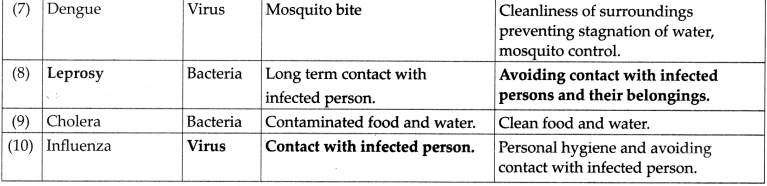
Write down the modes of infection and preventive measures for leprosy.
Solution & Step-by-Step Answer:
Question 5
Maharashtra Board Solution
What are the modes of infection and preventive measures for Hepatitis?
Solution & Step-by-Step Answer:
Question 6
Maharashtra Board Solution
What are the modes of infection and preventive measures for Influenza.
Solution & Step-by-Step Answer:
Answer the following questions:
Question 1
Maharashtra Board Solution
How is bread made?
Solution & Step-by-Step Answer:
Question 2
Maharashtra Board Solution
What is the advantage of Rhizobium to farmers?
Solution & Step-by-Step Answer:
Question 3
Maharashtra Board Solution
How can we observe Lactobacilli in buttermilk?
Solution & Step-by-Step Answer:
Question 4
Maharashtra Board Solution
What is symbiosis? Give example.
Solution & Step-by-Step Answer:
Complete the following table:
Question 1
Maharashtra Board Solution
The spread and prevention of disease
Solution & Step-by-Step Answer:
Question 2
Maharashtra Board Solution
Different species of Clostridium bacteria and the diseases caused by them.
Solution & Step-by-Step Answer:
Answer in detail:
Question 1
Maharashtra Board Solution
How is alcohol produced?
Solution & Step-by-Step Answer:
Question 2
Maharashtra Board Solution
Give the uses of Lactobacilli.
Solution & Step-by-Step Answer:
Uses of Lactobacilli:
Question 3
Maharashtra Board Solution
What is Penicillin? What is it used for?
Solution & Step-by-Step Answer:
Question 4
Maharashtra Board Solution
How was the antibiotic penicillin discovered?
Solution & Step-by-Step Answer:
Question 5
Maharashtra Board Solution
What are the precautions to be followed while taking antibiotics?
Solution & Step-by-Step Answer:
Question 6
Maharashtra Board Solution
How can we observe Rhizobium bacteria in the roots of leguminous plant?
Solution & Step-by-Step Answer:
|