Maharashtra State Board Class 9 Science Solutions Chapter 9 Environmental Management
Class 9 Science Chapter 9 Environmental Management Textbook Questions and Answers
1. Match the items in column ‘A’ with the proper ones in coloum ‘B’ and explain their impact on the environment.
Column ‘A’ Column ‘B’
1. Harmful waste – a. Glass, rubber, carry bags, etc.
2. Domestic waste – b. Chemicals, pigments, ash, etc.
3. Biomedical waste – c. Radioactive material
4. Industrial waste – d. Left over food, vegetables, peelings of fruits.
5. Urban waste – e. Bandages, cotton, needles, etc.
Answer:
(1 – c),
(2 – d),
(3 – e),
(4 – b),
(5 – a)
2. Complete the statements using the given options and justify those statements. (Geographic favourability, climate, weather, observatory)
a. Of the abiotic factors that affect biodiversity by far the most important is ……………….
Answer:
Climate.
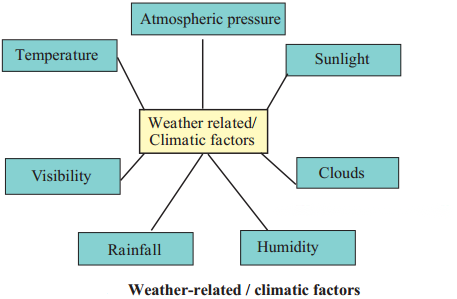
Climate influences our basic needs like food, clothing and shelter as well as our occupations. Various factors of climate like temperature, atmospheric pressure, sunlight, rainfall, humidity etc. will decide which kind of plants and animals can survive there.
b. A description of the climatic conditions of short duration in a particular area is ……………….
Answer:
Weather.
Atmospheric conditions at a specific time at a particular place are referred to as weather. Weather is related to a specific location and specific time whereas climate is related to a longer duration and larger area.
c. Irrespective of the progress of human beings, we have to think about ……………….
Answer:
Geographical favourability.
Geographical favourability includes location, availability of water, availability of natural resources and climate of a region. This has a great impact on the progress of human beings. Countries that have more favourable factors will progress more.
d. Establishments where various climatic factors are recorded are called ……………….
Answer:
Observatories
Most countries in the world have established meteorology departments for recording climatic factors. These departments have observatories which are equipped with modern instruments and technology.
3. Answer the following questions.
a. How is first aid provided to victims of disasters who are injured?
Answer:
(i) Bleeding: If the victim is injured and bleeding through the wound, the wound should be covered with an antiseptic pad and pressure applied on it for 5 minutes with either thumb or palm.
Fracture and impact on vertebrae: If any bone is fractured, it is essential that the fractured part be immobilized. It can be done with the help of any available wooden rods / batons / rulers. If there is an impact on the back or vertebral column; the patient should be kept immobile on a firm stretcher.
Bums: If victims have bum injuries, it is beneficial to hold the injured part under clean and cold flowing water for at least 10 minutes. How is Solid Waste classified? OR What are the sources of Solid Waste?
Domestic waste: Waste food, paper, plastic paper, plastic bags, vegetable waste, fruit skins, glass and sheet metal articles, etc.
Industrial waste: Chemicals, pigments, sludge, ash, metals, etc.
Hazardous waste: Chemicals generated in various industries, radioactive materials, explosives, infectious materials, etc. Farm/Garden waste: Leaves, flowers, branches of trees, crop residues like straw, animal urine and dung, pesticides, remains of various chemicals and fertilizers, etc.
Electronic waste: Non-functional TV sets, cell phones, music systems, computers and their parts, etc.
Biomedical waste: Bandages, dressings, gloves, needles, saline bottles, medicines, medicine bottles, test tubes, body parts, blood, etc. from clinics, hospitals, blood banks and laboratories. Urban waste: Waste generated through household industries and large commercial and industrial establishments, carry bags, glass, metal pieces and rods, threads, rubber, paper, cans from shops, vegetable and meat markets, construction waste, etc.
(viii) Radioactive waste: Radioactive materials like Strontium-10, Cerium-141, Barium-140 and heavy water, etc. generated from atomic energy plants, uranium mines, atomic research centres, nuclear weapons testing sites, etc.
(ix) Mining waste: Remains of heavy metals like lead, arsenic, cadmium, etc. from mines.
b. State the scientific and eco-friendly methods of waste management.
Answer:
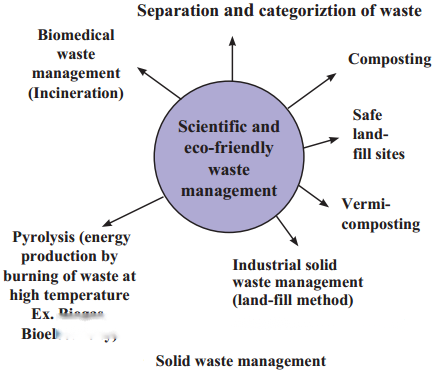
Following are the scientific and eco-friendly methods of waste management:
c. Explain with suitable examples, the relationship between weather forecasting and disaster management.
Answer:
d. Why is e-waste harmful? Express your opinion about this.
Answer:
e. How will you register individual your participation in solid waste management?
Answer:
We can register our individual participation in solid waste management in the following ways:
4. Write notes.
Meteorology, Climatic factors, Monsoon model, Industrial waste, Plastic waste, Principles of first aid.
5. Give examples of the importance of climate in the living world with explanations, in your own words.
Answer:
6. Explain with suitable examples, the care to be taken when using the methods of transporting patients.
Answer:
7. Explain the differences.
a. Weather and climate
Answer:
Weather | Climate | ||
(i) | Atmospheric conditions at a specific time at a particular place are referred to as weather. | (i) | The climate of a particular region is the average of daily readings of various weather-related parameters recorded for several years. |
(ii) | Weather can change continuously. | (ii) | Climate remains constant in a region for a long duration. |
(iii) | Weather is related to a specific location and specific time. | (iii) | Climate is related to a longer duration and larger area. |
(iv) | Changes in the weather may occur for short periods of time. | (iv) | Changes in the climate take place slowly over a much long duration. |
b. Degradable and non-degradable waste
Answer:
Degradable Waste | Non-degradable Waste | ||
(i) | This type of waste is easily degraded by microbes. | (i) | This type of waste is not easily degraded by microbes because it takes a very long period of time and the use of various techniques. |
(ii) | It includes kitchen waste (spoiled food, fruits, vegetables), ash, soil, dung, parts of the plants etc. | (ii) | It includes plastic, metal and other similar materials. |
(iii) | It is also called wet solid waste or wet garbage. | (iii) | It is also called dry solid waste or dry garbage. |
(iv) | If it is carefully decomposed, we can obtain compost and fuel of good quality from it. | (iv) | It can be recycled. |
Class 9 Science Chapter 9 Environmental Management Intext Questions and Answers
Can you recall?
Environmental Management Class 9 Question 1.
Which natural calamities have you experienced? How did they affect the conditions in your surroundings?
Answer:
In July 2005, heavy rains caused flooding in many parts of Maharashtra including large areas of Mumbai.
They effects were as follows.
Environmental Management Class 9 Exercise Question 2.
How will you make a plan to be safe from calamities or to minimize the damage?
Answer:
Thus by taking appropriate measures, we can be safe from calamities
Class 9 Science Chapter 9 Environmental Management Question 3.
How does the atmosphere affect our daily life?
Answer:
The atmosphere affect our daily life in following ways
Environmental Management Class 9 Answers Question 4.
Forecasts about which weather related factors are given during the news bulletins on Doordarshan and Akashvani?
Answer:
Forecasts about different weather related factors such as cloud cover, rain, snowfall, wind speed and temperature are given during the news bulletins on Doordarshan and Akashvani.
9 Environmental Management Exercises Question 5.
What is meant by pollution?
Answer:
Contamination of natural environment that can harmfully affect the ecosystem is called as pollution.
9th Class Science Chapter 9 Environmental Management Exercise Question 6.
What is meant by solid waste?
Answer:
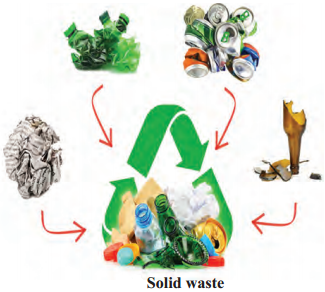
The waste materials generated through the various daily human activities are called solid waste.
Maharashtra Board Class 9 Science Solutions Question 7.
What are the different things included in solid waste?
Answer:
Domestic waste, industrial waste, hazardous waste, electronic waste, biomedical waste, urban waste, radioactive waste and mining waste are the different things included in solid waste.
Answer the following
Answer the following:
ii. Industrial waste is mostly recycled and biomedical waste is treated by the scientific methods mentioned below.
a. Solid waste is disposed off in secured land fills. The site for secured landfill is selected 2 km away from water bodies and away from human habitation. Care is taken to see that the site does not fall in sensitive zone. The landfills are layered with clay and plastic and then the garbage is spread and left.
b. Pyrolysis is done for semi combustible material. Semi combustible materials are heated to high temperature by gas arid electricity.
c. The municipality can also set up biogas plants where the solid waste is converted to biogas by anaerobic fermentation. The biogas can be used to generate power and also a good manure which can be used for agriculture.
(d) Biomedical waste is burnt in incinerators to kill the pathogens. Disinfection and sterilization is also done while treating biomedical waste by the Municipal Corporation.
These are some of the waste management processes used in village/town/city.
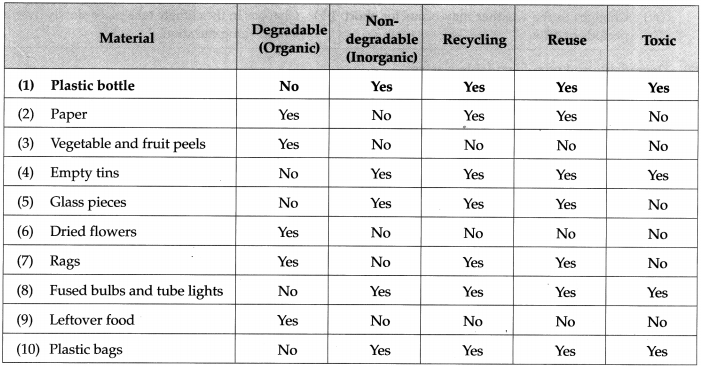
Answer the following questions:
(ii) Out of these left over food from tiffins and fruit peels and pencil shaving can be used to make compost manure in school garden. The remaining waste can be sold to scrap dealers and sent for recycling.
(iii) Yes, we can do the same with the garbage generated in the house.

Class 9 Science Chapter 9 Environmental Management Additional Important Questions and Answers
Choose and write the correct option
(c) 10 lakh years
Question 19
Maharashtra Board Solution
Period of natural degradation for thermocol or Styrofoam cup is (a) 10 lakh years (b) infinite duration (c) 200-250 years (d) 1 year
Solution & Step-by-Step Answer:
block bg-white dark:bg-slate-900/80 border-l-4 border-emerald-500 rounded-r-xl p-5 my-3 shadow-xs border border-slate-200/60 dark:border-slate-800">
Solution & Step-by-Step Answer:
(b) infinite duration
Question 20
Maharashtra Board Solution
If any bone is fractured, it is essential that the fractured part be (a) mobilized (b) immobilized (c) pulled (d) massaged
Solution & Step-by-Step Answer:
(b) immobilized
Question 21
Maharashtra Board Solution
For transporting children and under-weight victims, method is used. (a) carrying piggy back (b) human crutch method (c) cradle method (d) stretcher
Solution & Step-by-Step Answer:
(c) cradle method
Question 22
Maharashtra Board Solution
method is useful to carry patients who are unconscious. (a) Cradle Method (b) Carrying piggy back (c) Human crutch (d) Carrying on four-hand chair
Solution & Step-by-Step Answer:
(b) Carrying piggy back
Question 23
Maharashtra Board Solution
method is used for carrying an unconscious patient through a short distance. (a) Carrying piggy back (b) Cradle method (c) Carrying on two-hand chair (d) Pulling or lifting method
Solution & Step-by-Step Answer:
(d) Pulling or lifting method
Question 24
Maharashtra Board Solution
method is useful to carry patients who cannot use their hands but can hold their body upright. (a) Carrying on four-hand chair (b) Carrying on two-hand chair (c) Carrying piggy back (d) Cradle method
Solution & Step-by-Step Answer:
(b) Carrying on two-hand chair
v 25.
Question 26
Maharashtra Board Solution
For injuries like sprains, twisting and contusion, should be applied on the injured part. (a) turmeric powder (b) antiseptic pad (c) ice-pack (d) pressure
Solution & Step-by-Step Answer:
(c) ice-pack
Find the odd man out:
Question 1
Maharashtra Board Solution
Waste food, paper, plastic, bandages.
Solution & Step-by-Step Answer:
Bandages: It is a biomedical waste whereas the others are domestic waste.
Question 2
Maharashtra Board Solution
Pesticides, fertilizers, crop residue, sludge.
Solution & Step-by-Step Answer:
Sludge: It is an industrial waste whereas the others are farm waste.
Question 3
Maharashtra Board Solution
Strontium -10, Cerium – 141, Barium – 140, Cadmium.
Solution & Step-by-Step Answer:
Cadmium: It is a mining waste whereas the others are radioactive waste.
Question 4
Maharashtra Board Solution
Banana peels, cloth bag, food waste, plastic bag.
Solution & Step-by-Step Answer:
Plastic bag: It is a non-biodegradable waste whereas the others are degradable wastes.
Question 5
Maharashtra Board Solution
Fruits, ash, metals, vegetables.
Solution & Step-by-Step Answer:
Metal: It is a non-biodegradable waste whereas the others are degradable wastes.
Complete the analogy: (1) Specific duration and specific time: Weather : : Longer duration and longer time : Match the columns:
Question 1
Maharashtra Board Solution
|
Column ‘A’ | Column ‘B’ |
(1) Mining waste | (a) Leaves, flowers, crop residue. |
(2) Electronic waste | (b) Remains of heavy metals like lead, arsenic, cadmium. |
(3) Farm waste | (c) Strontium-10, |
(4) Radioactive waste | (d) Cell phones, TV sets, Computers |
(1 – b),
(2 – d),
(3 – a),
(4 – c)
Question 2
Maharashtra Board Solution
Solution & Step-by-Step Answer:
(1 – c),
(2 – a), (3 – d), (4 -b)
Question 3
Maharashtra Board Solution
|
Column ‘A’ | Column ‘B’ |
(1) Thermocol | (a) 1 year. |
(1 – b),
(2 – d),
(3 – a),
(4 – c)
State whether the following statements are true or false. Correct the false statements:
Question 1
Maharashtra Board Solution
Climate is a long term predominant condition of the atmosphere.
Solution & Step-by-Step Answer:
True.
Question 2
Maharashtra Board Solution
Climate changes continuously.
Solution & Step-by-Step Answer:
False. Climate does not change continuously. It remains constant in a region for a long duration.
Question 3
Maharashtra Board Solution
If present climatic conditions are analysed with reference to the past climatic conditions, we can predict climatic changes of the future.
Solution & Step-by-Step Answer:
True.
Question 4
Maharashtra Board Solution
Forecasting is difficult for places where climatic changes are slow and of a limited nature.
Solution & Step-by-Step Answer:
False. Forecasting is easy for places where climatic changes are slow and of a limited nature.
Question 5
Maharashtra Board Solution
Climate plays a very important role in the formation and enrichment of soil.
Solution & Step-by-Step Answer:
True.
Question 6
Maharashtra Board Solution
Prediction maps are prepared once in 24 hours.
Solution & Step-by-Step Answer:
False. Prediction maps are prepared twice in every 24 hours.
Question 7
Maharashtra Board Solution
The first prediction of monsoon in India was made by Dr. Vasantrao Govariakar.
Solution & Step-by-Step Answer:
False. The first prediction of monsoon in India was made my H.F. Blanford.
Question 8
Maharashtra Board Solution
H.F. Blanford used the rainfall in Kerala as the parameter for prediction of monsoon in India.
Solution & Step-by-Step Answer:
False. H.F. Blanford used the snowfall in Himalayas as a parameter for prediction of monsoon in India.
Question 9
Maharashtra Board Solution
In Holistic model, predictions are made taking into account estimates of current weather-related events and ongoing physical interactions between them.
Solution & Step-by-Step Answer:
False. In Holistic model, predictions are based upon those parameters used in other models which have the greatest effect on monsoon.
Question 10
Maharashtra Board Solution
Any meteorological model depends upon the inter-relationships between parameters used in that model and the results expected from it.
Solution & Step-by-Step Answer:
True.
Question 11
Maharashtra Board Solution
Remains of heavy metals like lead, arsenic, cadmium, etc. from mines are industrial waste.
Solution & Step-by-Step Answer:
False. Remains of heavy metals like lead, arsenic, cadmium etc. from mines are mining waste.
Question 12
Maharashtra Board Solution
Use of ‘use and throw’ type of articles like pens, canned cold drinks, tetra packs should be encouraged in waste management.
Solution & Step-by-Step Answer:
False. Use of ‘use and throw’ type of articles like pens, canned cold drinks, tetra packs should be strictly avoided in waste management.
Question 13
Maharashtra Board Solution
We should use tissue paper instead of one’s own handkerchief for effective waste management.
Solution & Step-by-Step Answer:
False. We should use one’s own handkerchief instead of tissue paper for effective waste management.
Question 14
Maharashtra Board Solution
Certain plastic bags take 1 month to degrade.
Solution & Step-by-Step Answer:
False. Certain plastic bags take 10 lakh years to degrade.
Question 15
Maharashtra Board Solution
Banana peels can degrade in 3-4 weeks.
Solution & Step-by-Step Answer:
True.
Question 16
Maharashtra Board Solution
If the victim has burn injuries, it is beneficial to cover the burnt part with blanket.
Solution & Step-by-Step Answer:
False. If the victim has burn injuries, it is beneficial to hold the injured part under clean and cold flowing water for at least 10 minutes.
Question 17
Maharashtra Board Solution
CPR helps to bring the circulation to normal.
Solution & Step-by-Step Answer:
True.
Question 18
Maharashtra Board Solution
If breathing has stopped, the head should be held in backward sloping position.
Solution & Step-by-Step Answer:
False. If breathing has stopped, the victim should be given artificial ventilation by mouth to mouth resuscitation.
Question 19
Maharashtra Board Solution
Japan is the largest producer of electricity from solid waste.
Solution & Step-by-Step Answer:
False. America is the largest producer of electricity from solid waste.
Question 20
Maharashtra Board Solution
China has developed the projects of production of threads, paper and other useful materials from banana peels.
Solution & Step-by-Step Answer:
False. Japan has developed the projects of production of threads, paper and other useful materials from banana peels.
Define the following:
Question 1
Maharashtra Board Solution
Weather
Solution & Step-by-Step Answer:
Atmospheric conditions at a specific time at a particular place are referred to as weather.
Question 2
Maharashtra Board Solution
Climate
Solution & Step-by-Step Answer:
The climate of a particular region is the average of daily readings of various weather-related parameters recorded for several years.
Question 3
Maharashtra Board Solution
Meteorology
Solution & Step-by-Step Answer:
The science that studies the inter-relationships between the various components of air, natural cycles, geological movements of earth and climate is called meteorology.
Question 4
Maharashtra Board Solution
Solid waste
Solution & Step-by-Step Answer:
Waste materials generated through daily human activities are called solid waste.
Question 5
Maharashtra Board Solution
Urban waste
Solution & Step-by-Step Answer:
Waste generated through household industries and large commercial and industrial establishments is called Urban waste.
Answer the following:
Question 1
Maharashtra Board Solution
What is the necessity of solid waste management?
Solution & Step-by-Step Answer:
Necessity of solid waste management:
Question 2
Maharashtra Board Solution
What are the harmful effects of solid waste?
Solution & Step-by-Step Answer:
Harmful effects of solid waste:
Question 3
Maharashtra Board Solution
What first-aid should be given for injuries like sprains, twisting and contusion?
Solution & Step-by-Step Answer:
For injuries like sprains, twisting and contusion, the ‘RICE’ remedy should be applied:
Question 4
Maharashtra Board Solution
Why do meteorological models need to be changed continually?
Solution & Step-by-Step Answer:
Question 5
Maharashtra Board Solution
What is urban waste? What does it include?
Solution & Step-by-Step Answer:
Question 6
Maharashtra Board Solution
What does biomedical waste include?
Solution & Step-by-Step Answer:
biomedical waste includes bandages, dressings, gloves, needles, saline bottle, medicines, medicine bottles, test tubes, body parts, blood etc. from clinics, hospitals, blood banks and laboratories.
Write short notes on:
Question 1
Maharashtra Board Solution
Meteorology
Solution & Step-by-Step Answer:
Question 2
Maharashtra Board Solution
Climatic factors
Solution & Step-by-Step Answer:
Question 3
Maharashtra Board Solution
Monsoon model
Solution & Step-by-Step Answer:
Question 4
Maharashtra Board Solution
Plastic waste
Solution & Step-by-Step Answer:
Question 5
Maharashtra Board Solution
Industrial waste
Solution & Step-by-Step Answer:
Question 6
Maharashtra Board Solution
Principles of first aid
Solution & Step-by-Step Answer:
Life and Resuscitation – ‘ABC’ is the Basic Principle of first aid which is provided to the victims of disaster.
Question 7
Maharashtra Board Solution
Statistical Model
Solution & Step-by-Step Answer:
Question 9
Maharashtra Board Solution
Holistic Model
Solution & Step-by-Step Answer:
Complete the following concept chart:
Question 1
Maharashtra Board Solution
Weather-related climatic factors
Solution & Step-by-Step Answer:
Question 2
Maharashtra Board Solution
Harmful effects of solid waste
Solution & Step-by-Step Answer:
Question 3
Maharashtra Board Solution
Scientific and eco-friendly waste Management
Solution & Step-by-Step Answer:
Answer in detail:
Question 1
Maharashtra Board Solution
What are the principles of solid waste management?
Solution & Step-by-Step Answer:
Principles of solid waste management:
Question 2
Maharashtra Board Solution
What is disaster management? What actions does it include?
Solution & Step-by-Step Answer:
Disaster management is action implemented through proper planning, organized activity and co-ordination.
It includes the following:
Question 3
Maharashtra Board Solution
Write a short note on : Indian Meteorological Department
Solution & Step-by-Step Answer:
|