Latest Maharashtra State Board (SSC & HSC) 2026-27 Syllabus Digest & Solutions Updated!
Class 11 (FYJC / HSC)Sociology2026-27 Syllabus

Chapter 5 Culture Solutions

Complete Maharashtra State Board Balbharati & Yuvakbharati textbook solutions for Chapter 5 Culture. Step-by-step solved exercises, numerical problems, and digest answers.

20 Solved Questions2 Diagrams1169 words

Maharashtra State Board Class 11 Sociology Solutions Chapter 5 Culture

1. (A) Choose the correct alternative and complete the statements.

Question 1 Maharashtra Board Solution
Culture is ………………. (natural / personal / adaptive)
Solution & Step-by-Step Answer:
adaptive
Question 2 Maharashtra Board Solution
Material culture is ………………. (concrete / abstract / intangible)
Solution & Step-by-Step Answer:
concrete
Question 3 Maharashtra Board Solution
Bollywood music is an example of ………………. (high culture / popular culture / folk culture)
Solution & Step-by-Step Answer:
popular culture

1. (B) Correct the incorrect pair.

Question 1 Maharashtra Board Solution
(a) Classical singing of Bhimsen Joshi – High culture (b) Shakespeare’s literature – Folk culture (c) Harry Potter books – Popular culture (d) Religious group – Sub-culture
Solution & Step-by-Step Answer:
(b) Shakespeare’s literature – High culture

1. (C) Identify the appropriate term from the given options.

(Folk Culture, Material Culture, Popular Culture)
Question 1.
Songs transmitted from one generation to the next.
Answer:
Folk Culture

Question 2 Maharashtra Board Solution
Use of mobile phones today.
Solution & Step-by-Step Answer:
Material Culture

1. (D) Correct underlined words and complete the sentence.

Question 1 Maharashtra Board Solution
Belief in superstition is an example of material culture.
Solution & Step-by-Step Answer:
Belief in superstition is an example of non-material culture.
Question 2 Maharashtra Board Solution
E-commerce is an example of popular culture.
Solution & Step-by-Step Answer:
E-commerce is an example of mass culture.

2. Write short notes.

Question 1 Maharashtra Board Solution
Characteristics of Culture.
Solution & Step-by-Step Answer:
The term culture refers to the way of life of a member of various societies or groups. Culture has the following characteristics:
Question 2 Maharashtra Board Solution
Social Benefits of Culture.
Solution & Step-by-Step Answer:
Culture has many social benefits:

3. Differentiate between.

Question 1 Maharashtra Board Solution
Material Culture and Non-Material Culture.
Solution & Step-by-Step Answer:

Material Culture

Non-Material Culture

(i) Material culture refers to the physical objects which are man-made.

(i) Non-material culture refers to non¬physical ideas created by human beings.

(ii) Material culture is concrete and tangible in nature.

(ii) Non-material culture is abstract and intangible in nature.

(iii) It consists of manufactured objects like clothing, roads, jewellery, computers, airplanes etc.

(iii) It consists of norms, regulations, values, signs, symbols, knowledge, beliefs, etc.

(iv) The material aspect of culture changes very fast.

(iv) Change in non-material culture is difficult and not readily accepted by society.

Question 2 Maharashtra Board Solution
Folkways and Mores.
Solution & Step-by-Step Answer:

Folkways

Mores

(i) Folkways are mildly enforced social expectations.

(i) Mores are strictly held beliefs about behaviours.

(ii) Violation of folkways is not seen as a serious threat to social order.

(ii) Violation of mores is seen as a serious threat to social order.

(iii) Folkways are less deeply rooted in society and change more rapidly.

(iii) Mores are more deeply rooted and change less frequently.

(iv) Folkways are customary, normal and habitual ways of a group, to meet certain needs or solving day to day problems.

(iv) Mores are more serious norms and have serious binding on groups.

(v) The manner of speech, dressing, the time of meals and numerous other practices of daily life are some examples of customary practices to which an individual confirm in their personal habits.

(v) Murder, stealing, lying, incest are examples of social Mores in almost all cultures.

4. Explain the following concept with suitable examples.

Question 1 Maharashtra Board Solution
Norms
Solution & Step-by-Step Answer:
Question 2 Maharashtra Board Solution
Folk Culture
Solution & Step-by-Step Answer:
Folk culture refers to the culture of ordinary people particularly those living in pre-industrial societies. It is an authentic culture. It never aspire to be an art but its distinctiveness is accepted and respected.

Example : Parents expect obedience from children, the time of meals, the number of meals per day, the manner of taking meals the manner of speech; dressing; forms of etiquette and numerous other practices of daily life.

5. Complete the concept maps.
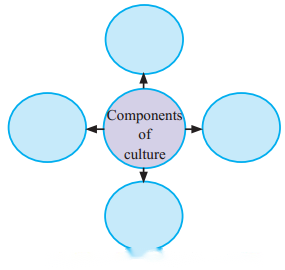
Question 1 Maharashtra Board Solution
Solution & Step-by-Step Answer:

6. Give your personal response.

Question 1 Maharashtra Board Solution
Very few people make an effort to learn classical music today.
Solution & Step-by-Step Answer:
Classical music is not popular among people today because like any other form of music one requires exposure over a period of time to become familiar. While pop music is appreciated by a large number of people with no cultural expertise.
Question 2 Maharashtra Board Solution
It is not easy to give up superstitious beliefs.
Solution & Step-by-Step Answer:
Superstitious beliefs are form of non-material culture which are rooted in society for many decades and centuries. Change in this aspect is not readily accepted by the society or certain sections of the society. It is rooted in society for many decades and centuries. Hence, change in these aspects is not easy

11th Sociology Digest Chapter 5 Culture Intext Questions and Answers

ACTIVITY (Textbook Page No. 61)

Question 1 Maharashtra Board Solution
Presentation : students make groups of 5 in class and present an aspect of culture, (e.g., language, dialect, dress, folklore, dances, music, art, food habits, architecture, literature, tribal life, rural life, urban life) of any state in India.
Solution & Step-by-Step Answer:
Students should conduct a presentation in the classroom with the help of using power point, charts to explain the various cultural elements of any one state in India.
Question 2 Maharashtra Board Solution
Culture varies from society to society. Each Society or a group will have different culture. These cultures are sometimes overlapping and sometimes exclusive. Give examples. (Textbook Page No. 51)
Solution & Step-by-Step Answer:
Compare culture of different states in India, how they are different in their lifestyles, food habits, dressing styles etc. Also explain by giving examples how certain elements of culture overlap or have similarities. Many cultural elements of different states are also exclusive in nature, peculiar to that region to maintain the ethnicity.

Both Gujarat and Maharashtra were created on May 1, 1960. The dialects spoken in each state are also different. In Maharashtra, the majority of the people speak the Marathi language. The same is true for the Gujarati language in Gujarat this is an example of exclusive culture.
Hindi, one of the official language of India, is a common language. This is an example of overlapping culture.

Question 3 Maharashtra Board Solution
Observe cultural change around you and list examples of cultural lag in society. (Textbook Page No. 52)
Solution & Step-by-Step Answer:
Make a note of cultural changes around you. Example:

Example of cultural lag
For example, expectant parents can use genetic engineering to select their unborn child’s eye colour or sex. However, many people view this type of genetic engineering as unethical and believe it could lead to unintended social consequences. This an example of cultural lag.

Question 4 Maharashtra Board Solution
Look at your surrounding and list out the examples of cultural hybridisation in the areas of food, toys, religious practices, festivals, celebrations. (Textbook Page No. 59)
Solution & Step-by-Step Answer: